
Ingredients
The oven
- a large pile of dry hardwood
- 40to 60 volcanic or river stones, fist sized
- banana or breadfruit leaves, a great many
- green coconut fronds, for covering
The food
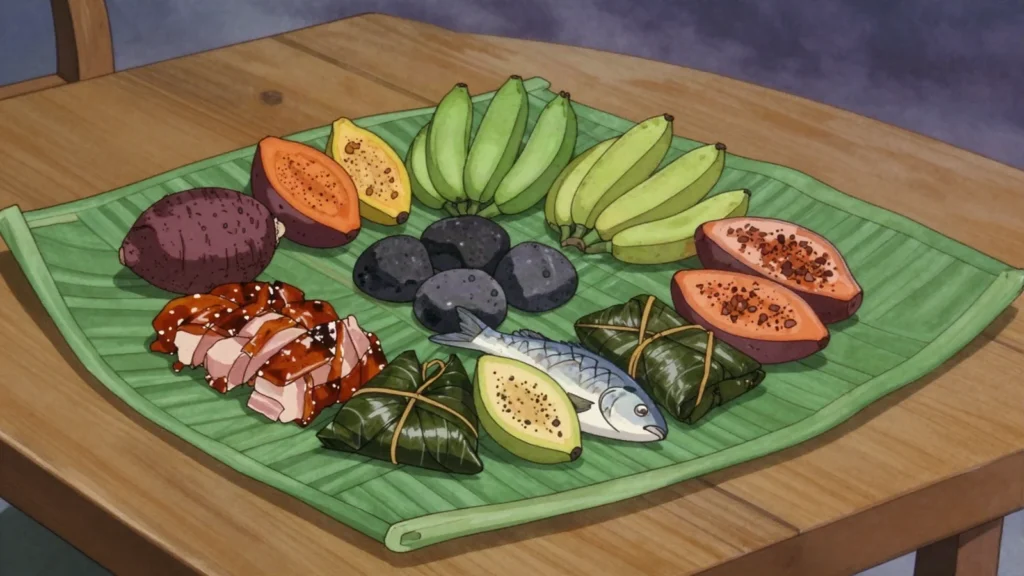
- 1whole suckling pig, or large pork joints
- 6taro corms, peeled
- 6breadfruit, whole
- green bananas, whole
- whole fish, wrapped in leaf
Palusami
- young taro leaves
- 500 mlthick coconut cream
- 1onion, chopped
- salt
Equipment
- long wooden tongs, au
- a rake or long stick
- heavy gloves
Directions
- Keep children well away from the whole area. Steam released when opening the umu causes severe burns. Stand back and let it clear before reaching in. Lay a base of dry wood in a criss-cross pattern.
- Pile the stones over and among the wood. It needs about an hour and a half. Discard any stone that splits badly. Rake the burnt wood and ash away when they are ready.
- Spread the hot stones into an even flat bed. Peel the taro and leave the corms whole. Leave the breadfruit and green bananas in their skins. Wrap whole fish in banana leaf parcels. Making palusami is done in the same time.
- Wash the young taro leaves carefully. Stack several leaves in your cupped hand. Pour thick coconut cream into the cup. Add chopped onion and a pinch of salt. Fold the leaves over into a sealed parcel.
- Wrap the whole thing in a breadfruit leaf. Taro leaves must be cooked thoroughly. Work quickly because the stones lose heat. Lay the hardest food directly on the stones first. Set the pork over and among them. Place the palusami parcels on top.
- Lay banana and breadfruit leaves thickly over everything. Add coconut fronds over the leaves. The covering must be complete. Pull the sacks and fronds off from one side. Stand back and let the first rush of steam clear.
- Lift the leaves away with tongs, not with hands. The taro should be soft when pierced. Lift everything onto a long table or a mat. Leftovers are eaten cold through the week.
Technique
- The Samoan umu is built above ground, which distinguishes it from the pit ovens of Hawaii, New Zealand and Fiji.
- The Sunday umu after church, called toonai, is a fixed part of the week in most Samoan households.
Substitutions
- A covered barbecue or a large domestic oven can cook the same dishes, though not with the same smoke and steam.
- Palusami can be made with spinach and baked in foil for an approximation.
Variations
- Fiji has the lovo and New Zealand the hangi, both dug into the ground.
- Some households add whole chickens or corned beef to the umu.
- A smaller weekday umu is built with fewer stones and less food.
History
An earth oven, in which food is cooked using heated volcanic stones covered with leaves and often soil, documented across Samoa and much of wider Polynesia for many centuries as the primary traditional cooking method for large quantities of food, particularly for feasts and significant community or family gatherings. Building and maintaining a proper umu, heating the stones sufficiently and arranging food so it cooks evenly using only that stored heat rather than an open flame, is treated as a specialized skill within Samoan culture, traditionally passed down through practice rather than through any codified written method. Palusami, whole fish, taro and other Samoan staple foods are all commonly cooked in an umu, making the earth oven itself less a single dish than a foundational cooking technique underlying much of traditional Samoan feast cooking.
Frequently asked questions
What is Umu?
Umu is a main from Samoa: above-ground oven of hot volcanic stones cooking pork, taro and fish. An earth oven, in which food is cooked using heated volcanic stones covered with leaves and often soil, documented across Samoa and much of wider Polynesia for many centuries as the primary traditional cooking method for large quantities of food, particularly for feasts and significant community or family gatherings. Building and maintaining a proper umu, heating the stones sufficiently and arranging food so it cooks evenly using only that stored heat rather than an open flame, is treated as a specialized skill within Samoan culture, traditionally passed down through practice rather than through any codified written method. Palusami, whole fish, taro and other Samoan staple foods are all commonly cooked in an umu, making the earth oven itself less a single dish than a foundational cooking technique underlying much of traditional Samoan feast cooking.
How long does Umu take to make?
Umu takes 2 hours of preparation and 2 hours of cooking. The recipe makes feeds a large family. It is rated hard to make.
What can I substitute in Umu?
Yes, within limits. A covered barbecue or a large domestic oven can cook the same dishes, though not with the same smoke and steam. Palusami can be made with spinach and baked in foil for an approximation.
What is the most important thing to get right in Umu?
Keep children well away from the whole area. Steam released when opening the umu causes severe burns. Stand back and let it clear before reaching in. Lay a base of dry wood in a criss-cross pattern.