
Ingredients
Noodles
- 500 gstrong white flour, or Japanese udon flour
- 230 mlwater
- 25 gsalt
Or
- 600 gfresh or frozen udon
Kake broth
- 1.2 litresdashi
- 80 mllight soy sauce, usukuchi
- 60 mlmirin
- 1 tspsalt
Toppings
- spring onions, sliced
- tenkasu, tempura scraps
- a raw egg
- kamaboko fish cake
- grated ginger
- shichimi togarashi
To serve
- hot in broth, or chilled with dipping sauce
Directions
- Salt strengthens gluten and tightens the dough, and it is what gives udon its firm springy bite. Warm weather makes the dough ferment and slacken faster, so summer dough gets less salt and shorter resting, and winter dough gets more. Sanuki makers take this seriously.
- Press it together into a rough mass and let it rest, wrapped, for 30 minutes. Now the kneading, and the traditional method is the one everyone hears about.
- Roll it evenly, since uneven thickness gives noodles that cook at different rates. Dust it generously with flour, fold it in three, and cut it into strips about 3 mm wide.
- Cut them evenly and squarish in section, which is characteristic of udon. Toss the cut noodles in flour and shake off the excess.
- Use far more water than seems necessary and add no salt at all, since the noodles are already heavily salted and the water is what draws it out. Fresh udon takes 8 to 12 minutes, and thicker noodles longer.
- Stir them once at the start so they do not stick. Taste one to check, since there should be no chalky raw centre. Drain them and rinse them under cold running water, rubbing them gently with your hands. For cold udon, finish in iced water. Combine dashi, light soy and mirin and bring it to a simmer.
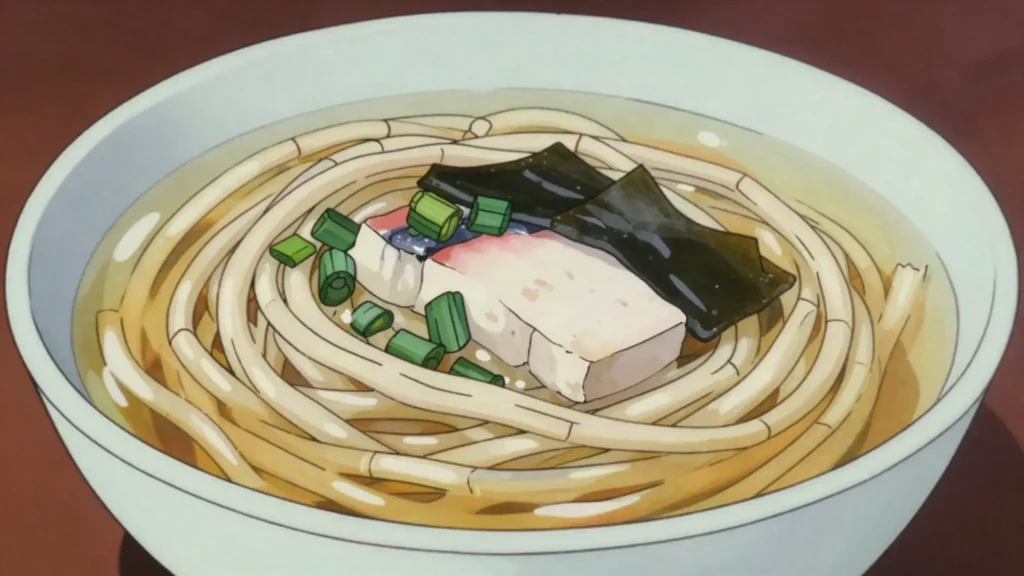
- Serve the noodles in bowls with the hot broth poured over and the toppings scattered on. For a cold version, serve the chilled noodles on a tray with a small cup of concentrated dipping sauce.
Technique
- The Kūkai attribution is legend rather than documented history.
- Foot-kneading is genuine practice and is used commercially in Sanuki.
- The salt is adjusted seasonally and is mostly washed out in cooking.
Substitutions
- Fresh or frozen udon, which is very good and saves hours.
- Dried udon, which is the weakest option.
Variations
- Kamatama, with raw egg and soy straight from the pot.
- Bukkake udon, with concentrated sauce poured over.
- Curry udon, in Japanese curry sauce.
History
Thick wheat flour noodles, served in a hot broth or chilled with a dipping sauce, documented in Japan since at least the 800s, with several competing historical accounts crediting either Chinese Buddhist monks or Japanese travelers returning from China with introducing an early form of the wheat noodle later developed into distinctly Japanese udon. Its thick, chewy texture, achieved through a specific kneading and resting technique for the wheat dough, distinguishes udon clearly from thinner Japanese noodles like soba and ramen, and different regions across Japan maintain their own distinct udon broth styles and preparations. Udon remains one of Japan’s most essential noodle dishes, eaten in countless regional variations across the country.
Frequently asked questions
What is Udon?
Udon is a main from Japan: thick chewy wheat noodles in hot dashi broth or chilled with dipping sauce. Thick wheat flour noodles, served in a hot broth or chilled with a dipping sauce, documented in Japan since at least the 800s, with several competing historical accounts crediting either Chinese Buddhist monks or Japanese travelers returning from China with introducing an early form of the wheat noodle later developed into distinctly Japanese udon. Its thick, chewy texture, achieved through a specific kneading and resting technique for the wheat dough, distinguishes udon clearly from thinner Japanese noodles like soba and ramen, and different regions across Japan maintain their own distinct udon broth styles and preparations. Udon remains one of Japan’s most essential noodle dishes, eaten in countless regional variations across the country.
How long does Udon take to make?
Udon takes 40 min plus 3 hr resting of preparation and 15 min of cooking. The recipe makes 4 servings. It is rated hard to make.
What can I substitute in Udon?
Yes, within limits. Fresh or frozen udon, which is very good and saves hours. Dried udon, which is the weakest option.
What is the most important thing to get right in Udon?
Stir them once at the start so they do not stick. Taste one to check, since there should be no chalky raw centre. Drain them and rinse them under cold running water, rubbing them gently with your hands. For cold udon, finish in iced water. Combine dashi, light soy and mirin and bring it to a simmer.