
Ingredients
Base
- 150 gcornflour, or 200 ml wheat sprout extract
- 1.2 litreswater
- 600 gsugar
- 200 mlmilk
Fat
- 300 gghee
Aromatics
- a generous pinch of saffron
- 1 tspground cardamom
- 2 tbsprosewater or kewra
Nuts
- 150 gpistachios, split
- 150 galmonds, slivered
- 50 gcashews
Also
- 1 tspcitric acid or 2 tbsp lemon juice
Equipment
- a heavy wide pan
- a strong arm
- a greased tray
To serve
- cut in wedges, with tea
Directions
- Add the sugar and the milk and stir to combine. Bloom the saffron in a spoonful of warm milk. Use a heavy wide pan and a long-handled wooden spoon or spatula. It will thicken to a paste in about 15 minutes.
- Add the ghee gradually and let each addition be absorbed before the next. Poured in at once it sits on top and never incorporates. Keep stirring throughout without pausing. The mixture will pass through stages: first a thick paste, then a glossy mass, then something that pulls away from the sides of the pan.
- Add the citric acid or lemon juice about halfway through. The acid stops the sugar crystallising, which is what would otherwise give a grainy rather than glassy halwa.
- Add the saffron milk, cardamom and rosewater toward the end. Drop a small piece into cold water: it should set firm immediately and be chewy rather than sticky when you press it. That cold water test is the reliable one.
- Stir in most of the nuts at this point. Now work fast, because it sets as it cools. Tip it onto a well-greased tray and spread it quickly with a greased spatula or a greased rolling pin.
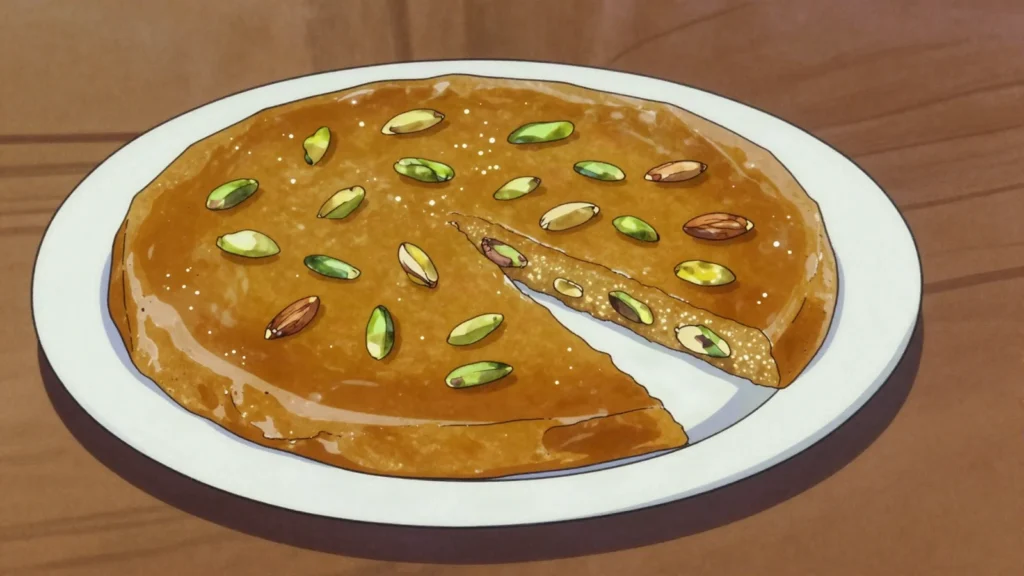
- Spread it fast and while it is still hot. Within a few minutes it becomes too stiff to move at all. Press the remaining nuts into the surface. Traditionally it is spread in a thick disc rather than a thin sheet. Score it before it sets hard, because a fully cooled sohan halwa has to be broken rather than cut. Let it cool completely and set.
- Break or cut it along the score lines. It keeps for weeks in a tin and travels extremely well, which is exactly why it is the gift people carry from Multan. Serve it in small pieces with tea, and expect it to be very sweet and to stick to the teeth.
Technique
- The wheat sprout version is the older method and cornflour is the modern standard.
- Multan’s sohan halwa shops are a destination and the sweet is a recognised regional speciality.
- It is hard enough that it is broken rather than sliced once fully set.
Substitutions
- Cornflour in place of wheat sprout extract, which is what most makers use.
- Lemon juice in place of citric acid.
Variations
- Made with wheat sprouts, the traditional way.
- The softer Iranian sohan, which is a different sweet.
- With extra pistachios, which is the premium version.
History
Multan’s signature sweet, sold by shops around the shrine of Bahauddin Zakariya and carried across Pakistan as a gift.
Frequently asked questions
What is Sohan Halwa?
Sohan Halwa is a dessert from Pakistan: dense disc of reduced wheat sprout, ghee and nuts, cut in wedges. Multan’s signature sweet, sold by shops around the shrine of Bahauddin Zakariya and carried across Pakistan as a gift.
How long does Sohan Halwa take to make?
Sohan Halwa takes 30 min plus overnight sprouting of preparation and 2 hr of cooking. The recipe makes 1 tray, about 24 pieces. It is rated hard to make.
What can I substitute in Sohan Halwa?
Yes, within limits. Cornflour in place of wheat sprout extract, which is what most makers use. Lemon juice in place of citric acid.
What is the most important thing to get right in Sohan Halwa?
Add the ghee gradually and let each addition be absorbed before the next. Poured in at once it sits on top and never incorporates. Keep stirring throughout without pausing. The mixture will pass through stages: first a thick paste, then a glossy mass, then something that pulls away from the sides of the pan.