
Ingredients
Fish
- 2whole mukeke (Lake Tanganyika perch) of about 700 g each, or 2 whole sea bass, gutted, scaled and slashed 3 times each side
- Juice of 3 lemons
- 6garlic cloves, crushed
- 20 gfresh ginger, grated
- 2 tspsalt
- 1 tspblack pepper
- 1stock cube, crumbled
- 4 tbspoil
Sauce
- 3 tbsppalm or vegetable oil
- 2onions, sliced
- 4tomatoes, chopped
- 1red pepper, sliced
- 3garlic cloves, chopped
- 1chilli, chopped
- 200 mlwater
- 1 tspsalt
To serve
- Fried green plantain or chips
- 1lemon, in wedges
- Sliced raw onion
Directions
- Slash the whole fish three times on each side, right down to the bone, so the marinade penetrates and the thickest part cooks in the same time as the tail.
- Rub with the lemon juice, garlic, ginger, salt, pepper, stock cube and oil, pushing the mixture into the slashes and the belly cavity. Marinate 1 hour in the fridge, no longer, or the lemon starts to break the flesh down.
- Light the charcoal and let it burn to grey embers. Oil the grill bars well and get them hot before the fish goes anywhere near them.
- Grill the fish 12 to 15 cm above the coals for 8 to 10 minutes on the first side without moving it — moving it early is what makes the skin stick and tear.
- Turn once with two spatulas and grill the second side 6 to 8 minutes, basting with any leftover marinade.
- Meanwhile make the sauce: fry the onion in the oil for 8 minutes, add the garlic, chilli and pepper for 2 minutes, then the tomatoes and water, and simmer 12 minutes to a thick, oily sauce. Season.
- The fish is cooked when the flesh at the thickest slash is opaque and lifts cleanly from the backbone, and the dorsal fin pulls out with no resistance.
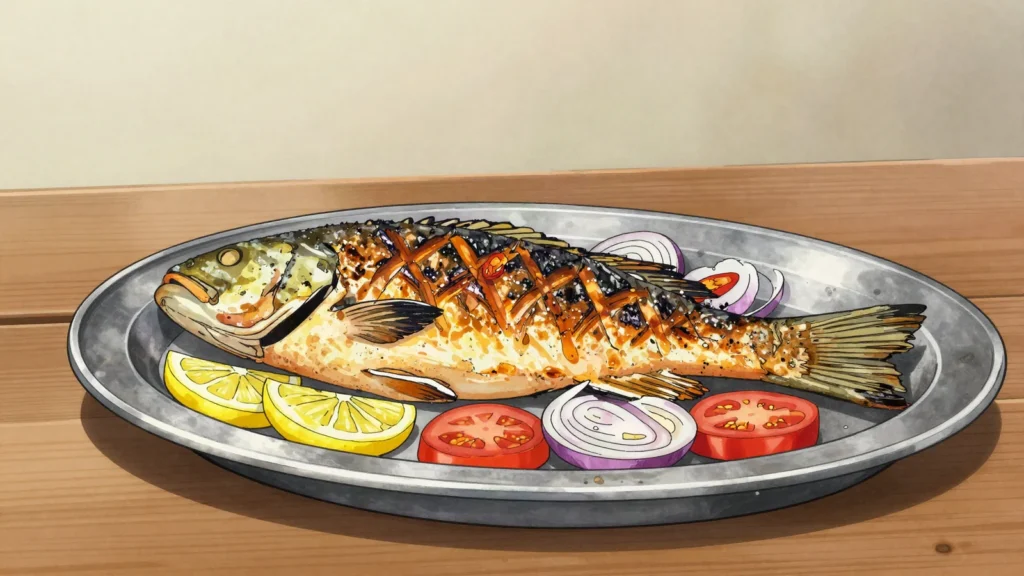
- Serve whole on a platter, with the hot sauce spooned over or served alongside, fried plantain, lemon wedges and raw onion. For the stewed version, lay the grilled fish into the sauce and simmer 5 minutes before serving.
Technique
- Mukeke is Lates stappersii, one of the endemic Lake Tanganyika perches, and it is the fish Bujumbura is known for — eaten at the lakeside restaurants along the shore, grilled to order and served with fried plantain and beer.
- Two other lake fish complete the local trio: ndagala, the tiny sardine-like fish dried in the sun and fried, and sangala, the big Nile perch relative served in steaks.
- Whole fish on charcoal needs a genuinely hot, well-oiled grate and patience. Charcoal that is still flaming will coat the skin in soot; wait for grey embers.
Substitutions
- Outside Burundi use whole sea bass, snapper or tilapia of similar size — firm-fleshed lake or sea fish behave the same way on the fire.
- No charcoal grill: roast at 220°C (425°F) for 20 to 25 minutes on an oiled tray, then flash under a hot grill for 3 minutes to blister the skin.
Variations
- The stewed version, simmered in the tomato sauce from raw rather than grilled first, is the standard home preparation.
- Smaller mukeke are sometimes deep-fried whole and eaten bones and all with lemon and chilli.
History
A freshwater fish native to Lake Tanganyika, one of the African Great Lakes bordering Burundi, typically grilled or fried and seasoned simply, reflecting Burundi’s access to that significant lake as an important source of fresh fish for communities along its shores. Its preparation, generally kept straightforward with minimal seasoning beyond salt and perhaps a simple accompanying sauce, lets the fish’s own fresh flavour remain the clear focus rather than being disguised by elaborate spicing. Mukeke remains particularly associated with communities along Lake Tanganyika’s Burundian shoreline specifically, considered a valued regional specialty within the country’s broader food culture, distinct from the bean-and-grain-based staples more common further from the lake.
Frequently asked questions
What is Mukeke?
Mukeke is a main from Burundi: prized Lake Tanganyika fish, grilled or stewed in Bujumbura. A freshwater fish native to Lake Tanganyika, one of the African Great Lakes bordering Burundi, typically grilled or fried and seasoned simply, reflecting Burundi’s access to that significant lake as an important source of fresh fish for communities along its shores. Its preparation, generally kept straightforward with minimal seasoning beyond salt and perhaps a simple accompanying sauce, lets the fish’s own fresh flavour remain the clear focus rather than being disguised by elaborate spicing. Mukeke remains particularly associated with communities along Lake Tanganyika’s Burundian shoreline specifically, considered a valued regional specialty within the country’s broader food culture, distinct from the bean-and-grain-based staples more common further from the lake.
How long does Mukeke take to make?
Mukeke takes 25 min plus 1 hr marinating of preparation and 30 min of cooking. The recipe makes 4 servings. It is rated medium to make.
What can I substitute in Mukeke?
Yes, within limits. Outside Burundi use whole sea bass, snapper or tilapia of similar size — firm-fleshed lake or sea fish behave the same way on the fire. No charcoal grill: roast at 220°C (425°F) for 20 to 25 minutes on an oiled tray, then flash under a hot grill for 3 minutes to blister the skin.
What is the most important thing to get right in Mukeke?
Slash the whole fish three times on each side, right down to the bone, so the marinade penetrates and the thickest part cooks in the same time as the tail.