
Ingredients
Braised pork, lu rou
- 1.5 kgpork belly, skin on, in large pieces
- 2 litreswater
Braising spices
- 3star anise
- 1cinnamon stick
- 2 tspSichuan peppercorns
- 4bay leaves
- 3 slicesdried liquorice root, optional
- 2 tspfennel seed
- 4cloves
- 2black cardamom pods
- 2dried chillies
Braising liquid
- 80 mllight soy sauce
- 40 mldark soy sauce
- 80 mlShaoxing wine
- 50 grock sugar
- 6 slicesginger
- 6spring onions
- 1 tbspsalt
Baijimo bread
- 500 gplain flour
- 280 mlwarm water
- 3 ginstant yeast
- ½ tspsalt
To finish
- 1green chilli, chopped
- coriander, chopped
Directions
- Start with the braise, which is better made a day ahead. Blanch the pork belly in boiling water for 5 minutes, then rinse it and discard the water. Tie the whole spices in a muslin bag, which is what Chinese cooks call a spice packet. Bagging the spices lets you lift them out cleanly and stops the peppercorns and cloves ending up in the chopped meat.
- Put the pork in a heavy pot with the water, spice bag, both soy sauces, wine, rock sugar, ginger, spring onions and salt. Bring it to a boil, skim thoroughly, then turn it down to a bare simmer. Simmer, covered, for 2 hours 30 minutes to 3 hours. Keep it at a bare simmer throughout. It is done when the belly is completely tender and the skin and fat are soft enough to cut with a spoon.
- Mix the flour, water, yeast and salt into a firm dough and knead 10 minutes. Keep the dough firm rather than soft, because baijimo should be dense and slightly chewy rather than fluffy. Prove it for about 2 hours, until risen but not doubled. A fully risen dough gives a light bready roll that collapses under the wet meat.
- Divide into 8 pieces and roll each into a rope, then coil it into a spiral and press it flat into a disc about 1 cm thick. Now cook them in a dry heavy pan over a medium heat for 3 to 4 minutes a side, until pale gold with brown rings.
- Cook them dry, with no oil at all, which is what gives the crisp dry crust. Then finish them in a 200°C oven for 8 to 10 minutes. Take the cold braised pork out and chop it on a board with a heavy cleaver, fat and lean and skin together.
- Chop it, do not slice it. The fat, lean and gelatinous skin are chopped together until they merge into a rough juicy mass, and that mixture is the point. Add a spoonful of the hot braising liquid to the chopped meat as you work.
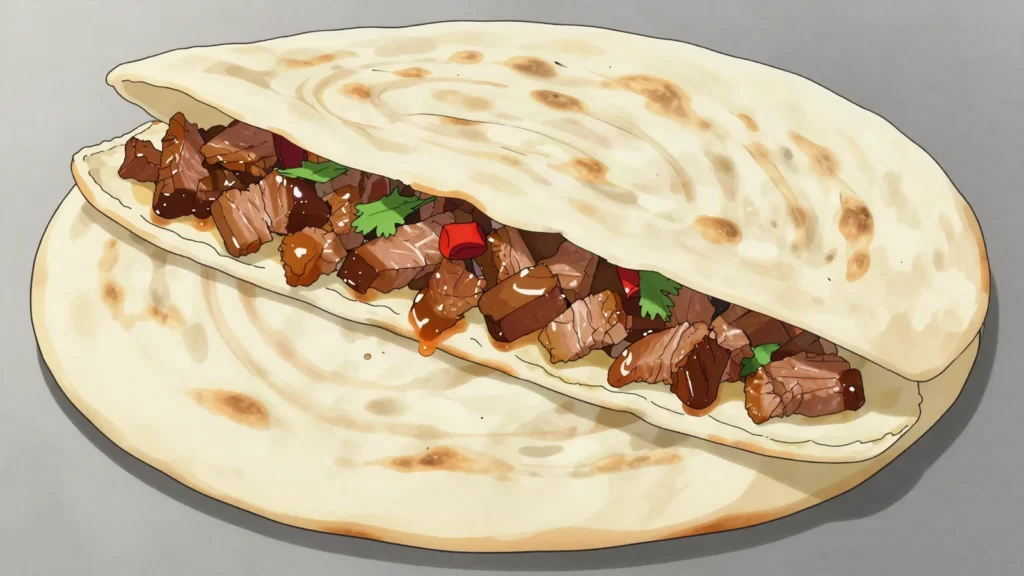
- Chop in a little chilli and coriander with the meat, which is standard in Xi’an. Split each hot baijimo almost through, leaving a hinge, and stuff it with the chopped pork. Fill it generously and spoon a little more braising liquid in. Serve immediately, while the bread is hot and the meat is warm. The bread must be freshly made.
Technique
- The braising liquid keeps in the freezer and improves every time it is used.
- A lamb version, made with the same method, is standard in the Muslim quarter of Xi’an.
- The bread is sometimes bought and the braise made at home, and vice versa.
Substitutions
- Pork shoulder in place of belly, which is leaner and less good.
- A plain English muffin at a pinch, though the bread is half the dish.
Variations
- Made with lamb, as the Muslim-quarter version.
- With more chilli, which is common.
- Served with a bowl of the braising liquid as a soup.
History
Braised, shredded pork, stuffed into a split flatbread similar to a pita, developed in China’s Shaanxi province and sometimes described as one of the world’s oldest sandwiches, since the flatbread itself, called mo, is documented in the region for many centuries, well before the sandwich became a recognized food category in Western cooking history. Its braised meat filling, slow-cooked with a specific regional blend of spices until tender enough to shred easily, reflects Shaanxi’s particular regional cooking tradition, and roujiamo spread from its Shaanxi regional origin into much wider popularity across China through the 1900s and 2000s, becoming one of the country’s most widely recognized street foods well beyond its home province.
Frequently asked questions
What is Roujiamo?
Roujiamo is a street food from China: shaanxi griddled flatbread stuffed with slow-braised chopped pork, called China’s hamburger. Braised, shredded pork, stuffed into a split flatbread similar to a pita, developed in China’s Shaanxi province and sometimes described as one of the world’s oldest sandwiches, since the flatbread itself, called mo, is documented in the region for many centuries, well before the sandwich became a recognized food category in Western cooking history. Its braised meat filling, slow-cooked with a specific regional blend of spices until tender enough to shred easily, reflects Shaanxi’s particular regional cooking tradition, and roujiamo spread from its Shaanxi regional origin into much wider popularity across China through the 1900s and 2000s, becoming one of the country’s most widely recognized street foods well beyond its home province.
How long does Roujiamo take to make?
Roujiamo takes 40 min plus 2 hr rising of preparation and 3 hr of cooking. The recipe makes 8 sandwiches. It is rated hard to make.
What can I substitute in Roujiamo?
Yes, within limits. Pork shoulder in place of belly, which is leaner and less good. A plain English muffin at a pinch, though the bread is half the dish.
What is the most important thing to get right in Roujiamo?
Start with the braise, which is better made a day ahead. Blanch the pork belly in boiling water for 5 minutes, then rinse it and discard the water. Tie the whole spices in a muslin bag, which is what Chinese cooks call a spice packet. Bagging the spices lets you lift them out cleanly and stops the peppercorns and cloves ending up in the chopped meat.