
Ingredients
The cassava
- 2 kgcassava
- peeled, cored and grated
- or 1 kg cassava dough
- attiéké-style, fermented
To ferment
- a cloth or bag
- a warm place
- 2or 3 days
To cook
- about 500 ml water
- a heavy pot
- a strong wooden spoon
To serve
- okra sauce
- or palm nut sauce
- eaten with the right hand
Directions
- Peel it thoroughly and discard all the peel. Grate it rather than leaving it in pieces. Cook it thoroughly afterwards. Do not shorten the fermentation. Cut the cassava into shorter lengths. Score the skin down each length. Cassava has a thick two-layer peel. Pull it right out and discard it. Check every single piece for it.
- Grate all the cassava very finely. That helps the processing considerably. Use a fine grater or a processor. Put the grated cassava in a cloth. Set the wrapped cloth somewhere warm. Leave it for two or three days. Let it drain rather than sitting in it.
- Hang the wrapped cloth up if you can. It should smell sour rather than rotten. Discard it if it ever smells foul. Discard it if mould grows on it. Put the measured water in a heavy pot.
- Bring the pot right up to a boil. Add the fermented cassava gradually. Stir it in fully as you add it. Add it in one handful at a time. Work every single addition in fully. Working it smooth is the hard part. Stir and work it against the pot. It becomes extremely stiff indeed. Use a strong long wooden spoon. It takes real force towards the end.
- Keep the heat low once it thickens. Stand well back and use a long spoon. Keep children well away from the pot. Work it until completely smooth. There should be no lumps at all. Press and fold it against the side.
- Work in one direction steadily. Cover the pot and lower the heat. Let it steam for about fifteen minutes. The cassava must cook right through.
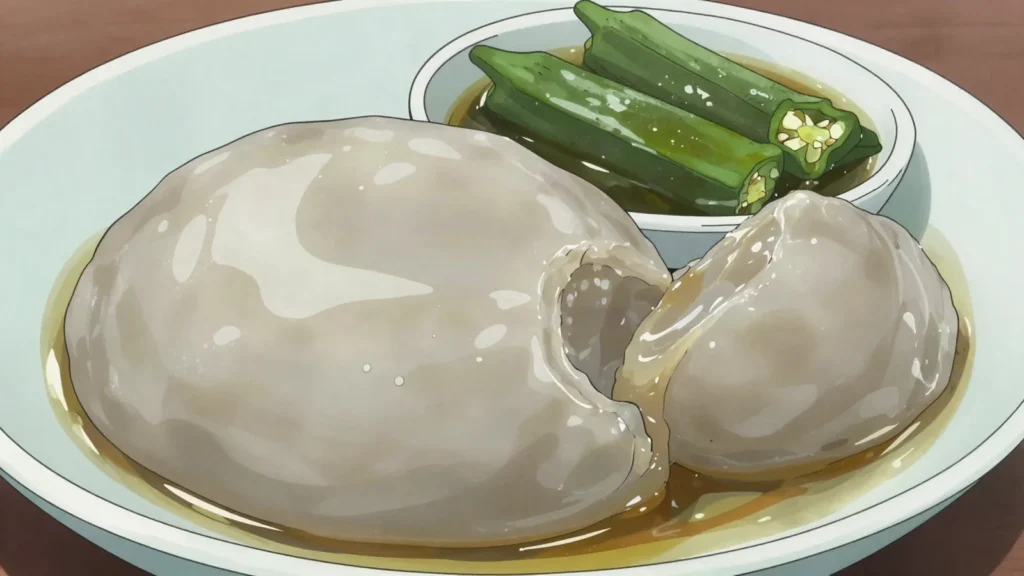
- Work it hard once more after steaming. A few minutes of hard work does it. Shape it into smooth round balls. Wet hands stop it sticking to you. Set one ball in each of the bowls. Ladle sauce over or beside it. It keeps a day in the refrigerator. Steam it again briefly to soften it.
Technique
- Cassava contains cyanogenic glycosides that release cyanide when the plant is damaged, and fermenting it genuinely reduces them — that is a documented effect and the reason fermentation is used across Africa, making it a safety process as well as a flavour one. Grating breaks the cells so the compounds meet the enzymes that break them down, the fermentation time lets that complete, and cooking deals with what remains. All three stages matter, so do not shorten the fermentation or skip the grating; boiling alone does not fully process bitter cassava.
- Ready-made fermented cassava dough is sold in African food shops and is what the atlas recommends, since it removes the processing question entirely. The traditional method is given for completeness.
- Stiff starch pastes spit violently and those spits are extremely hot, sticking to skin like hot sugar. Keep the heat low once it thickens, stand well back, use a long strong wooden spoon and keep children away — stirring becomes genuinely hard work towards the end.
Substitutions
- Add the fermented cassava a handful at a time, working each fully in before the next, since rushing it gives lumps that will not come out.
- Wet your hands with cold water to shape the balls and re-wet between each, or wrap portions in plastic; both are done.
Variations
- Cassava is native to South America and the Portuguese carried it to the Gulf of Guinea in the sixteenth century, where it suited the farming because it tolerates poor soil and drought and stores in the ground. That transfer happened through colonial trade on the same ships that carried enslaved people, which the atlas records rather than skipping.
- Judge the fermentation by smell: sour is wanted and rotten is not, and those are genuinely different. Discard it if it smells foul or grows mould.
- The sourness from fermenting is characteristic and balances a rich okra or palm nut sauce rather than being a fault.
History
A fermented cassava dough, cooked into a smooth, stretchy paste similar in concept to foutou but distinguished by its fermentation step, letting grated cassava sit and sour for a day or more before cooking, developed among ethnic groups in southern and central Côte d’Ivoire as a variation on the wider West African pounded-starch tradition. That fermentation both develops a distinctive tangy flavour absent from unfermented foutou and reflects a broader regional pattern of fermenting cassava, found across many West and Central African cassava-based staple foods, as a technique that both improves flavour and helps neutralize some of the naturally occurring toxic compounds present in raw cassava. Placali is traditionally eaten by hand alongside a stew or sauce, in the same manner as foutou and other regional pounded-starch staples.
Frequently asked questions
What is Placali?
Placali is a main from Côte d’Ivoire: smooth fermented cassava dough eaten with okra or palm-nut sauce. A fermented cassava dough, cooked into a smooth, stretchy paste similar in concept to foutou but distinguished by its fermentation step, letting grated cassava sit and sour for a day or more before cooking, developed among ethnic groups in southern and central Côte d’Ivoire as a variation on the wider West African pounded-starch tradition. That fermentation both develops a distinctive tangy flavour absent from unfermented foutou and reflects a broader regional pattern of fermenting cassava, found across many West and Central African cassava-based staple foods, as a technique that both improves flavour and helps neutralize some of the naturally occurring toxic compounds present in raw cassava. Placali is traditionally eaten by hand alongside a stew or sauce, in the same manner as foutou and other regional pounded-starch staples.
How long does Placali take to make?
Placali takes 20 minutes plus fermenting of preparation and 40 minutes of cooking. The recipe makes serves 6. It is rated hard to make.
What can I substitute in Placali?
Yes, within limits. Add the fermented cassava a handful at a time, working each fully in before the next, since rushing it gives lumps that will not come out. Wet your hands with cold water to shape the balls and re-wet between each, or wrap portions in plastic; both are done.
What is the most important thing to get right in Placali?
Peel it thoroughly and discard all the peel. Grate it rather than leaving it in pieces. Cook it thoroughly afterwards. Do not shorten the fermentation. Cut the cassava into shorter lengths. Score the skin down each length. Cassava has a thick two-layer peel. Pull it right out and discard it. Check every single piece for it.