
Ingredients
The dough
- 500 gstrong white flour
- about 300 ml warm water
- 1 teaspoonsalt
- 2 tablespoonsoil
- plus oil, for stretching
The filling
- 800 gpotatoes
- peeled and grated or diced small
- 2onions, finely chopped
- 3 tablespoonsoil
- 1 teaspoonsalt
- plenty of black pepper
- 1 teaspoonpaprika, optional
To finish
- oil, to brush
- or melted butter
- a little water
- or milk, to splash
To bake
- a round baking tin
- a large cloth for stretching
- a hot oven
Directions
- Put the flour and salt in a bowl. Add the warm water in gradually. Add the oil in to it as well now. Bring it together into a soft dough. It should be quite soft and pliable. Knead it for about ten minutes. Knead it until smooth and elastic. It should feel springy under the hand. Divide the dough into three or four balls. Coat each ball generously in oil.
- Set them all on an oiled plate. The oil keeps them soft and pliable. Coat every one of them properly. Cover the balls and let them rest. Give them at least one full hour. Peel and then grate the potatoes. Both of them are done in Bosnia.
- Squeeze it out before filling. Wet filling makes soggy pastry. Mix the potato with the chopped onion. Add the oil, the salt and the pepper. Potato is bland and takes a lot of salt. Season it more strongly than seems right. Spread a large clean cloth on a table.
- Flour the whole cloth lightly. The cloth must be clean and dry. Set one ball in the middle of the cloth. Flatten it out with your hands. Press it out into a flat round first. Oil both of your hands as you work. Work outward from it gradually.
- Pull it outward with the backs of your hands. Work around the circle steadily. Do not pull from one place only. Keep stretching until it is very thin. You should see the cloth through it. Trim the thick edges off with a knife. Discard them or else re-roll them. Spread filling along one long edge.
- Lay it in a line rather than spreading it. A thin line along the edge is right. Oil separates the layers as it rolls. Lift the cloth edge to start the roll. Use the cloth to roll the dough. Do not touch the thin sheet directly. Roll it into a long thin tube. Roll it loosely rather than tightly.
- Let it roll itself with the cloth. Oil the whole baking tin well. Start at the centre of the tin. Fill the whole tin completely. That stops the ends unrolling. Brush the top with oil or butter. Brush it right out to the edges.
- Heat the oven to two hundred degrees. Bake it for about forty minutes. The raw potato needs real time. Take it out after about thirty minutes. Return it to the oven afterwards. Judging it takes a careful look. Bake it for longer if it resists.
- Cover it with a cloth for ten minutes. Serving it is done while still warm. Cut it into wedges or sections. Serve sour yoghurt alongside it. It keeps two days covered over.
Technique
- The dough is stretched by hand over a cloth until you can see the cloth through it, which is what distinguishes Bosnian pita from börek made with bought filo. It takes real practice and tears easily at first; the atlas says so plainly and gives both routes, since bought filo makes a perfectly good pita even though hand-stretched dough is thicker and chewier.
- Rest the oiled dough balls at least an hour: the oil keeps them soft and stops a skin forming, and the rest relaxes the gluten completely. An unrested dough springs back and cannot be stretched at all.
- Use the cloth to roll the filled sheet rather than touching the thin dough directly, and roll it loosely — a tight roll gives dense pastry where a loose one stays flaky. Drizzle oil generously over the whole sheet first, which separates the layers as it rolls; without it they fuse together.
Substitutions
- Bought filo stands in for hand-stretched dough and makes a good pita, though it is thinner and less chewy.
- Grated potato cooks faster and more evenly and small dice is the other option; both are done in Bosnia. Squeeze the water out of grated potato before filling, since wet filling makes soggy pastry.
Variations
- The potato goes in raw and cooks inside the pastry, releasing moisture that steams it from within — so the pita needs a full forty minutes and a skewer should pass through the middle easily, with resistance meaning the potato is still raw.
- Splash a little water or milk over it about thirty minutes in and return it to the oven, which steams the filling through and softens the pastry; that is the Bosnian way of finishing.
- Trim the thick tough edges of the stretched sheet, which will not cook properly, and do not worry about small tears, which close up when rolled.
History
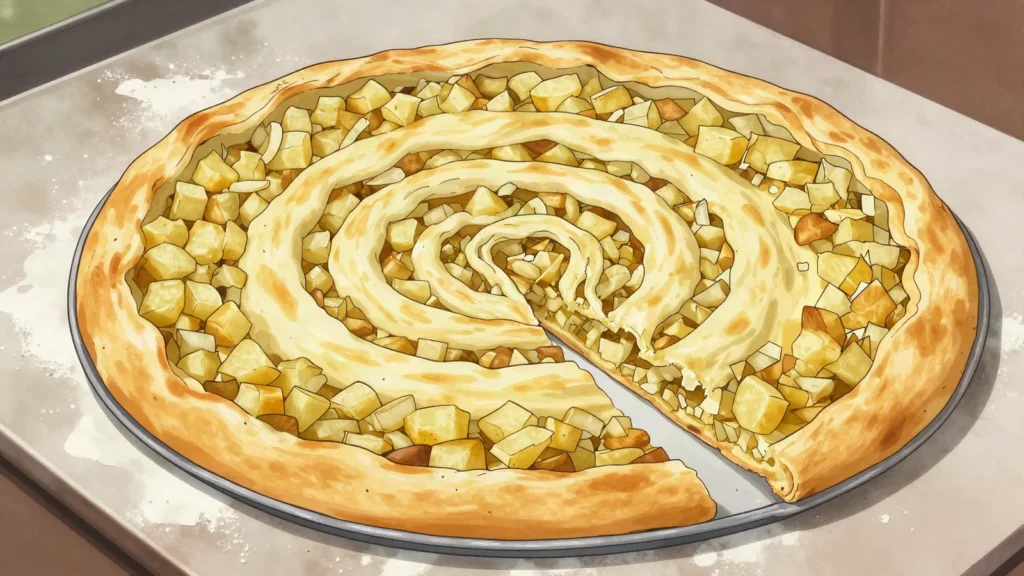
One of the family of Bosnian pite rolled in a spiral; Bosnian filo is stretched by hand, which distinguishes pita from Turkish börek.
Frequently asked questions
What is Pita krompiruša?
Pita krompiruša is a bread & pastry from Bosnia and Herzegovina: coiled hand-stretched pastry filled with potato and onion. One of the family of Bosnian pite rolled in a spiral; Bosnian filo is stretched by hand, which distinguishes pita from Turkish börek.
How long does Pita krompiruša take to make?
Pita krompiruša takes 1 hour 30 minutes of preparation and 50 minutes of cooking. The recipe makes serves 6. It is rated hard to make.
What can I substitute in Pita krompiruša?
Yes, within limits. Bought filo stands in for hand-stretched dough and makes a good pita, though it is thinner and less chewy. Grated potato cooks faster and more evenly and small dice is the other option; both are done in Bosnia. Squeeze the water out of grated potato before filling, since wet filling makes soggy pastry.
What is the most important thing to get right in Pita krompiruša?
Flour the whole cloth lightly. The cloth must be clean and dry. Set one ball in the middle of the cloth. Flatten it out with your hands. Press it out into a flat round first. Oil both of your hands as you work. Work outward from it gradually.