
Ingredients
The dough
- 500 gplain flour
- 60 gbutter or lard, softened
- 1egg
- about 200 ml warm water
- 1 teaspoonsalt
- 1 teaspoonsugar
- 1 teaspoonbaking powder
The fillings
- 300 gwhite cheese, grated
- or 300 g minced beef, cooked with onion
- or 300 g black beans, mashed
- or shredded chicken
To fry
- oil, for deep frying
To serve
- hot, at dawn
- with strong black coffee
- or hot chocolate
Directions
- Grate it rather than slicing it. The dough must rest before rolling. Put the flour in a large bowl. Add the salt, sugar and baking powder. Stir them together thoroughly. Rub the softened butter into the flour. Rub it in until it looks like crumbs. Beat the egg into the warm water. Add it gradually to the flour.
- Add only enough to bring it together. Add it in just a little at a time. Knead it for about five minutes. It should become smooth and elastic. Cover the dough and let it rest. Give it about thirty full minutes.
- Grate the white cheese if using it. Cooked fillings must be entirely cold. Cool them all completely first. The filling must not be wet at all. Drain or reduce a wet filling. Roll the dough out very thin indeed.
- Roll it about two millimetres thick. Thin dough fries crisp and blistered. Roll it thinner than seems right. Cutting them is straightforward enough. Cut discs with a bowl or a cutter. About twelve centimetres across is usual. Keep every one of them the same size. Put filling on one half of each disc.
- Leave a clear border all round. Do not overfill any of them at all. Fold the dough over the filling. Press the edges together firmly. A dry edge opens right up in the oil.
- Press the edge down with a fork. Press the fork firmly into the edge. Check each one for gaps or cracks. Press any gaps closed before frying. Heating the oil takes attention. Pour the oil into a deep heavy pot. Fill it no more than half full.
- Heat it to about one hundred and eighty degrees. A deep pot of hot oil is genuinely dangerous. Keep a lid nearby to smother a flare-up. Never put water on an oil fire at all.
- Keep children well away from the pot. Drop a scrap of dough into the oil. It should sizzle and rise immediately. Adjust the heat before the batch. Do not crowd the pot at any point. Turn them and give two more minutes. Only the dough needs cooking through.
- Lift them out onto a wire rack. Let all the excess oil drip away. That softens the crust within minutes. Serve them straight from the fryer. Serve strong coffee alongside. Melted cheese inside stays very hot.
Technique
- Roll the dough about two millimetres thick — thinner than seems right — since thin dough fries to a crisp blistered shell where thick dough stays doughy inside. A smooth flat pastelito was rolled too thick; the bubbled surface is what you are after.
- Cooked fillings must be completely cold and not wet: hot filling softens the dough so it cannot be sealed and creates steam that bursts them, and wet filling leaks and splits the dough. Wet the border with water before folding, since a dry edge opens in the oil, and check every one for gaps before frying.
- Melted cheese inside holds heat far longer than the shell and can badly burn the mouth, so warn people before they bite in.
Substitutions
- Beef cooked with onion, mashed black beans and shredded chicken are all standard fillings alongside cheese; stalls offer several at once.
- Lard stands in for butter in the dough.
Variations
- This is wheat dough rather than the maize flour of a Venezuelan empanada, which gives a smoother more elastic dough that fries to a blistered crisp shell.
- Rest the dough thirty minutes before rolling, which relaxes the gluten so it rolls without springing back.
- Stalls open before first light along the mountain roads of Mérida and Táchira and often close by mid-morning; it is genuinely a breakfast food.
History
Breakfast fare of Mérida and Táchira, sold at dawn from stalls along the mountain roads.
Frequently asked questions
What is Pastelito andino?
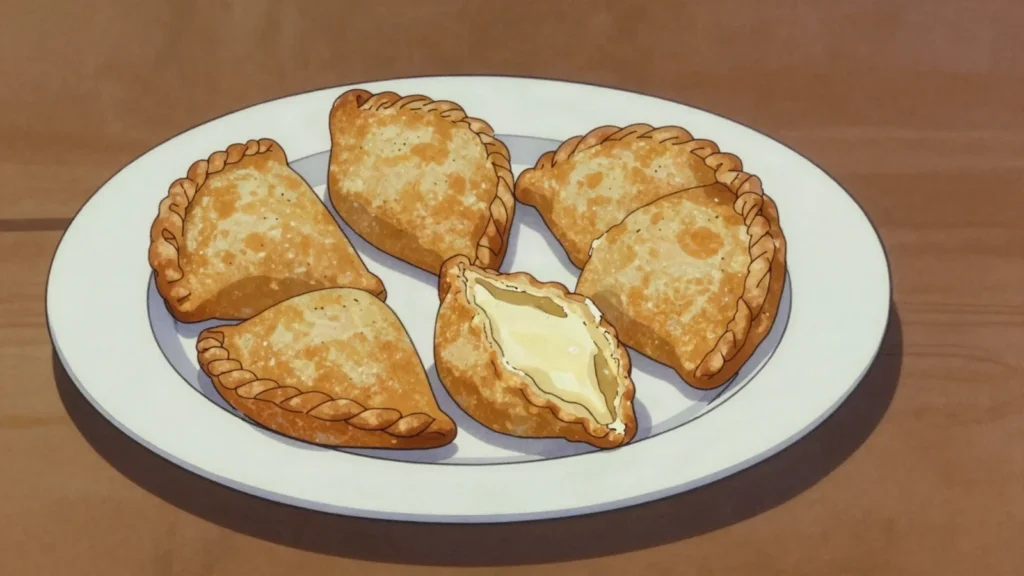
Pastelito andino is a street food from Venezuela: fried half-moon of wheat dough filled with cheese, meat or beans. Breakfast fare of Mérida and Táchira, sold at dawn from stalls along the mountain roads.
How long does Pastelito andino take to make?
Pastelito andino takes 40 minutes plus resting of preparation and 25 minutes of cooking. The recipe makes about 16 pastelitos. It is rated medium to make.
What can I substitute in Pastelito andino?
Yes, within limits. Beef cooked with onion, mashed black beans and shredded chicken are all standard fillings alongside cheese; stalls offer several at once. Lard stands in for butter in the dough.
What is the most important thing to get right in Pastelito andino?
Grate it rather than slicing it. The dough must rest before rolling. Put the flour in a large bowl. Add the salt, sugar and baking powder. Stir them together thoroughly. Rub the softened butter into the flour. Rub it in until it looks like crumbs. Beat the egg into the warm water. Add it gradually to the flour.