
Ingredients
Liver
- 800 gbeef liver
- sliced into thin strips
- 1 tablespoonvinegar, for cleaning
- 1 teaspoonsalt
The griddle
- 8garlic cloves, crushed
- 6green chillies, sliced
- 2green peppers, sliced
- 5 tablespoonsoil
- 2 teaspoonsground cumin
- 1 teaspoonground coriander
- 1 teaspoonchilli flakes
- 2 tablespoonsvinegar
- 1 teaspoonsalt
- black pepper
Sometimes added
- 1 tablespoontomato paste
- juice of 1 lemon
- a pinch of cardamom
To serve
- baladi bread or soft rolls
- tahina sauce
- pickled vegetables, torshi
- lemon wedges
- chopped parsley
Directions
- Keep it cold right up until cooking. It is sliced into thin strips rather than steaks. Reduce the chilli if you want it milder. Two or three minutes is often enough.
- Rinse the liver in cold water. Peel off the thin outer membrane. Pull it off from one corner in a sheet. Cut out any large tubes or gristle. Lay the liver flat on a board. Cut it into strips about a centimetre wide. Keep them all a similar even thickness.
- Toss the strips with vinegar and salt. Let them sit for fifteen minutes. Rinse them thoroughly in cold water. Pat every strip completely dry. Use plenty of kitchen paper for it. Wet liver steams instead of searing. Cook in batches rather than crowding it. Crush the garlic cloves roughly. Slice the green chillies into rings.
- Slice the green peppers into strips. Have everything ready before you start. Heat the oil in a wide heavy pan. Get it genuinely very hot indeed. Add the sliced peppers and chillies. Fry them hard for about two minutes. They should blister and soften slightly. Lift them out and set them aside. Add a single layer of liver strips. Do not crowd the pan at all here.
- Let them sit untouched for a minute. Turning them is done once only. Turn the strips over with tongs. Give them another minute on that side. Add the crushed garlic to the pan. Add the cumin, coriander and chilli flakes. Stir it hard for thirty seconds only.
- Return the peppers and chillies to the pan. Pour in the vinegar and let it hiss. Season it with salt and black pepper. Toss everything together once. Take it off the heat straight away. Making the tahina takes a moment. Add lemon juice, crushed garlic and salt. Whisk it until it is smooth and pourable. It thickens before it thins, so keep going.
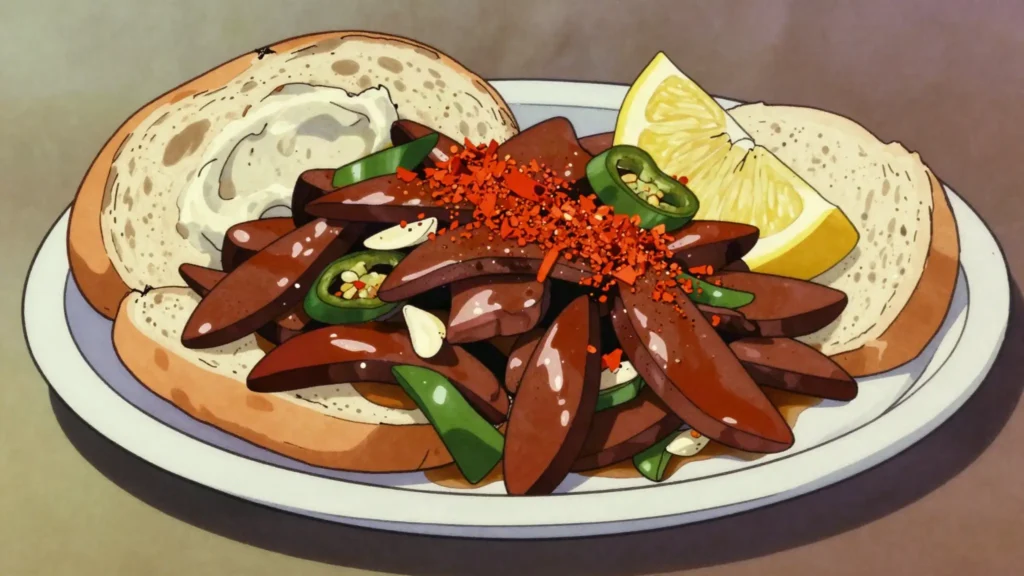
- Pile the hot liver into it generously. Spoon tahina sauce over the top. Add pickled vegetables alongside. Scatter chopped parsley over it. It must be eaten straight from the pan.
Technique
- Liver is extremely high in vitamin A, which builds up in the body and is genuinely harmful in excess; pregnant people are advised to avoid it entirely because high retinol intake is linked to birth defects, and frequent eating is not advised for anyone.
- Liver cooks in a very short time and turns hard, grainy and bitter when overcooked, so two or three minutes is often enough; the outside should be well browned with the inside still faintly pink, and grey right through means it is overdone.
- The thin outer membrane tightens and curls in heat, making the strips buckle while staying tough, so pull it off in a sheet from one corner before slicing; and dry every strip thoroughly, since wet liver steams grey instead of searing.
Substitutions
- Lamb liver works, though beef liver is what Alexandria uses.
- Soaking the liver in milk instead of vinegar softens any strong flavour.
Variations
- Some stalls add tomato paste to the pan and others keep it clear.
- The chilli level varies enormously, and Alexandrian versions run hot.
- It is served in a roll or on a plate with tahina and bread.
History
Spiced liver, typically beef or calf liver, quickly sautéed with garlic, chili, cumin and green pepper, documented across Egypt with its name directly referencing the city of Alexandria, called Eskandaria in Arabic, where this specific spiced liver preparation is particularly closely associated and widely considered to have originated as a distinct regional specialty. Its bold, notably spicy seasoning, more pronounced than many other Egyptian dishes, reflects Alexandria’s particular regional culinary character within the wider landscape of Egyptian cuisine, shaped in part by the city’s long history as a Mediterranean port with correspondingly varied trade and culinary influence. Kebda eskandarani remains a popular street food and sandwich filling across Egypt, closely tied to Alexandria’s specific regional culinary identity.
Frequently asked questions
What is Kebda eskandarani?
Kebda eskandarani is a street food from Egypt: alexandrian chili-garlic beef liver, fried and piled into rolls. Spiced liver, typically beef or calf liver, quickly sautéed with garlic, chili, cumin and green pepper, documented across Egypt with its name directly referencing the city of Alexandria, called Eskandaria in Arabic, where this specific spiced liver preparation is particularly closely associated and widely considered to have originated as a distinct regional specialty. Its bold, notably spicy seasoning, more pronounced than many other Egyptian dishes, reflects Alexandria’s particular regional culinary character within the wider landscape of Egyptian cuisine, shaped in part by the city’s long history as a Mediterranean port with correspondingly varied trade and culinary influence. Kebda eskandarani remains a popular street food and sandwich filling across Egypt, closely tied to Alexandria’s specific regional culinary identity.
How long does Kebda eskandarani take to make?
Kebda eskandarani takes 20 minutes of preparation and 15 minutes of cooking. The recipe makes serves 4. It is rated medium to make.
What can I substitute in Kebda eskandarani?
Yes, within limits. Lamb liver works, though beef liver is what Alexandria uses. Soaking the liver in milk instead of vinegar softens any strong flavour.
What is the most important thing to get right in Kebda eskandarani?
Keep it cold right up until cooking. It is sliced into thin strips rather than steaks. Reduce the chilli if you want it milder. Two or three minutes is often enough.