
Ingredients
- 2 litreswhole milk
- 600 gcaster sugar
- 1vanilla pod, split, or 2 tsp vanilla extract
- ½ tspbicarbonate of soda
- a pinch of salt
Directions
- Warm the milk with the sugar, vanilla and salt over medium heat, stirring until the sugar is fully dissolved and the milk is steaming but not boiling. Dissolve the bicarbonate of soda in a tablespoon of cold water and stir it in.
- Bring to a gentle simmer and hold it there, uncovered, stirring every few minutes with a heatproof spatula and scraping the base and corners of the pan. For the first hour it will barely change colour.
- Strain through a fine sieve while hot to catch any grainy bits, lift out the vanilla pod, and pour into sterilised jars.
- Cool completely before sealing. It keeps a month in the fridge.
Technique
- Bicarbonate of soda is the whole trick. Without it you get a thin, sweet milk syrup; with it you get the browning reaction between lactose and milk proteins that gives the true colour and toasty flavour.
- Stirring matters more the further you go. Any milk solids that stick and darken on the base will speck the finished paste with bitter black flecks.
- There is a lasting rivalry with Uruguay over who invented it, tied to a story about a maid leaving milk and sugar on the fire in 1829. Both countries make excellent versions and neither claim is settled.
- Never boil an unopened tin of condensed milk: sealed tins can burst violently. If you use the tin method, decant the milk into a covered dish and bake it in a water bath instead.
Substitutions
- In a hurry? Bake a 397 g tin of sweetened condensed milk, decanted into a dish, covered with foil, in a bain-marie at 200°C (400°F) for 90 minutes, whisking smooth at the end.
- Goat’s milk gives dulce de leche de cabra, sharper and more fragrant, common in the Argentine northwest.
Variations
- Dulce de leche repostero, cooked 20 minutes longer to a stiffer paste that will not run out of a cake or an alfajor.
- Dulce de leche con nueces, stirred through with toasted walnuts.
- Uruguayan-style, made slightly darker and less sweet.
History
A thick, caramel-like spread made by slowly heating sweetened milk until it reduces and caramelises, claimed by several Latin American countries though Argentina maintains one of the strongest and most publicly promoted national associations with it, including a popular, though not fully verifiable, legend crediting its accidental discovery to a servant of 19th-century Argentine political leader Juan Manuel de Rosas, who is said to have left sweetened milk on the stove too long and discovered the caramelised result by accident. Uruguay, Chile and other Latin American countries maintain their own competing claims and near-identical products under different regional names, reflecting a broader, genuinely shared Latin American tradition of slow-cooked sweetened milk rather than a single clearly documented point of invention in any one country.
Frequently asked questions
What is Dulce de leche?
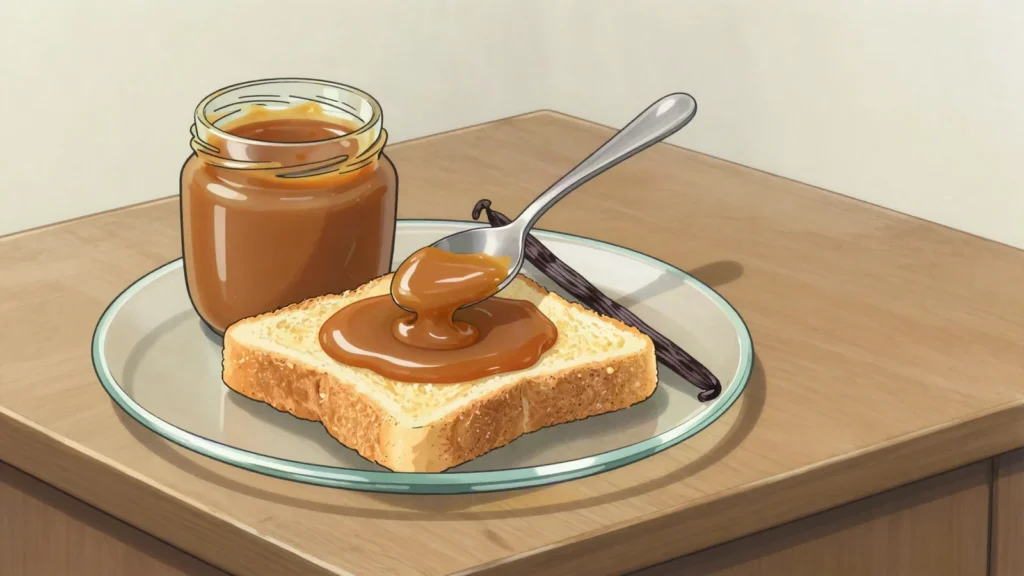
Dulce de leche is a dessert from Argentina: slow-caramelised milk spread on toast and into every pastry. A thick, caramel-like spread made by slowly heating sweetened milk until it reduces and caramelises, claimed by several Latin American countries though Argentina maintains one of the strongest and most publicly promoted national associations with it, including a popular, though not fully verifiable, legend crediting its accidental discovery to a servant of 19th-century Argentine political leader Juan Manuel de Rosas, who is said to have left sweetened milk on the stove too long and discovered the caramelised result by accident. Uruguay, Chile and other Latin American countries maintain their own competing claims and near-identical products under different regional names, reflecting a broader, genuinely shared Latin American tradition of slow-cooked sweetened milk rather than a single clearly documented point of invention in any one country.
How long does Dulce de leche take to make?
Dulce de leche takes 10 min of preparation and 2 hr 30 min of cooking. The recipe makes about 500 g. It is rated medium to make.
What can I substitute in Dulce de leche?
Yes, within limits. In a hurry? Bake a 397 g tin of sweetened condensed milk, decanted into a dish, covered with foil, in a bain-marie at 200°C (400°F) for 90 minutes, whisking smooth at the end. Goat’s milk gives dulce de leche de cabra, sharper and more fragrant, common in the Argentine northwest.
What is the most important thing to get right in Dulce de leche?
Bicarbonate of soda is the whole trick. Without it you get a thin, sweet milk syrup; with it you get the browning reaction between lactose and milk proteins that gives the true colour and toasty flavour.