
Ingredients
Dough
- 500 gplain flour
- 100 gtoasted sesame seeds, ground
- 60 gmelted butter
- 2 tbspolive oil
- 1egg
- 1 tspground aniseed
- 1 tspground cinnamon
- ½ tspturmeric
- ½ tspsalt
- 1 tspinstant yeast
- a large pinch of saffron steeped in 2 tbsp warm water
- 2 tbsporange blossom water
- 2 tbspvinegar
- about 150 ml warm water
To finish
- 1.5 litresoil, for frying
- 800 ghoney
- 2 tbsporange blossom water
- 200 gtoasted sesame seeds
Directions
- Toast the sesame seeds until golden and grind half of them to a coarse meal.
- Mix the flour with the ground sesame, aniseed, cinnamon, turmeric, salt and yeast.
- Add the melted butter, olive oil, egg, saffron water, orange blossom water and vinegar, then bring it together with just enough warm water to make a firm dough.
- Knead for a full 15 minutes. This dough has to be worked hard and should finish stiff, because a soft one will not hold the folded shape through frying.
- Rest it, covered, for 1 hour, which lets the gluten relax enough to roll paper-thin without springing back.
- Roll out very thin, to about 2 mm, and cut into rectangles roughly 10 cm by 6 cm.
- Cut four parallel slits down the length of each rectangle, leaving both ends joined so it holds together.
- Lift every other strip onto one finger, thread the far corner back through the gap, and pinch it to the near corner. That forms the flower.
- This folding is the whole craft of chebakia and it takes real practice. Moroccan households fold them in enormous batches in the weeks before Ramadan precisely because the work is so slow.
- Heat the oil to 160°C (320°F) and fry in batches for 4 to 5 minutes, turning, until golden. Low and slow is essential: fried hot, the outside browns while the folded centre stays raw.
- Warm the honey with the orange blossom water until it runs freely but is nowhere near boiling.
- Lift the pastries straight out of the oil and into the warm honey, and leave them for 5 to 7 minutes, turning, until they stop bubbling and can take up no more.
- Straight from oil to honey is the rule. A cooled chebakia floats on the surface and absorbs almost nothing.
- Lift out with a slotted spoon, drain on a rack, and scatter heavily with the remaining toasted sesame.
- Cool completely. They keep for a month in a sealed tin, and are eaten beside a bowl of harira at iftar.
Technique
- Hot pastry into warm honey. Get that transition right and everything else is forgivable.
- The dough is heavily sesame-based rather than merely sesame-coated, which is why it tastes of sesame all the way through.
- Make them a week or two ahead. They improve as the honey settles into the layers.
Substitutions
- Sunflower oil for frying, which is what most households use for a batch this size.
- Half honey and half sugar syrup, which is a common economy.
Variations
- Shaped as simple twisted knots if the flower defeats you.
- With a little ground almond in the dough.
- Griwech, the closely related Algerian pastry, cut in wider ribbons.
History
Rolled and fried in large batches in the weeks before Ramadan, then steeped in honey and sesame; it is eaten beside harira at iftar nationwide.
Frequently asked questions
What is Chebakia?
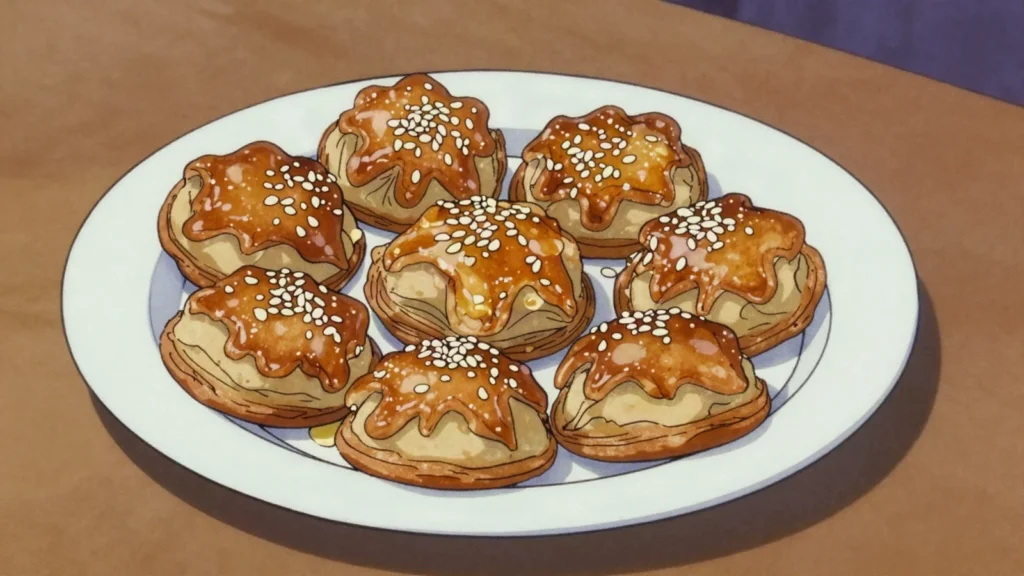
Chebakia is a dessert from Morocco: sesame-coated flower-shaped pastry fried and glazed with honey; Ramadan essential. Rolled and fried in large batches in the weeks before Ramadan, then steeped in honey and sesame; it is eaten beside harira at iftar nationwide.
How long does Chebakia take to make?
Chebakia takes 1 hr 30 min plus 1 hr resting of preparation and 45 min of cooking. The recipe makes 50 pastries. It is rated hard to make.
What can I substitute in Chebakia?
Yes, within limits. Sunflower oil for frying, which is what most households use for a batch this size. Half honey and half sugar syrup, which is a common economy.
What is the most important thing to get right in Chebakia?
This folding is the whole craft of chebakia and it takes real practice. Moroccan households fold them in enormous batches in the weeks before Ramadan precisely because the work is so slow.