
Ingredients
Aubergine
- 3large aubergines
- 2 teaspoonssalt, for drawing out water
- oil, for frying
Walnut paste
- 250 gshelled walnuts
- 4garlic cloves
- 1 teaspoonground coriander
- 1 teaspoonblue fenugreek, utskho suneli
- 1 teaspoondried marigold, Imeretian saffron
- 1/2 teaspoonground chilli
- 2 tablespoonsred wine vinegar
- or 3 tablespoons pomegranate juice
- 4 tablespoonscold water
- 1 teaspoonsalt
To finish
- the seeds of 1 pomegranate
- a handful of coriander leaves
- a few sprigs of flat parsley
Directions
- Trim the stalks off and stand each aubergine upright. Cut it lengthways into slices about half a centimetre thick. Discard the two outer slices that are mostly skin. Lay the slices out on a tray or a board. Sprinkle salt over both sides of every slice. Leave them for at least thirty minutes. Rinse the slices briefly under cold water. Now pat them completely dry with kitchen paper.
- Heat a shallow layer of oil in a wide frying pan. Get it properly hot before the aubergine goes in. Lay the slices in a single layer without crowding. Fry them for about three minutes on each side. They should be golden brown and completely soft.
- Lift them onto kitchen paper to drain. Brush them with oil and bake at 200C for twenty minutes. Let all the slices cool completely before filling them. Put the walnuts in a food processor with the garlic.
- Grind them until they are almost a powder. Do not grind so long that they turn oily. Add all the spices and the salt. Add the vinegar or pomegranate juice. Add the cold water a spoonful at a time. The paste should become smooth and spreadable. Taste it and adjust the salt and the vinegar. It should be strongly garlicky and clearly sour.
- Cover it and leave it for twenty minutes. Add a little more water if it becomes too stiff. Lay a cooled aubergine slice flat on the board. Spread a generous spoonful of paste along it. Leave a clear centimetre at the far end.
- Roll it up from the wider end toward the point. Set it seam side down on the serving plate. Work through all the slices the same way. Arrange them neatly in rows on a flat dish.
- Scatter pomegranate seeds generously over the rolls. It should never be served hot from the pan. Chill it for an hour if the kitchen is warm. Bring it back to room temperature before serving. It sits on the table with other cold dishes.
Technique
- The supra is the Georgian feast, structured around a series of toasts led by a tamada, and cold dishes stay on the table throughout it.
- Blue fenugreek and dried marigold are two of the defining Georgian spices and are not interchangeable with fenugreek seed or saffron.
Substitutions
- Ordinary ground fenugreek can stand in for blue fenugreek, using rather less since it is more bitter.
- Turmeric gives colour in place of dried marigold, though the flavour is quite different.
Variations
- The same walnut paste fills rolled cooked beetroot or is spread on bread.
- Some households add a little chopped fresh coriander into the paste itself.
- Pkhali is the related Georgian family of vegetable and walnut pastes served in mounds.
History
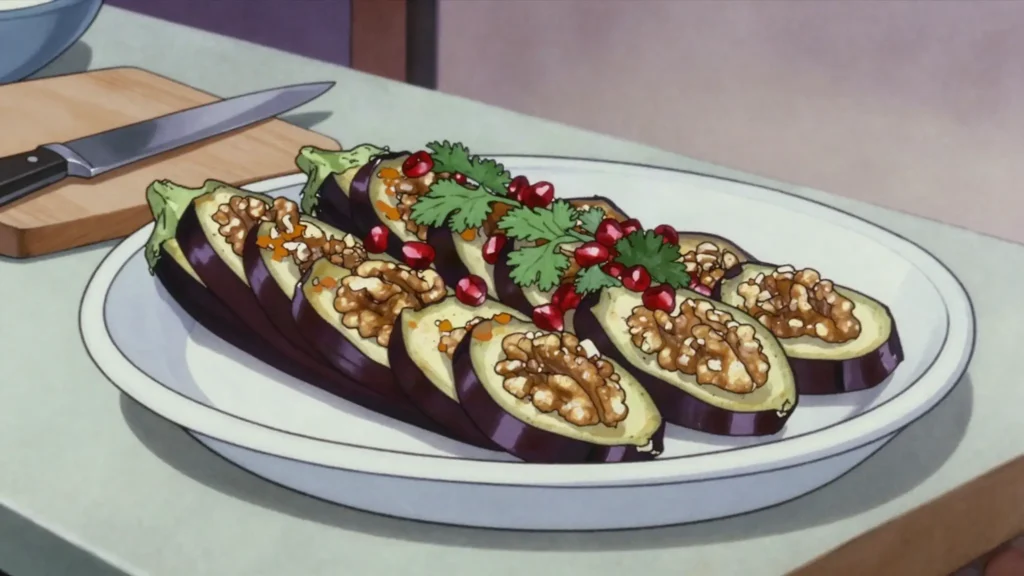
Fried aubergine slices, rolled around a paste of ground walnut, garlic and vinegar, and typically garnished with pomegranate seed, documented across Georgia for many generations as a defining example of the country’s distinctive walnut-based culinary tradition. Its combination of fried aubergine with a rich walnut filling reflects the broader Georgian technique of pairing vegetables with ground walnut pastes seasoned with garlic and vinegar, a pattern found across several traditional Georgian dishes including pkhali. Badrijani nigvzit remains one of the most iconic dishes served as part of a traditional Georgian supra feast, valued both for its distinctive flavour and for its visually striking presentation with scattered pomegranate seeds on top.
Frequently asked questions
What is Badrijani nigvzit?
Badrijani nigvzit is a salad & side from Georgia: fried aubergine rolls stuffed with walnut paste. Fried aubergine slices, rolled around a paste of ground walnut, garlic and vinegar, and typically garnished with pomegranate seed, documented across Georgia for many generations as a defining example of the country’s distinctive walnut-based culinary tradition. Its combination of fried aubergine with a rich walnut filling reflects the broader Georgian technique of pairing vegetables with ground walnut pastes seasoned with garlic and vinegar, a pattern found across several traditional Georgian dishes including pkhali. Badrijani nigvzit remains one of the most iconic dishes served as part of a traditional Georgian supra feast, valued both for its distinctive flavour and for its visually striking presentation with scattered pomegranate seeds on top.
How long does Badrijani nigvzit take to make?
Badrijani nigvzit takes 30 minutes of preparation and 25 minutes of cooking. The recipe makes about 16 rolls. It is rated medium to make.
What can I substitute in Badrijani nigvzit?
Yes, within limits. Ordinary ground fenugreek can stand in for blue fenugreek, using rather less since it is more bitter. Turmeric gives colour in place of dried marigold, though the flavour is quite different.
What is the most important thing to get right in Badrijani nigvzit?
Grind them until they are almost a powder. Do not grind so long that they turn oily. Add all the spices and the salt. Add the vinegar or pomegranate juice. Add the cold water a spoonful at a time. The paste should become smooth and spreadable. Taste it and adjust the salt and the vinegar. It should be strongly garlicky and clearly sour.