
Ingredients
The cassava dough
- 1.5 kgfermented cassava dough
- sold as agbelima or cassava dough
- from an African grocer
- or ready-made yakeyake granules
- or 2 kg fresh cassava
- fermented at home
- see the safety notes
For the granules
- a little water, to sprinkle
- half a teaspoon salt
- optional
- a fine sieve or a flat basket
Equipment
- a couscoussier
- or a steamer basket over a pot
- muslin, to line it
- a wide bowl, for rubbing
- a wooden spoon
To serve
- a tomato and pepper stew
- or okra stew
- or groundnut soup
- fried or grilled fish
- shito, Ghanaian pepper sauce
- sliced raw onion
Directions
- Start with the fermented dough. It must be broken into granules. Put the fermented dough in a wide bowl. Break it up roughly with your fingers. Work in small circular movements. Keep working until it is even. Sprinkle a little water if it is too dry.
- Add salt now if you are using it. Return those to the bowl and rub again. Repeat until most of it has passed through. So do not work the granules too fine.
- Set up a steamer with water beneath. Line the steamer basket with muslin. Bring the water to a steady boil. Tip the granules into the basket loosely. Do not press or pack them down.
- Steam must pass through them freely. Steam them for about twenty minutes. Sprinkle a little water over them. Rub them between your hands to separate. Be careful, since they are very hot. Let them cool a moment before handling. Steam scalds badly and condenses on skin.
- Break up every clump you find. Return them to the basket loosely. Steam them for another fifteen minutes. It should be soft with no hard centre.
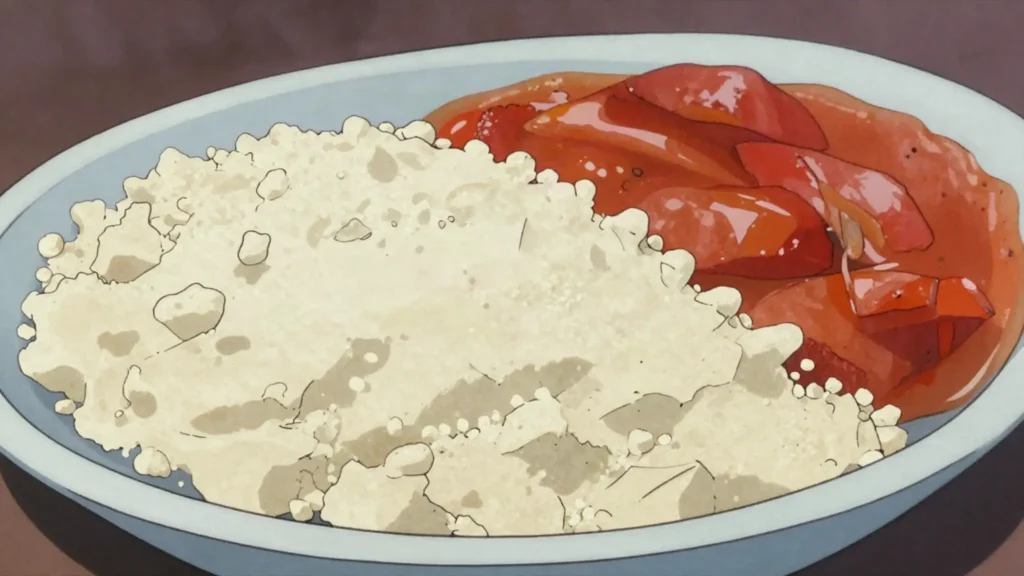
- Tip it onto a wide tray or platter. Break up all of the remaining lumps. It should be loose and separate. Cover it over and keep it warm. It is fiercely hot and deeply savoury. Wash hands before and after the meal. It keeps two days refrigerated.
- Sprinkle a little water over it first. Never microwave it without added water. Steam it from frozen to reheat. Fermented cassava dough keeps a week chilled.
Technique
- Cassava contains linamarin, which converts to hydrogen cyanide when the tissue is damaged, and poisoning is documented including konzo, a condition causing permanent leg paralysis. The days-long fermentation used here is itself a processing method that breaks those compounds down substantially, and the steaming afterwards drives off more. That combination is not accidental — it is a technology developed over centuries.
- Never eat cassava raw, never taste fermenting dough, peel it thickly, cook it right through, and discard any root that tastes bitter. Bitterness is the warning signal.
- Buy ready-fermented cassava dough, sold as agbelima, or ready-made yakeyake granules. African grocers stock both frozen. It is the easiest route and the safest, and the atlas recommends it.
- The second steaming is essential. Rub the granules out between steamings, breaking every clump — skipping that gives dense clumped granules and leaves them undercooked.
- Do not work the granules too fine. Yakeyake is deliberately coarser than attiéké, and that coarseness is characteristic.
- Steam scalds worse than boiling water and condenses on skin. Let the granules cool a moment before rubbing them out.
- This is not a swallow food. Yakeyake is eaten with a spoon or the fingers and chewed normally, unlike fufu, banku and kenkey, which are pinched, dipped and swallowed whole. That difference is worth stating.
- One raw material — fermented cassava dough — becomes banku, kenkey, water fufu, akpu, attiéké and yakeyake depending entirely on the processing. The atlas records that family and adjudicates no origin claim.
- Shito, the Ghanaian pepper sauce served alongside, is made with dried fish and shrimp and is a fish and shellfish allergen. Tell guests.
Substitutions
- Ready-made yakeyake or attiéké granules from an African grocer replace the whole process and only need steaming to reheat.
- Attiéké replaces yakeyake closely; it is finer and more pressed, and the dish works the same way.
- Fermented cassava dough sold as agbelima replaces home fermentation entirely.
- Any Ghanaian stew works — tomato and pepper, okra, groundnut or palm nut soup.
- Grilled tilapia is the classic fish; any firm white fish does the same job.
- Shito can be left out for anyone avoiding fish and shellfish; a plain fresh chilli sauce substitutes.
Variations
- Attiéké in Côte d’Ivoire is the finer, more pressed relative and is the best known of these granules.
- Banku and kenkey are the fermented maize and cassava doughs of Ghana, boiled rather than steamed.
- Water fufu in Cameroon and akpu in Nigeria are the same fermented cassava cooked into a smooth dough.
- Yakeyake with grilled tilapia and shito is the classic Ga plate.
- Some households mix a little maize dough into the cassava, giving a firmer granule.
- A version served with a light okra soup rather than a thick stew is common in the Volta Region.
History
A Ga and Ewe dish from the same fermented cassava tradition as Ivorian attiéké, steamed rather than granulated fine.
Frequently asked questions
What is Yakeyake?
Yakeyake is a main from Ghana: steamed granules of fermented cassava dough eaten with stew. A Ga and Ewe dish from the same fermented cassava tradition as Ivorian attiéké, steamed rather than granulated fine.
How long does Yakeyake take to make?
Yakeyake takes 30 minutes of preparation and 40 minutes of cooking. The recipe makes serves 6. It is rated medium to make.
What can I substitute in Yakeyake?
Yes, within limits. Ready-made yakeyake or attiéké granules from an African grocer replace the whole process and only need steaming to reheat. Attiéké replaces yakeyake closely; it is finer and more pressed, and the dish works the same way. Fermented cassava dough sold as agbelima replaces home fermentation entirely. Any Ghanaian stew works — tomato and pepper, okra, groundnut or palm nut soup. Grilled tilapia is the classic fish; any firm white fish does the same job. Shito can be left out for anyone avoiding fish and shellfish; a plain fresh chilli sauce substitutes.
What is the most important thing to get right in Yakeyake?
Start with the fermented dough. It must be broken into granules. Put the fermented dough in a wide bowl. Break it up roughly with your fingers. Work in small circular movements. Keep working until it is even. Sprinkle a little water if it is too dry.