
Ingredients
What to buy
- Hoegaarden, the original revival
- or St Bernardus Wit, Blanche de Namur, Celis White
- cloudy and pale
- see the note on why no method is given
To serve
- at 4 to 7 degrees
- colder than most Belgian beer
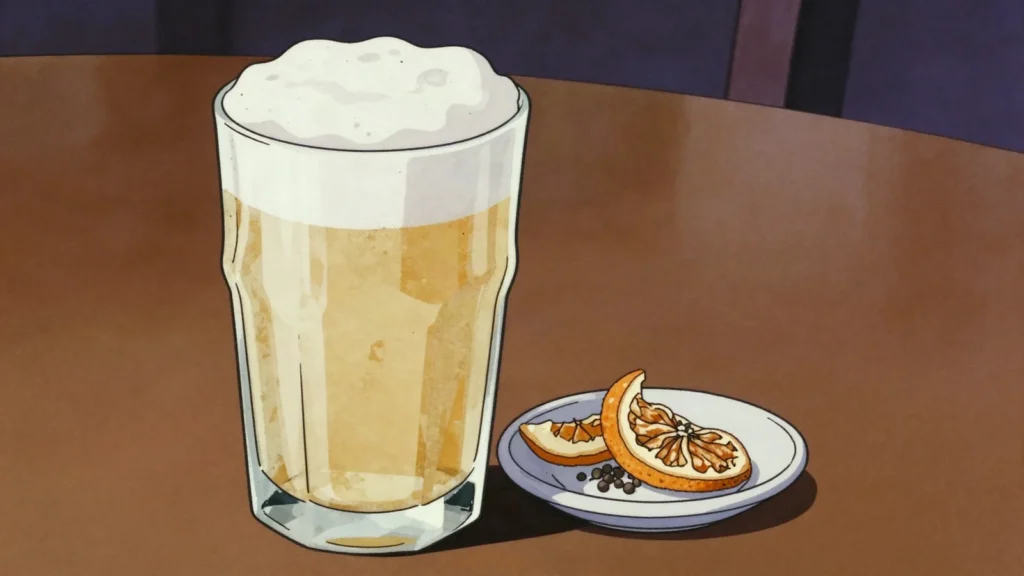
- in a heavy hexagonal tumbler
- or any large glass
- roll the bottle before pouring
- see the note
- without an orange slice
- see the note
To eat with
- mussels
- shrimp croquettes
- salads
- goat’s cheese
- grilled fish
- Thai and Vietnamese food
Directions
- Roll the bottle gently before pouring.
- Lay the bottle on its side and roll it slowly. Cold suits it.
- Discard any that are open before cooking and do not close when tapped.
- Discard any that stay shut after cooking. Mussels should smell of the sea and nothing else.
- Check the date and buy the freshest you can. Anyone pregnant should not drink alcohol.
Technique
- Do not put an orange slice in it. That is largely an American bar habit rather than Belgian practice, and fruit oil and pulp kill the head, which is one of a witbier’s pleasures. It also masks a beer that has gone stale, which is part of why the habit spread. Some people like it that way, and the atlas records the practice without prescribing against it.
- Roll the bottle gently before pouring. The yeast settles at the base and witbier is meant to be cloudy, so rolling redistributes it without shaking it up — or pour most of it, swirl the last and add it. This is the opposite of what you do with a gueuze, where you leave the sediment behind.
- The cloudiness is correct. Unmalted wheat carries proteins that stay in suspension, and a clear witbier has been filtered and has lost something.
- It is coriander seed, not leaf. The two taste nothing alike — the seed is citrusy and floral. Belgian brewers often prefer a small round variety that is more lemony than the ordinary kind. The orange peel is dried bitter Curaçao peel, which gives aroma rather than sweetness.
- Serve it colder than other Belgian beer, at four to seven degrees. It is a refreshment beer and cold suits it.
- It is best fresh, and this matters more here than with almost any other Belgian style. It is built entirely on delicate aromatics, coriander and orange fade fast, and an old witbier tastes of cardboard. Check the date.
- Light spoils it quickly, which is why cloudy beers suffer in clear bottles.
- Belgian white beer died out when the last Hoegaarden brewery closed in 1957, and Pierre Celis — a milkman who had worked at the old brewery as a young man — started brewing it again in 1966. A revived style is a reconstruction, informed by memory and record rather than continuous practice, and the atlas says so rather than implying an unbroken line. Celis later founded a brewery in Austin, Texas. Witbier is now brewed worldwide, all downstream of one man in one village.
- It works well with Thai and Vietnamese cooking, where the citrus and coriander meet lemongrass and lime.
- For mussels cooked in it: discard any that are open before cooking and do not close when tapped, and any that stay shut after cooking. That second rule is widely given and genuinely debated — some shellfish experts consider a firmly shut mussel after cooking simply a strong one — and the atlas records the debate while giving the conservative advice. Mussels should smell of the sea and nothing else; cook them the day you buy them.
- It is one of the weaker Belgian styles at four to five and a half percent, and one of the most approachable — it suits people who do not usually like beer.
- It contains wheat and barley, so it contains gluten, and coriander is a spice some people react to.
- The reason for no brewing method is the same as for saison: this is a style rather than a brand, legal and safe to brew at home, and the omission is a limitation of this atlas rather than a property of the beer.
- Do not drink alcohol if you are pregnant or driving.
Substitutions
- German Hefeweizen is the other great cloudy wheat beer, with banana and clove rather than citrus.
- Berliner Weisse is the sour wheat alternative.
- Any modern craft witbier follows the same template.
- Non-alcoholic witbiers are among the better zero-alcohol beers.
- A dry sparkling cider fills a similar place at a table.
- Lemonade with a squeeze of lime is the soft parallel.
Variations
- Hoegaarden is the revival that started it.
- Celis White was Pierre Celis’s Texas version of the same beer.
- St Bernardus Wit was brewed to Celis’s original approach.
- Blanche de Namur is the Walloon example.
- Fruited witbiers with raspberry or peach are common commercially.
- Hefeweizen is the German wheat beer with a wholly different yeast character.
History
The Hoegaarden white beer tradition died out in 1957 and was revived in 1966 by milkman Pierre Celis, who rebuilt it into a global style.
Frequently asked questions
What is Witbier?
Witbier is a wine & spirit from Belgium: cloudy wheat beer spiced with coriander and orange peel, served cold. The Hoegaarden white beer tradition died out in 1957 and was revived in 1966 by milkman Pierre Celis, who rebuilt it into a global style.
How long does Witbier take to make?
Witbier takes 5 minutes of preparation and none of cooking. The recipe makes buy by the bottle. It is rated easy to make.
What can I substitute in Witbier?
Yes, within limits. German Hefeweizen is the other great cloudy wheat beer, with banana and clove rather than citrus. Berliner Weisse is the sour wheat alternative. Any modern craft witbier follows the same template. Non-alcoholic witbiers are among the better zero-alcohol beers. A dry sparkling cider fills a similar place at a table. Lemonade with a squeeze of lime is the soft parallel.
What is the most important thing to get right in Witbier?
Discard any that are open before cooking and do not close when tapped.