
Ingredients
Oysters
- 24live Sydney rock oysters (Saccostrea glomerata), unopened, from a named estuary such as the Hawkesbury, Wallis Lake, Clyde River or Merimbula
- a shucking knife with a short stubby blade
- a folded tea towel or a chainmail glove
- crushed ice and rock salt to bed the plate
Natural
- 1lemon, in wedges
- cracked black pepper
Mignonette
- 3 tbspred wine vinegar
- 1small shallot, very finely diced
- ½ tspcaster sugar
- ½ tspcracked black pepper
Kilpatrick, the cooked Australian classic
- 4rashers streaky bacon, finely diced and fried crisp
- 3 tbspWorcestershire sauce
- 2 tbsptomato sauce
- 1 tspbutter
Directions
- Buy them unopened and alive, keep them cup side down in the fridge under a damp cloth, never in water or a sealed bag, and use them within three days; an oyster that gapes and does not close when tapped is dead and must go.
- Scrub the shells under cold running water with a stiff brush to remove grit and mud, particularly around the hinge where the knife will go.
- Wrap the oyster in a folded tea towel with the cup, or deeper, half downwards and the hinge pointing towards you, holding it flat on the bench rather than in mid-air.
- Work the knife tip into the hinge and twist rather than push, using a small firm rotation until you feel and hear the hinge pop. Force from the arm is how people stab themselves; the movement comes from the wrist.
- Slide the blade along the inside of the flat top shell to cut the adductor muscle, keeping the blade pressed against the upper shell so you do not shred the meat, then lift the top shell away.
- Run the knife under the oyster to release the lower muscle, check for shell fragments, and keep every drop of the liquor in the cup; that seawater is half the flavour and pouring it off is a common mistake.
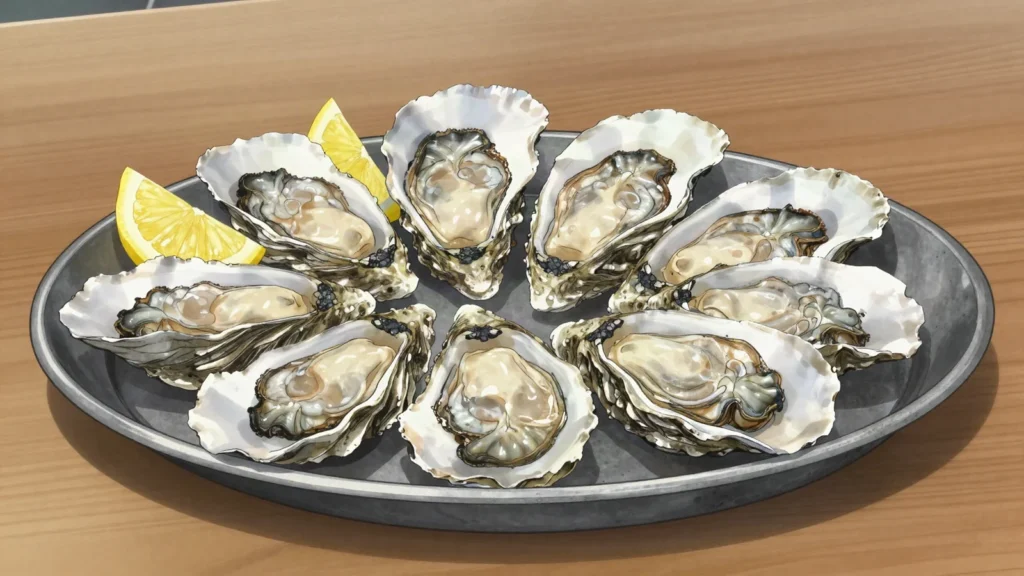
- Set them on crushed ice or a bed of rock salt to hold them level, and serve within minutes with lemon and pepper, or a teaspoon of mignonette. Sydney rocks are small, dense and intensely mineral, and are best eaten with one bite and a chew.
- For Kilpatrick, top each shucked oyster with a little Worcestershire and tomato sauce, scatter the crisp bacon over and grill under a very hot grill for 3 to 4 minutes, just until the edges of the oyster curl and the bacon sizzles.
Technique
- Sydney rock oysters are a distinct species from the Pacific oyster and grow far more slowly, taking three to four years to reach market size, which is why they are smaller and why the flavour is so much more concentrated.
- They express merroir. Wallis Lake, Hawkesbury, Clyde River and Georges River oysters taste measurably different from one another, and Australian oyster bars list the estuary rather than just the species.
- Never wash a shucked oyster or drain the liquor. Grit should be dealt with by scrubbing the outside before opening.
- Kilpatrick is Australian rather than Scottish in its current form, and it is a way of using oysters that are large or less pristine; the best small rocks are wasted under bacon and sauce.
Substitutions
- No Sydney rocks: Pacific oysters from Tasmania or South Australia are larger, creamier and more widely available and are shucked identically.
- No shucking knife: a short sturdy flat-head screwdriver has been used by generations of Australians, though a proper knife is safer.
- The mignonette can be made with champagne vinegar and a finely chopped green chilli for a sharper modern dressing.
Variations
- Oysters mornay, under a cheese sauce and grilled, is the other pub classic.
- A finger lime and pepperberry dressing is the native-ingredient modern Australian treatment.
- Tempura oysters, lightly battered and fried for 60 seconds, are common in Sydney restaurants.
History
Aboriginal middens show thousands of years of harvesting; commercial estuary farming on New South Wales rivers began in the 1870s.
Frequently asked questions
What is Sydney Rock Oysters?
Sydney Rock Oysters is a main from Australia: small intensely mineral oysters eaten raw with lemon on the half shell. Aboriginal middens show thousands of years of harvesting; commercial estuary farming on New South Wales rivers began in the 1870s.
How long does Sydney Rock Oysters take to make?
Sydney Rock Oysters takes 25 min of preparation and no cooking, or 8 min for the cooked versions of cooking. The recipe makes 24 oysters, 4 servings. It is rated medium to make.
What can I substitute in Sydney Rock Oysters?
Yes, within limits. No Sydney rocks: Pacific oysters from Tasmania or South Australia are larger, creamier and more widely available and are shucked identically. No shucking knife: a short sturdy flat-head screwdriver has been used by generations of Australians, though a proper knife is safer. The mignonette can be made with champagne vinegar and a finely chopped green chilli for a sharper modern dressing.
What is the most important thing to get right in Sydney Rock Oysters?
Buy them unopened and alive, keep them cup side down in the fridge under a damp cloth, never in water or a sealed bag, and use them within three days; an oyster that gapes and does not close when tapped is dead and must go.