
Ingredients
Dumpling
- 400 gsago starch (saksak), fresh wet sago if you can get it, or dried sago flour
- 4very ripe cooking bananas or plantains (about 500 g), grated or mashed
- 150 mlwarm water, only if using dried sago flour
- ½ tspsalt
Coconut
- 400 mlthick coconut cream, from 2 freshly grated mature coconuts
- 2 tbspsugar (optional – traditionally none, the banana provides the sweetness)
- a pinch of salt
Wrapping
- 8banana leaf rectangles, about 25 by 20 cm, wilted over a flame until pliable
- strips of banana leaf rib or thin string, for tying
Directions
- Wilt the banana leaves by passing each one over an open flame for a few seconds until it turns glossy, deep green and folds without splitting. Brittle leaves will crack open in the steamer.
- If using dried sago flour, sprinkle the warm water over it and rub it through your fingers until it is evenly damp and clumps when squeezed but is not wet. Fresh wet sago needs no water at all.
- Mash or coarsely grate the ripe bananas – they should be heavily spotted and soft, sweet enough to need no sugar.
- Work the banana and salt into the sago with your hands until you have a thick, sticky, speckled paste that just holds together. Do not overwork it; sago becomes gluey.
- Lay a banana leaf shiny side up, place a heaped 2 tablespoons of the mixture along the centre, and press it into a log about 12 cm long.
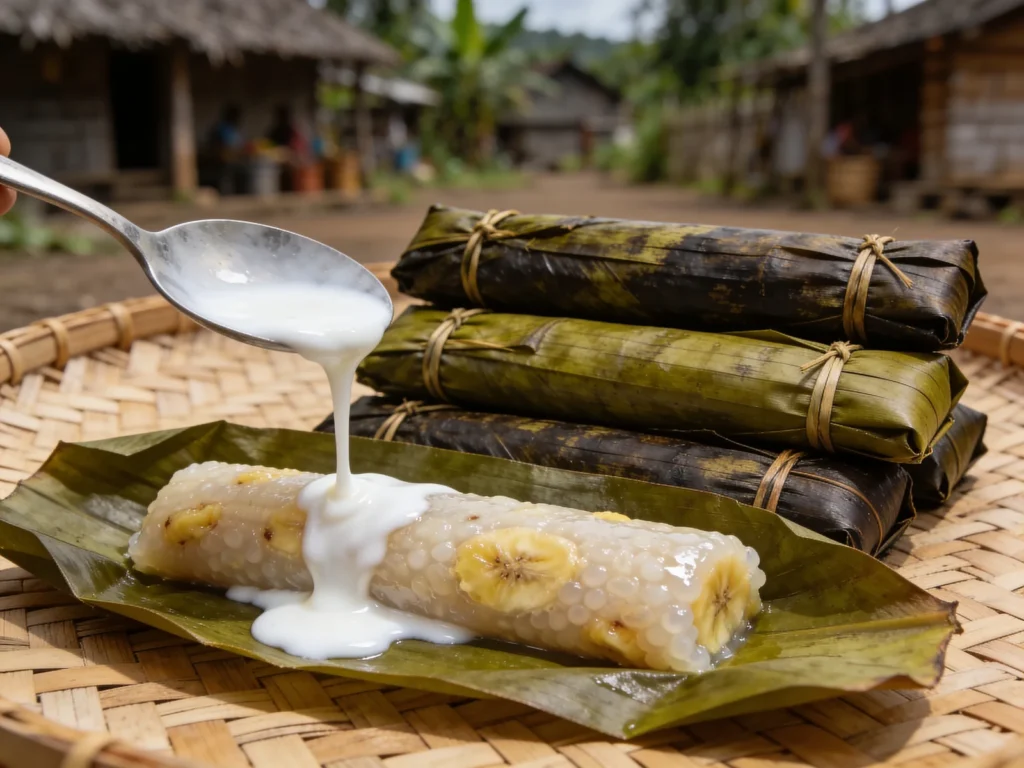
- Spoon a tablespoon of thick coconut cream over the log, then fold the long sides of the leaf over the filling, fold the ends under, and tie each parcel with a strip of leaf rib.
- Arrange the parcels seam side down in a steamer over rapidly boiling water, or lay them directly on hot stones in an earth oven as is done in the villages.
- Steam for 25–30 minutes. The parcels are done when the leaf has darkened to olive and smells toasted, and the filling inside has turned from opaque white to translucent and springs back to the touch.
- Rest 5 minutes, then unwrap. The saksak should be glossy, chewy and slightly elastic, sweet from the banana, rich from the coconut. Serve warm in the leaf, with extra coconut cream poured over.
Technique
- Sago is the pith starch of the sago palm, washed out and settled – the staple of the Sepik and lowland swamps, where a single palm feeds a family for weeks. It has almost no flavour of its own, so the banana and coconut do all the work.
- Translucency is the doneness test. Sago that is still chalky white in the centre is undercooked and will taste raw and powdery.
- Do not add water to fresh wet sago. It already carries enough moisture, and extra water turns the mixture into a slurry that leaks out of the leaf.
Substitutions
- No sago? Tapioca or cassava starch behaves almost identically and is the standard substitute, giving a slightly bouncier dumpling.
- No banana leaves? Use foil lined with baking paper – the parcels steam fine but lose the grassy perfume the leaf gives.
- Very ripe ordinary bananas work in place of cooking bananas; use a few less, as they are sweeter and wetter.
Variations
- Saksak with grated coconut folded through the mixture as well as poured over.
- Sago and pawpaw saksak, made when bananas are scarce.
- Plain sago dumplings cooked in coconut cream in a pot rather than wrapped, the everyday quick version.
History
A dish made from sago, a starch extracted from the pith of the sago palm, processed into a paste or flatbread and eaten as a staple food, documented across the lowland and coastal regions of Papua New Guinea for many generations, particularly significant in areas where the swampy, often flood-prone terrain is poorly suited to growing other staple crops like taro or sweet potato that thrive better in higher, drier ground. Extracting sago starch from the palm’s pith requires substantial labor, traditionally involving pounding and washing the pith repeatedly to separate out the starch, a process passed down through generations of practiced technique within sago-dependent communities. Saksak remains an essential traditional staple food specifically across Papua New Guinea’s lowland and coastal sago-growing regions.
Frequently asked questions
What is Saksak?
Saksak is a dessert from Papua New Guinea: sago and banana dumplings steamed in banana leaves with coconut cream. A dish made from sago, a starch extracted from the pith of the sago palm, processed into a paste or flatbread and eaten as a staple food, documented across the lowland and coastal regions of Papua New Guinea for many generations, particularly significant in areas where the swampy, often flood-prone terrain is poorly suited to growing other staple crops like taro or sweet potato that thrive better in higher, drier ground. Extracting sago starch from the palm’s pith requires substantial labor, traditionally involving pounding and washing the pith repeatedly to separate out the starch, a process passed down through generations of practiced technique within sago-dependent communities. Saksak remains an essential traditional staple food specifically across Papua New Guinea’s lowland and coastal sago-growing regions.
How long does Saksak take to make?
Saksak takes 30 min of preparation and 30 min of cooking. The recipe makes 8 parcels (4 servings). It is rated medium to make.
What can I substitute in Saksak?
Yes, within limits. No sago? Tapioca or cassava starch behaves almost identically and is the standard substitute, giving a slightly bouncier dumpling. No banana leaves? Use foil lined with baking paper – the parcels steam fine but lose the grassy perfume the leaf gives. Very ripe ordinary bananas work in place of cooking bananas; use a few less, as they are sweeter and wetter.
What is the most important thing to get right in Saksak?
Work the banana and salt into the sago with your hands until you have a thick, sticky, speckled paste that just holds together. Do not overwork it; sago becomes gluey.