Ingredients
The pudding
- 150 gshort grain rice
- or pudding rice
- 1.2 litreswhole milk
- 150 gsugar
- or to taste
- a pinch of salt
The scenting
- 1 tablespoonorange blossom water
- or rose water
- or 2 small pieces mastic
- ground with sugar
Sometimes added
- 2 tablespoonscornflour
- for a firmer set
- a strip of lemon peel
- 1 stickcinnamon
To serve
- chopped pistachios
- ground cinnamon
- in small bowls
- well chilled
Directions
- Grind it with a little of the sugar. The sugar stops it sticking together. Add it at the end and taste as you go. You cannot take it out of it again. Add them in only right at the end. Long grain gives a thin loose result.
- Stir it regularly right through. Do not walk away from the pot. Rinse the rice well in cold water. Rinse it only very briefly here. It helps to thicken the pudding. Put the rice into a heavy pot. Add a little water to cover it. That prevents the milk catching early. Simmer it until the water is absorbed. Give it about ten full minutes.
- Pour the milk into the softened rice. Add it gradually rather than all at once. Stir it in as it all goes into it. That prevents any lumps forming. Bring it slowly up to a simmer. Keep it at a bare simmer only. Simmer it for about thirty minutes. It goes from liquid to a thick cream. Stir it every few minutes throughout. Stir more often as it thickens. Stir the sugar in partway through.
- Add it after about twenty minutes. Stir a good pinch of salt into it. Salt sharpens the sweetness considerably. It stops it tasting flat and cloying. Mix it smooth before it goes in. Dry cornflour lumps immediately. Stir the slurry in and cook it out. Give it three or four minutes.
- Cook it looser than you want it. Cooking it too thick gives a stiff pudding. Take the pot right off the heat. Stir in the orange blossom water. Add it in off the heat entirely. The aroma escapes if it boils.
- Stir it right through the pudding. Taste it and adjust cautiously. Grind the mastic with a little sugar. Stir the powder into the hot pudding. It needs a little heat to disperse. Add it a few minutes before the end. Stir it thoroughly right through. Ladle it out into small bowls. Do it while it is still hot and pourable.
- Press cling film onto the surface to prevent it. Refrigerate the bowls until cold. Scatter chopped pistachios over it. Dust ground cinnamon over that. Leave them off if in any doubt. It keeps three days refrigerated.
Technique
- Cook it looser than you want it, stopping while it still flows easily: it thickens a great deal as it chills, and cooking it too thick gives a pudding that goes almost solid. It sets from the rice starch alone with no eggs, which is what makes it firmer than European versions and spoonable rather than pourable.
- Milk and rice catch on the pot base and a burnt patch taints the whole batch, so keep it at a bare simmer in a heavy pot, stir every few minutes scraping the bottom, and stir more often as it thickens. Do not walk away from it.
- Both orange blossom water and mastic are genuinely very strong — one tablespoon or two small pieces is enough, and more tastes medicinal or of soap entirely. Add floral waters off the heat, since their aroma is volatile and long cooking drives it away, and taste as you go since you cannot take it out again.
Substitutions
- Rose water stands in for orange blossom; mastic must be ground with a little sugar first, which stops the resin sticking together and turns it to a fine powder.
- Two tablespoons of cornflour slaked in cold milk gives a firmer more reliable set; some households use it and some rely on the rice starch alone, and both are genuinely done.
Variations
- Use short grain or pudding rice, which releases far more starch than long grain and is what thickens the pudding, and whole milk rather than skimmed, since the fat carries the flavour.
- Starting the rice in a little water until it is absorbed, before the milk goes in, softens it early and stops the milk catching — a genuinely useful step. Add the sugar only partway through, since sugar added early slows the rice softening and makes it catch more readily.
- Pistachios scattered on top are visible but tree nut allergy can be severe, so say clearly if you have used them.
History
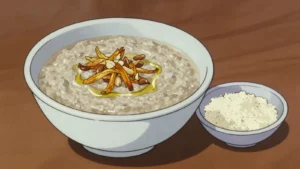
An everyday Levantine home sweet, set firmer than European versions and usually served chilled.
Frequently asked questions
What is Riz bi haleeb?
Riz bi haleeb is a dessert from Lebanon: cold rice pudding scented with orange blossom or mastic, eaten from small bowls. An everyday Levantine home sweet, set firmer than European versions and usually served chilled.
How long does Riz bi haleeb take to make?
Riz bi haleeb takes 10 minutes of preparation and 40 minutes of cooking. The recipe makes serves 6. It is rated easy to make.
What can I substitute in Riz bi haleeb?
Yes, within limits. Rose water stands in for orange blossom; mastic must be ground with a little sugar first, which stops the resin sticking together and turns it to a fine powder. Two tablespoons of cornflour slaked in cold milk gives a firmer more reliable set; some households use it and some rely on the rice starch alone, and both are genuinely done.
What is the most important thing to get right in Riz bi haleeb?
Stir it regularly right through. Do not walk away from the pot. Rinse the rice well in cold water. Rinse it only very briefly here. It helps to thicken the pudding. Put the rice into a heavy pot. Add a little water to cover it. That prevents the milk catching early. Simmer it until the water is absorbed. Give it about ten full minutes.