
Ingredients
The fish
- 12small horse mackerel
- chinchard, gutted and scaled
- 2 teaspoonssalt
- juice of 2 lemons
To coat
- 150 gplain flour
- or cassava flour
- 1 teaspoonsalt
- 1 teaspoonground white pepper
To fry
- oil, for deep frying
To serve
- pili pili
- a hot chilli sauce
- chikwangue
- or fried cassava
- raw onion
- lemon wedges
Directions
- Scale the fish with a sharp knife. Work from the tail towards the head. Cut them all off with a knife. Gutting it is straightforward enough. Rinse the whole cavity thoroughly. Rinse it all out very completely.
- Cut two or three slashes in each side. They also help the fish cook evenly. Cut down right towards the bone. Rub salt into the fish and the slashes. Squeeze lemon juice over them.
- Let them sit for fifteen minutes. Fifteen minutes seasons the surface. Mix the flour with salt and pepper. Toss each fish in the seasoned flour. Coat it inside the slashes as well. Shake each fish before frying. Loose flour burns in the hot oil.
- Pour the oil into a deep heavy pot. Fill it no more than half full. Heat it to about one hundred and eighty degrees. It should sizzle up immediately. Keep a lid nearby to smother a flare-up. Never put water on an oil fire at all.
- Keep children well away from the pot. Understanding the wet fish risk is worth repeating. Turn them over carefully with tongs. Give them another three or four minutes.
- Turn it with a spatula and tongs together. Judging them takes a careful look. Check by pulling at the dorsal fin. It should come away easily when cooked. Lift them out onto a wire rack. That softens the skin within minutes. Sprinkle a little salt over them hot. That sticks to the hot surface.
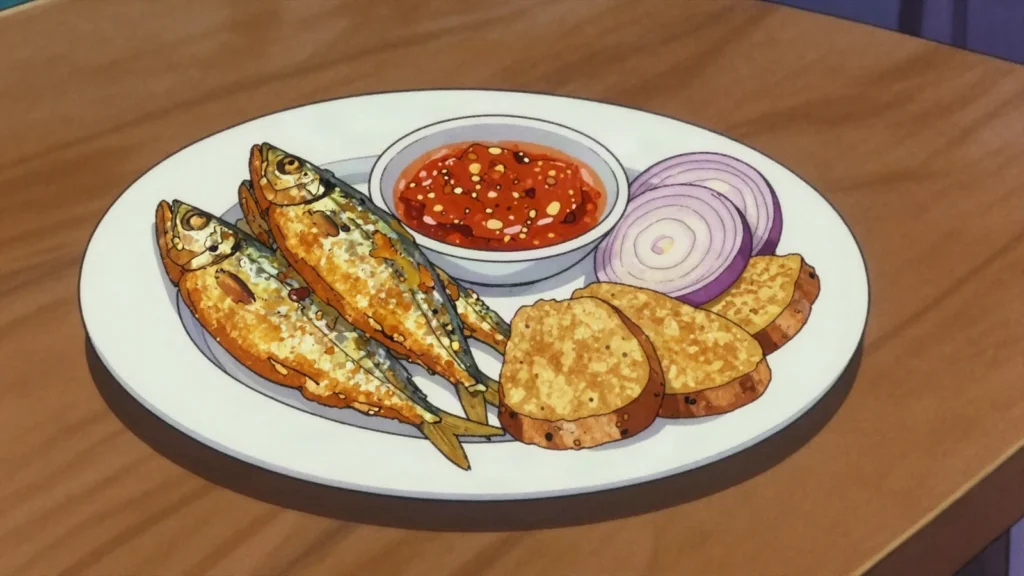
- Pile them onto a plate or paper. Put pili pili sauce out beside them. Add thinly sliced raw onion as well. Serve chikwangue or fried cassava alongside. It must be eaten hot from the oil.
Technique
- Oily schooling fish can form histamine when not kept cold, causing scombroid poisoning — flushing, headache, rash, cramps — and cooking does not destroy it, nor does freezing. Buy fish kept properly frozen and thaw it in the refrigerator rather than out, since fish left out warms unevenly with the outside sitting warm while the middle thaws, which is exactly when histamine forms. A sharp or peppery smell is a warning and a peppery taste means stop eating.
- Cheap imported frozen fish feeds a great many people and is genuinely affordable protein, and it also competes with local fishing — a documented pressure in the region. Both are true at once, and the atlas records both sides rather than pretending the picture is simple.
- Horse mackerel has a line of hard bony scutes along the tail that will not scale away and must be cut off with a knife. Pat the fish thoroughly dry before coating: wet fish spits violently in hot oil, steams rather than crisping, and sheds its coating.
Substitutions
- Cassava flour in place of wheat gives a lighter crisper coating and is locally available; both are used.
- Fried cassava stands in for chikwangue, the fermented cassava paste steamed in leaves.
Variations
- The fish is fried whole with head and tail, small enough to eat that way, with nothing filleted or trimmed.
- Two or three slashes cut in each side let the salt in, help it cook evenly and stop it curling in the oil.
- Drain them on a wire rack rather than paper, which traps steam and softens the skin.
History
Frozen mackerel imported into Central African ports became the cheapest urban protein; roadside fryers turn it out by the crate in Brazzaville.
Frequently asked questions
What is Mpiodi?
Mpiodi is a street food from Republic of the Congo: small horse mackerel fried whole and eaten hot with chili and cassava. Frozen mackerel imported into Central African ports became the cheapest urban protein; roadside fryers turn it out by the crate in Brazzaville.
How long does Mpiodi take to make?
Mpiodi takes 20 minutes of preparation and 25 minutes of cooking. The recipe makes serves 6. It is rated easy to make.
What can I substitute in Mpiodi?
Yes, within limits. Cassava flour in place of wheat gives a lighter crisper coating and is locally available; both are used. Fried cassava stands in for chikwangue, the fermented cassava paste steamed in leaves.
What is the most important thing to get right in Mpiodi?
Scale the fish with a sharp knife. Work from the tail towards the head. Cut them all off with a knife. Gutting it is straightforward enough. Rinse the whole cavity thoroughly. Rinse it all out very completely.