
Ingredients
- 4 litresfresh whey, drained from making cheese the same day
- 400 mldouble cream
- 200 mlwhole milk
- 1 tspfine salt (optional)
- 30 gsugar, only if you want the sweeter mysost style (optional)
Equipment
- a wide heavy-bottomed pan – the wider the better
- a wooden spatula and a whisk
- a cold water bath in the sink
- a small square mould or loaf tin, lightly oiled
Directions
- Strain the whey through muslin to remove every last curd fragment; anything left behind will scorch and speckle the finished cheese.
- Pour the whey into the widest heavy pan you have and bring to a brisk simmer over medium heat, uncovered.
- Boil it down for 2.5–3 hours, stirring occasionally at first and more often as it thickens, skimming the pale foam of residual protein off the surface in the first half hour.
- When the whey has reduced by about nine-tenths to a thick, tan, condensed-milk consistency, stir in the cream and milk.
- Continue cooking over medium-low heat, now stirring constantly and scraping the base and corners with the spatula. The Maillard reaction between the whey sugars and proteins takes over: the colour moves from beige through caramel to deep brown, and the smell turns from milky to toffee and faintly burnt sugar.
- Test by dropping a little onto a cold plate. It is ready when it sets firm within a minute and holds a clean edge, at roughly 110–115°C (225–250°F).
- Take the pan straight off the heat and stand it in a sink of cold water. Beat hard with a whisk for 5–8 minutes as it cools. This is the step that stops the lactose crystallising and gives brunost its smooth, fudgy body instead of a gritty one.
- When the mass is thick, glossy and too stiff to whisk, add the salt, scrape it into the oiled mould and press down to knock out air pockets.
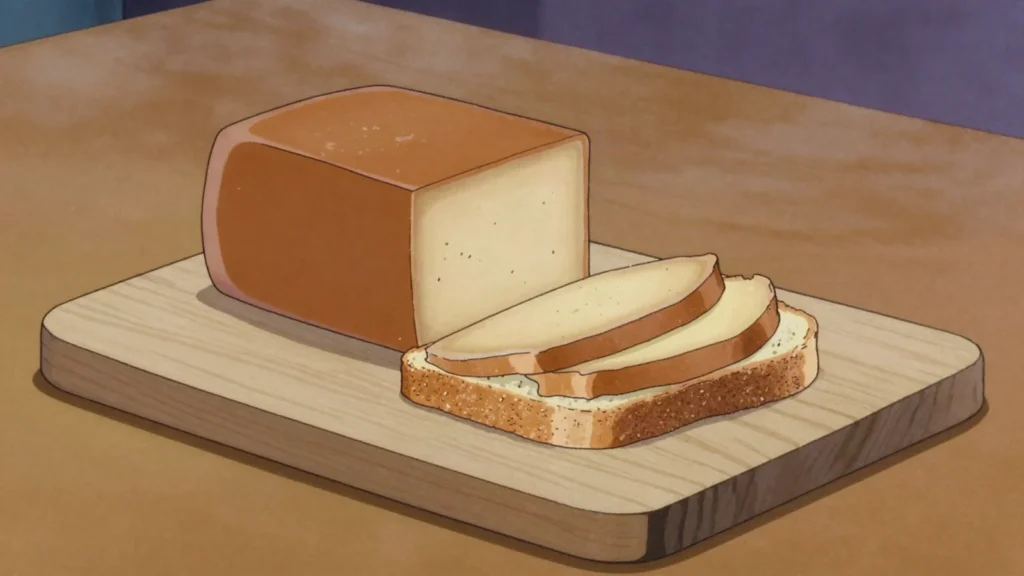
- Cool completely, then wrap tightly and refrigerate at least 12 hours before turning out. Shave it in paper-thin curls with an ostehovel onto buttered bread, crispbread or hot waffles with sour cream and jam.
Technique
- Brunost is not a cheese in the technical sense: no curd is formed and no ageing takes place. The brown colour and caramel flavour come entirely from the milk sugars cooking, which is why it must never be allowed to catch on the base.
- The vigorous beating during cooling is non-negotiable. Skip it and the lactose crystallises coarsely and the cheese turns sandy on the tongue.
- Real geitost uses goat whey and is sharper and tangier; the mass-market Gudbrandsdalsost blends goat and cow whey with cream. Both are shaved, never sliced thick – Norwegians will tell you a thick slab is a beginner’s mistake.
Substitutions
- No fresh whey? You can approximate the flavour by slowly reducing 2 litres of whole milk with 200 ml cream and 100 g whey powder, but the texture is softer and the result is closer to a milk caramel.
- Whey from making ricotta or paneer at home works well; use it the same day, as whey sours fast.
Variations
- Ekte geitost, made from pure goat whey – the sharpest and most traditional.
- Gudbrandsdalsost, the blended cow-and-goat version invented in the 1860s and now the everyday Norwegian brown cheese.
- Fløtemysost, a paler, milder cow-whey cheese enriched with extra cream.
History
A caramel-coloured cheese made not through traditional aging like most cheeses but by slowly boiling whey, the liquid byproduct of cheesemaking, until its natural milk sugars caramelise, producing a sweet, fudge-like cheese rather than a sharp or tangy one. Its invention is generally credited to Anne Hov, a Norwegian woman working at a dairy in Gudbrandsdalen in the 1860s, who developed the specific technique that turned whey, previously often discarded or fed to livestock, into a genuinely valuable and distinctly Norwegian product. Brunost became significant enough to Norwegian national identity that a 2013 truck fire involving a large shipment of it, which burned for days due to the cheese’s high fat and sugar content, drew international news coverage as a uniquely Norwegian incident.
Frequently asked questions
What is Brunost?
Brunost is a cheese & dairy from Norway: sweet caramel-brown whey cheese shaved onto bread and waffles. A caramel-coloured cheese made not through traditional aging like most cheeses but by slowly boiling whey, the liquid byproduct of cheesemaking, until its natural milk sugars caramelise, producing a sweet, fudge-like cheese rather than a sharp or tangy one. Its invention is generally credited to Anne Hov, a Norwegian woman working at a dairy in Gudbrandsdalen in the 1860s, who developed the specific technique that turned whey, previously often discarded or fed to livestock, into a genuinely valuable and distinctly Norwegian product. Brunost became significant enough to Norwegian national identity that a 2013 truck fire involving a large shipment of it, which burned for days due to the cheese’s high fat and sugar content, drew international news coverage as a uniquely Norwegian incident.
How long does Brunost take to make?
Brunost takes 15 min of preparation and 3–4 hr of cooking. The recipe makes about 400 g. It is rated hard to make.
What can I substitute in Brunost?
Yes, within limits. No fresh whey? You can approximate the flavour by slowly reducing 2 litres of whole milk with 200 ml cream and 100 g whey powder, but the texture is softer and the result is closer to a milk caramel. Whey from making ricotta or paneer at home works well; use it the same day, as whey sours fast.
What is the most important thing to get right in Brunost?
Take the pan straight off the heat and stand it in a sink of cold water. Beat hard with a whisk for 5–8 minutes as it cools. This is the step that stops the lactose crystallising and gives brunost its smooth, fudgy body instead of a gritty one.