
Ingredients
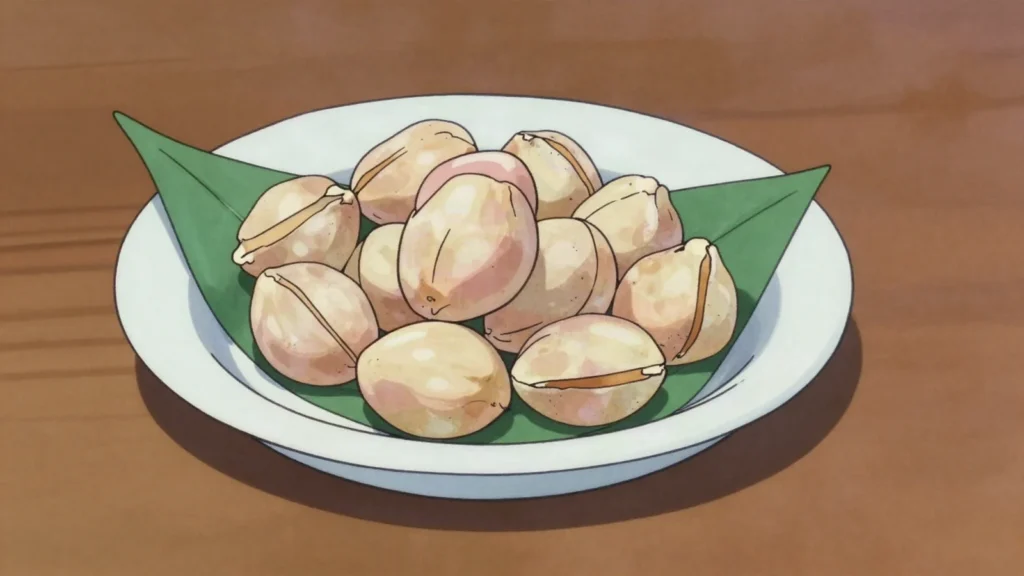
Nuts
- fresh kola nuts, woro
To present
- a cloth or a small dish
- kola in tens or in multiples
Sometimes with
- cash, cloth or salt, as part of the same gift
Directions
- In Mali and across the Manding world the emphasis falls differently from further east: kola is above all a thing that is given, carried and exchanged, rather than shared and chewed on the spot.
- Buy nuts that are firm and moist, and keep them wrapped in damp leaves so they stay fresh over a journey.
- Count them out in tens. Quantity carries meaning, and the number given is read as a measure of the weight of the occasion.
- For a marriage approach, kola is sent from the suitor’s family to the bride’s as the opening formal gesture.
- The kola is the message. Sending it says something has been proposed, accepting it says the proposal will be considered, and refusing it closes the matter without a word being spoken.
- For a funeral, kola is carried to the bereaved household as a condolence.
- For an ordinary visit, a few nuts are handed over on arrival as a greeting.
- Present them with the right hand, or with both hands to someone senior.
- To eat one, split it along its seam with a thumbnail into its lobes.
- Chew a lobe slowly, over several minutes. It is hard and sharply bitter at first, and the bitterness gives way to sweetness.
- It is a strong stimulant, roughly twice the caffeine of coffee by weight, and it is chewed by traders and drivers on long journeys and by griots through night-long performances.
- It suppresses hunger as well as sleep, which is a large part of why it moved along the trans-Saharan routes for centuries.
- Worth saying plainly: heavy long-term chewing has been linked in some studies with oral and digestive cancers, and the stimulant load affects sleep and blood pressure.
- The nuts are grown in the forest zone to the south, in Guinea and Côte d’Ivoire, and traded north into the Sahel, which is why they are valuable in Mali rather than commonplace.
- The same nut is offered and broken on the spot in Igbo and wider West African tradition, which is a related but distinctly different protocol.
Technique
- Woro is the Bambara word, and kola turns up under a different name in nearly every language along the trade route.
- White and red nuts are distinguished and different occasions call for different ones.
- The kola trade is one of the oldest continuous commercial networks in West Africa.
Substitutions
- There is no substitute for the nut itself.
- Bitter kola, a different plant used alongside it.
Variations
- The Igbo and southern Nigerian breaking ceremony, where the nut is split and shared immediately.
- Dried and ground for use in drinks.
- Chewed with alligator pepper.
History
Kola came north from the forest zone on trans-Saharan caravan routes; nuts are still presented formally at weddings, naming ceremonies and to elders.
Frequently asked questions
What is Kola nuts?
Kola nuts is a snack from Mali: bitter caffeine-rich nuts chewed slowly and exchanged at ceremonies. Kola came north from the forest zone on trans-Saharan caravan routes; nuts are still presented formally at weddings, naming ceremonies and to elders.
How long does Kola nuts take to make?
Kola nuts takes 5 min of preparation and no cooking at all. The recipe makes variable. It is rated easy to make.
What can I substitute in Kola nuts?
Yes, within limits. There is no substitute for the nut itself. Bitter kola, a different plant used alongside it.
What is the most important thing to get right in Kola nuts?
In Mali and across the Manding world the emphasis falls differently from further east: kola is above all a thing that is given, carried and exchanged, rather than shared and chewed on the spot.