Ingredients
Dough
- 500 gplain flour
- 280 mlwarm water
- 1 tspsalt
Layering
- 100 gbutter or mutton fat, melted
- 3onions, very finely chopped
- 1 tspsalt
- 1 tspblack pepper
To cook
- oil or fat, for the pan
To serve
- tea
- kaymak
- jam
Directions
- Make a soft dough with the flour, water and salt, knead it 10 minutes until smooth, and rest it 30 minutes under a cloth.
- Divide it into four and rest again for 10 minutes.
- Roll one piece out as thin as you possibly can, then keep going by stretching it with the backs of your hands until it is almost transparent.
- Thinness is the whole dish. Kattama is judged by how many layers it has, and a thick sheet gives you a filled flatbread instead.
- Brush the whole sheet generously with melted fat, right to the edges.
- Scatter the finely chopped onion evenly over, with salt and pepper.
- Chop the onion as finely as you can. Large pieces tear the thin dough as you roll it and burn against the pan.
- Roll the sheet up into a long tight rope from one edge.
- Now coil the rope into a spiral, like a snail, and tuck the end underneath.
- The coil is what makes the layers. Rolled into a rope and then wound flat, the sheet ends up folded on itself dozens of times.
- Press the coil down gently and let it rest 10 minutes.
- Roll or press it flat into a round about 1 cm thick, working from the centre outward and pressing rather than rolling hard.
- Press gently. Rolled aggressively the layers fuse back together and the whole point is lost.
- Cook in a heavy pan with a little fat over a medium heat for 5 to 7 minutes a side, covered for the first half.
- Covering it for the first few minutes steams the inside through while the base browns, and an uncovered pan gives a burnt outside and raw middle.
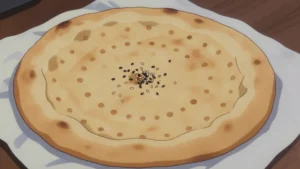
- It is ready when both sides are deep golden with dark blisters and it feels light for its size.
- Tear it apart rather than cutting it, so the layers separate.
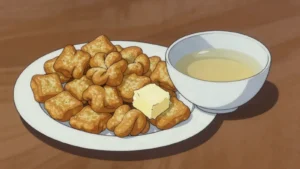
- Serve hot with tea, and with kaymak and jam for breakfast.
- It is made across Kyrgyzstan and neighbouring Central Asia, and the same coiled technique appears from Turkey to western China.
Technique
- Mutton tail fat is the traditional fat and gives a distinctive flavour that butter does not.
- It is served both plain as bread and as a breakfast item with cream and jam.
- The plain version, with fat but no onion, is equally common.
Substitutions
- Butter or ghee in place of mutton fat.
- Spring onion instead of onion, which is a common variation.
Variations
- Plain, with fat and no filling.
- With minced meat between the layers.
- Baked in a tandyr rather than cooked in a pan.
History
Layered flaky flatbread fried with onion, eaten with tea and kaymak.
Frequently asked questions
What is Kattama?
Kattama is a bread & pastry from Kyrgyzstan: flaky coiled onion flatbread. Layered flaky flatbread fried with onion, eaten with tea and kaymak.
How long does Kattama take to make?
Kattama takes 30 min plus 30 min resting of preparation and 30 min of cooking. The recipe makes 4 breads. It is rated medium to make.
What can I substitute in Kattama?
Yes, within limits. Butter or ghee in place of mutton fat. Spring onion instead of onion, which is a common variation.
What is the most important thing to get right in Kattama?
Thinness is the whole dish. Kattama is judged by how many layers it has, and a thick sheet gives you a filled flatbread instead.