
Ingredients
Dough
- 500 gplain flour
- 100 gbutter, softened
- 60 gsugar
- 1egg
- 150 mlmilk
- ½ tspsalt
- ½ tspbaking powder
To fry
- 1 litreneutral oil, or rendered mutton fat
To serve
- fresh butter
- öröm, Mongolian clotted cream
- sugar
- suutei tsai, salty milk tea
Directions
- Rub the softened butter into the flour, sugar, salt and baking powder with your fingertips until the mixture looks like coarse crumbs. Rubbing the fat in rather than melting it is what gives boortsog its short, biscuity break, and it is the main difference from the puffier fried breads further west.
- Beat the egg with the milk, pour it into the flour and bring the dough together, then knead for 5 minutes until smooth. It should be noticeably firmer than a bread dough.
- Cover and rest for 30 minutes so the gluten relaxes and the dough rolls out without springing back.
- Roll out to about 8 mm thick and cut into strips roughly 3 cm by 8 cm.
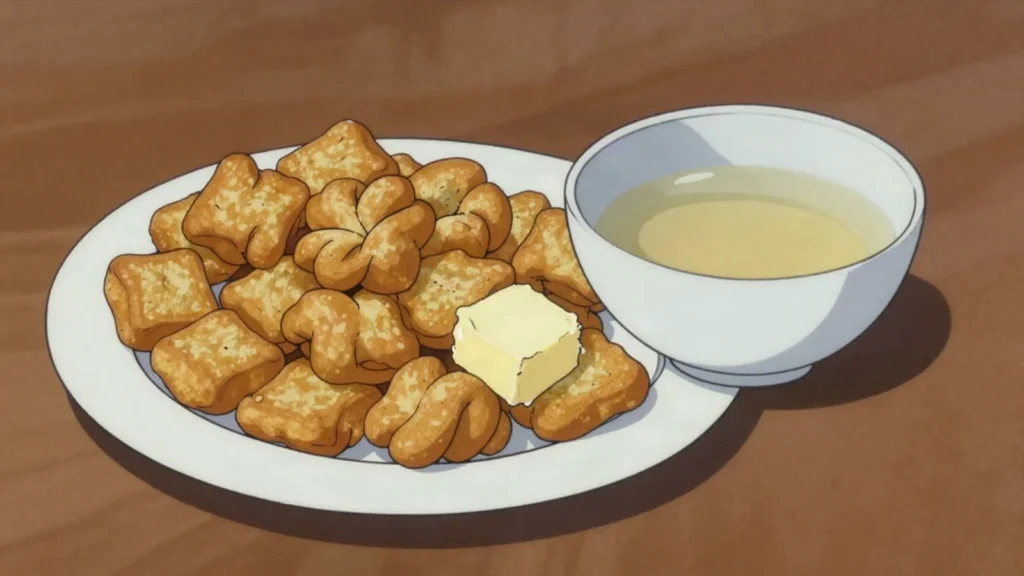
- Cut a slit down the centre of each strip and pull one end back through it to make the twist, or leave them as plain rectangles if you would rather.
- Heat the oil to 170°C (340°F), which is a little cooler than you would use for a yeasted dough, because this one has sugar in it and colours faster.
- Fry for 3 to 4 minutes, turning once, until deep gold. They will not puff hollow and are not meant to: they should be crisp outside and short inside.
- Drain on a rack and let them cool. They firm up considerably as they cool.
- Serve with fresh butter and öröm, dunked into salty milk tea. For Tsagaan Sar they are stacked into ul boov, the layered tower that stands on the table, always in an odd number of tiers.
Technique
- Firm dough, rubbed-in butter, cooler oil. Treat it like shortcrust rather than like bread.
- They keep well in a tin for a week, which is why they were a travelling food.
- Do not crowd the pan. Sweet dough drops the oil temperature fast and then absorbs it.
Substitutions
- Mutton fat for frying, which is traditional and gives a distinctly different flavour.
- Half the sugar for a plainer version eaten with meat rather than tea.
Variations
- Tossed in sugar while still warm.
- Kyrgyz boorsok, yeasted and puffed hollow.
- Cut into small cubes and eaten by the handful with tea.
History
Small pieces of fried dough, made from a simple wheat flour, milk or water and fat dough shaped into various forms before frying, developed across Mongolian nomadic cooking as a practical fried bread requiring minimal equipment beyond a pot of hot fat, well suited to preparation in a mobile, non-permanent household setting. It carries particular ceremonial significance tied to Tsagaan Sar, the Mongolian Lunar New Year, when large quantities are traditionally fried in advance and stacked into a specific pyramid-like arrangement as part of the holiday’s ceremonial food display, a custom documented across generations of Mongolian New Year celebration. Closely related fried dough dishes under similar names exist across other Central Asian and Turkic cultures, reflecting shared nomadic and trade-route culinary history rather than an isolated Mongolian invention.
Frequently asked questions
What is Boortsog?
Boortsog is a bread & pastry from Mongolia: fried dough pieces eaten with butter, sugar or dipped in milk tea. Small pieces of fried dough, made from a simple wheat flour, milk or water and fat dough shaped into various forms before frying, developed across Mongolian nomadic cooking as a practical fried bread requiring minimal equipment beyond a pot of hot fat, well suited to preparation in a mobile, non-permanent household setting. It carries particular ceremonial significance tied to Tsagaan Sar, the Mongolian Lunar New Year, when large quantities are traditionally fried in advance and stacked into a specific pyramid-like arrangement as part of the holiday’s ceremonial food display, a custom documented across generations of Mongolian New Year celebration. Closely related fried dough dishes under similar names exist across other Central Asian and Turkic cultures, reflecting shared nomadic and trade-route culinary history rather than an isolated Mongolian invention.
How long does Boortsog take to make?
Boortsog takes 20 min plus 30 min resting of preparation and 25 min of cooking. The recipe makes 40 pieces. It is rated easy to make.
What can I substitute in Boortsog?
Yes, within limits. Mutton fat for frying, which is traditional and gives a distinctly different flavour. Half the sugar for a plainer version eaten with meat rather than tea.
What is the most important thing to get right in Boortsog?
Rub the softened butter into the flour, sugar, salt and baking powder with your fingertips until the mixture looks like coarse crumbs. Rubbing the fat in rather than melting it is what gives boortsog its short, biscuity break, and it is the main difference from the puffier fried breads further west.