
Ingredients
Porridge
- 800 gfloury potatoes, peeled and cut into 3 cm chunks
- 1.2 litreswater
- 2 tspsalt
- 250 gcoarse yellow cornmeal (kukuruzno brasno)
To beat in
- 200 gkajmak (young, soft, salted skimmed cream)
- 150 gyoung Njegusi cow’s cheese, crumbled
- 60 gbutter
To serve
- 80 gkajmak, at room temperature
- Sour milk (kiselo mlijeko) or a glass of buttermilk
Directions
- Boil the potatoes in the salted water in a wide heavy pot over medium heat for 20 minutes, until a knife slides through with no resistance. Do not drain them.
- Crush the potatoes coarsely in their own water with a wooden masher so you have a loose, lumpy soup at about the thickness of single cream.
- Lower the heat. Rain the cornmeal in through your fingers in a steady thin stream while stirring hard in one direction with a wooden spoon, so no lumps form.
- Cook uncovered on low heat for 15–20 minutes, stirring every couple of minutes and scraping the base. It is ready when the mass pulls away from the sides of the pot and the raw maize smell has gone.
- Add the kajmak, the crumbled cheese and the butter in three lots, off direct heat, folding each in before the next.
- Now beat it: work the porridge hard with the wooden spoon for 5–8 minutes, lifting and slapping it against the side of the pot. It will turn glossy, elastic and start to string when you pull the spoon up.
- Return it to low heat for 2 minutes so the fat pools slightly at the edges, which is the sign the Montenegrin cooks look for.
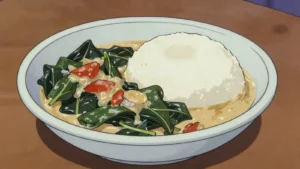
- Spoon into warm bowls, press a hollow in each and drop in a spoonful of cold kajmak so it melts into a pool. Serve at once with sour milk.
- Eat straight away from the shared pot if you can; kačamak stiffens as it cools and cannot be properly reheated.
Technique
- The beating is the dish. Fat and starch have to be worked together until they string, and a batch that is only stirred stays grainy and dull.
- Use coarse stone-ground maize, not fine polenta flour. Fine flour turns to glue and loses the slight bite that carries the cheese.
- Keep the potato cooking water. It is starchy and salted, and it is the liquid the maize swells in; fresh water gives a thinner, blander result.
- In the Njegusi and Katun highlands this is a shepherd’s and a feast dish at the same time, made on a wood stove in a copper pot and eaten with everyone digging into the middle.
Substitutions
- No kajmak: use 200 g thick clotted cream mixed with ½ tsp salt, or full-fat mascarpone loosened with a little sour cream.
- Young Njegusi cheese can be replaced by a mild fresh sheep’s cheese or a young feta rinsed of excess brine.
- For a fully cow-free version common in the mountains, use sheep’s milk cheese and sheep’s kajmak throughout.
Variations
- Cicvara, the close cousin, made with maize cooked directly in kajmak with no potato.
- Kačamak sa sirom, beaten with a much higher proportion of cheese for a stringier, richer bowl.
- Popara-style leftovers, sliced cold the next day and fried in butter.
History
Maize or potato porridge beaten with cheese and kajmak, the staple of Montenegro’s northern highlands.
Frequently asked questions
What is Kačamak?
Kačamak is a main from Montenegro: potato-cornmeal porridge beaten with kajmak and cheese. Maize or potato porridge beaten with cheese and kajmak, the staple of Montenegro’s northern highlands.
How long does Kačamak take to make?
Kačamak takes 15 min of preparation and 40 min of cooking. The recipe makes 4 servings. It is rated medium to make.
What can I substitute in Kačamak?
Yes, within limits. No kajmak: use 200 g thick clotted cream mixed with ½ tsp salt, or full-fat mascarpone loosened with a little sour cream. Young Njegusi cheese can be replaced by a mild fresh sheep’s cheese or a young feta rinsed of excess brine. For a fully cow-free version common in the mountains, use sheep’s milk cheese and sheep’s kajmak throughout.
What is the most important thing to get right in Kačamak?
Boil the potatoes in the salted water in a wide heavy pot over medium heat for 20 minutes, until a knife slides through with no resistance. Do not drain them.