
Ingredients
Rice
- 600 glong-grain rice
- 1 tbspturmeric or achiote
- 1 litrechicken stock
- 3 tbsplard or oil
- 1onion, chopped
- 4 clovesgarlic
- 1 tspground cumin
- salt
Chicken
- 6chicken thighs or drumsticks
- 1 tbspcumin
- 1 tspturmeric
- salt
- black pepper
Per juane
- 1egg, hard-boiled and halved
- 2black olives
- 1 sprigsacha culantro
Wrapping
- 12bijao leaves, softened
- kitchen string
Also
- 4eggs, beaten
Directions
- Season and brown the chicken pieces, then simmer them in stock for 30 minutes until just cooked, and keep the stock.
- Fry the onion, garlic and cumin in the lard, add the rice and turmeric, and turn it in the fat.
- Cook the rice in the chicken stock until just done but still firm, about 15 minutes, then cool it.
- Undercook the rice slightly. It steams again inside the leaf for an hour and finishes there, and fully cooked rice turns to paste.
- Beat the eggs and fold them thoroughly through the cooled rice.
- The beaten egg is what binds it. Without it the juane collapses into loose rice the moment the leaf is opened, and the round shape is the whole identity of the dish.
- Pass the bijao leaves briefly over a flame or through boiling water until they turn glossy and pliable.
- Soften the leaves first or they crack along the spine as you fold, and the parcel leaks.
- Lay two leaves in a cross, shiny side up.
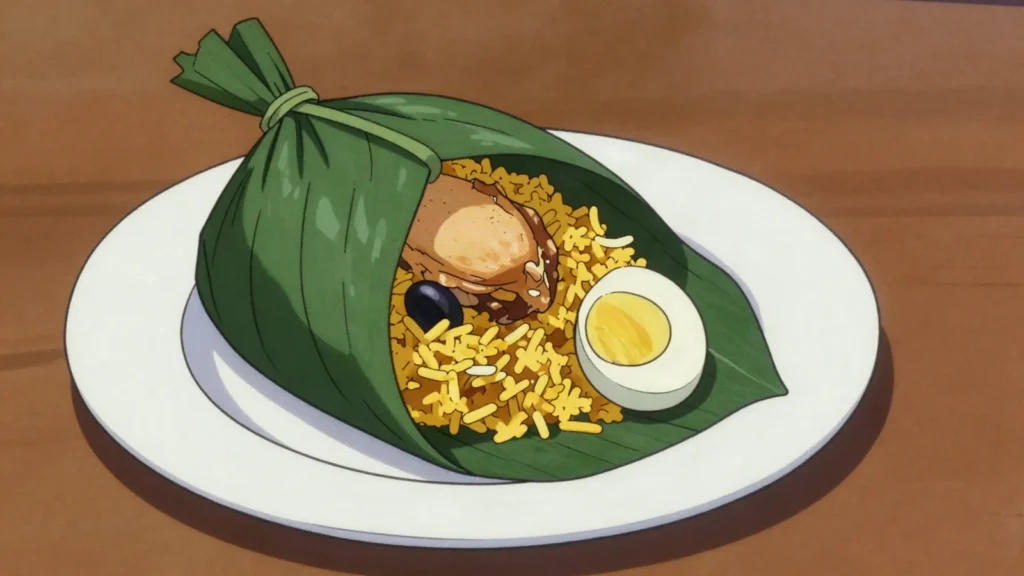
- Put a mound of rice in the centre, press a hollow into it, and bury a piece of chicken, half an egg, two olives and a sprig of sacha culantro inside.
- Cover with more rice and shape the whole thing into a ball with wet hands.
- Fold the leaves up and over the ball, one at a time, and tie the bundle firmly at the top with string.
- Tie it tight. A loose parcel takes on water in the pot and the juane comes out sodden.
- Lower the parcels into boiling water and simmer for 45 minutes to an hour.
- Lift them out and let them stand 10 minutes before untying.
- Serve in the leaf, opened at the table, with the leaf as the plate.
- It is jungle festival food, eaten at the Fiesta de San Juan on 24 June across the Peruvian Amazon, and the round shape is said to recall the head of John the Baptist.
Technique
- Bijao leaf gives a distinct grassy aroma that banana leaf does not quite match.
- Sacha culantro is a strong Amazonian herb and coriander is a weak stand-in.
- They travel well and are made to be carried, which is why they are wrapped at all.
Substitutions
- Banana leaf in place of bijao.
- Achiote oil instead of turmeric, which is more traditional.
Variations
- Juane de yuca, made with cassava instead of rice.
- Nina juane, made with egg and chicken and no rice at all.
- With more olives and a whole egg per parcel.
History
Rice mixed with chicken and olive, wrapped in bijao leaf and steamed, most closely associated with Peru’s Amazon region and specifically with the Feast of Saint John the Baptist, celebrated each June, a Catholic religious holiday layered onto the dish’s Amazonian regional identity through Spanish colonial-era religious influence. Its name is generally thought to reference John the Baptist directly, tying the dish specifically to that saint’s feast day rather than being eaten with any regularity outside that particular calendar occasion in many households. The bijao leaf wrapping, sealing the rice and chicken filling before steaming, reflects broader Amazonian and wider Latin American techniques of using large local leaves as natural, biodegradable cooking vessels, similar in principle to banana-leaf-wrapped dishes found across the wider tropical Americas.
Frequently asked questions
What is Juane?
Juane is a main from Peru: rice, chicken and olives steamed in bijao leaf, jungle festival dish. Rice mixed with chicken and olive, wrapped in bijao leaf and steamed, most closely associated with Peru’s Amazon region and specifically with the Feast of Saint John the Baptist, celebrated each June, a Catholic religious holiday layered onto the dish’s Amazonian regional identity through Spanish colonial-era religious influence. Its name is generally thought to reference John the Baptist directly, tying the dish specifically to that saint’s feast day rather than being eaten with any regularity outside that particular calendar occasion in many households. The bijao leaf wrapping, sealing the rice and chicken filling before steaming, reflects broader Amazonian and wider Latin American techniques of using large local leaves as natural, biodegradable cooking vessels, similar in principle to banana-leaf-wrapped dishes found across the wider tropical Americas.
How long does Juane take to make?
Juane takes 1 hr of preparation and 1 hr 30 min of cooking. The recipe makes 6 juanes. It is rated hard to make.
What can I substitute in Juane?
Yes, within limits. Banana leaf in place of bijao. Achiote oil instead of turmeric, which is more traditional.
What is the most important thing to get right in Juane?
The beaten egg is what binds it. Without it the juane collapses into loose rice the moment the leaf is opened, and the round shape is the whole identity of the dish.