
Ingredients
Lamb
- 1leg or shoulder of lamb, about 2.5 kg
Rub
- 2 tbsphawaij for meat
- 1 tbspground cumin
- 1 tbspground coriander
- 1 tspturmeric
- 1 tspblack pepper
- 1 tspground cardamom
- 6 clovesgarlic, crushed
- 2 tbspsalt
- 3 tbspghee
- juice of 1 lemon
To serve
- rice
- sahawiq
- flatbread
Directions
- Score the lamb deeply, right down to the bone in places.
- Score it deep. The rub has to reach the inside of the joint, and a surface rub on a shoulder this size seasons almost nothing.
- Mix the rub and work it into every cut and crevice with your hands.
- Cover and refrigerate overnight, and a full day is better still.
- Take it out an hour before cooking so that it is not fridge-cold going into the oven.
- Wrap the lamb tightly in two layers of foil, or in banana leaf and then foil.
- Sit it on a rack over a tray with a little water in the bottom and put it into the oven at 150°C (300°F).
- Roast it wrapped for 4 to 5 hours.
- Low and wrapped is the whole method. The traditional taboon is a clay pit oven where the meat cooks for hours in its own steam, and the foil is the domestic version of that sealed pit.
- Test it by twisting a bone: it should turn freely and the meat should come away with no resistance at all.
- Unwrap the joint, pour off and keep the juices, and raise the oven to 230°C (445°F).
- Return it uncovered for 15 to 20 minutes, to dry and brown the surface.
- Haneeth is meant to be dry on the outside, which is exactly where it differs from mandi and madfun, and the name itself points at that finish.
- Rest it for 15 minutes, loosely tented, which lets the juices settle back before you pull it apart.
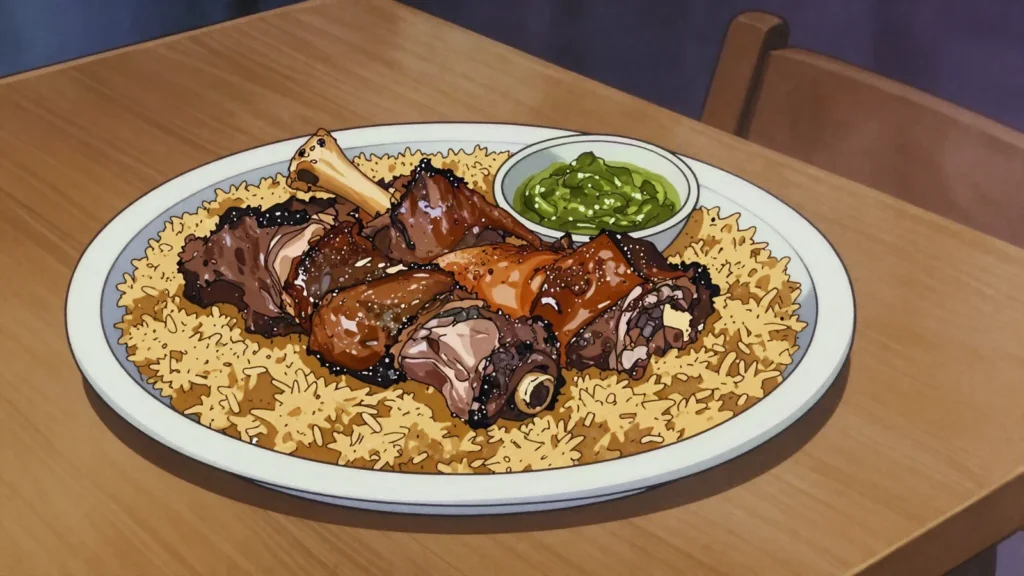
- Pull the meat off in large pieces, spoon a little of the reserved juice over, and serve it on a platter of rice with sahawiq and bread.
- It is a Hadhrami speciality from eastern Yemen, and the whole region cooks it when there are guests.
Technique
- Hawaij for meat, not the coffee blend. There is a recipe for both under Hawaij, and they are not interchangeable.
- Mandi is cooked over embers with rice underneath and comes out moister; haneeth is dry-finished, and that is the distinction.
- It is eaten with the right hand from a shared platter set in the middle of the group.
Substitutions
- Goat, which is just as traditional and takes the same timings.
- A slow cooker for the wrapped stage, though the browning still needs a hot oven.
Variations
- Mandi, cooked in a pit with the rice beneath the meat.
- Madfun, buried in the ground to cook.
- Given a smoked finish with a hot coal and a little oil under the lid.
History
Marinated lamb roasted in a clay pit oven until dry and tender, a Hadhrami speciality.
Frequently asked questions
What is Haneeth?
Haneeth is a main from Yemen: slow-roasted seasoned lamb, falling off the bone. Marinated lamb roasted in a clay pit oven until dry and tender, a Hadhrami speciality.
How long does Haneeth take to make?
Haneeth takes 20 min plus overnight marinating of preparation and 5 hr 30 min of cooking. The recipe makes 8 servings. It is rated medium to make.
What can I substitute in Haneeth?
Yes, within limits. Goat, which is just as traditional and takes the same timings. A slow cooker for the wrapped stage, though the browning still needs a hot oven.
What is the most important thing to get right in Haneeth?
Low and wrapped is the whole method. The traditional taboon is a clay pit oven where the meat cooks for hours in its own steam, and the foil is the domestic version of that sealed pit.