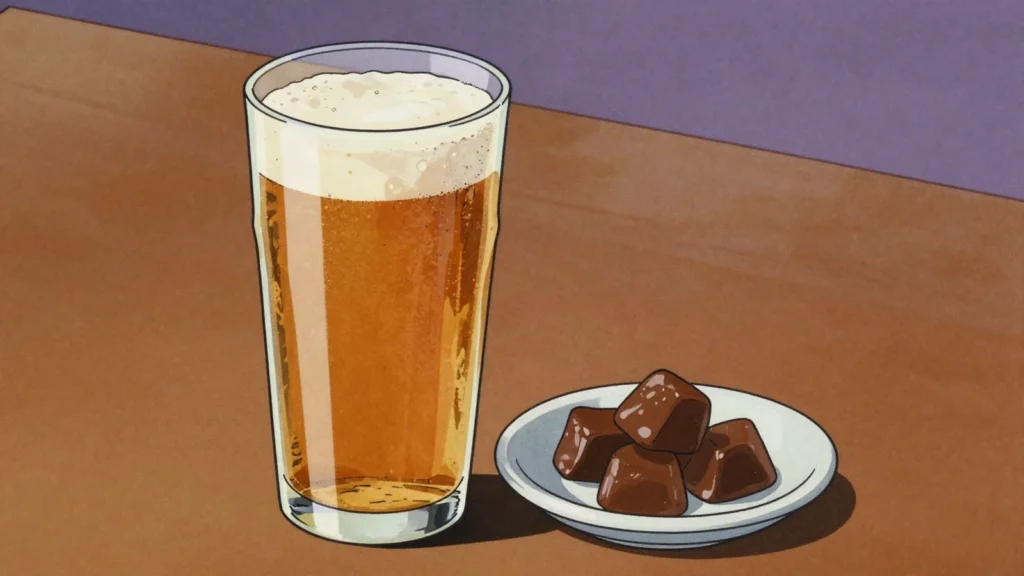

Ingredients
The beer
- 1 bottlelambic or young gueuze
- or a bottled faro, if you can find one
- see the note
The sweetening
- brown candy sugar
- candi, in lumps or crystals
- or dark muscovado sugar
- or a spoon of candy sugar syrup
- to taste, start with one lump
Optional
- a small pinch of ground coriander
- or a pinch of cinnamon
- historically used, see the note
To serve
- in a tumbler
- at 8 to 12 degrees
- stirred until dissolved
Directions
- Use brown candy sugar.
- Pour the beer into a tumbler.
- Pour it steadily and leave the sediment behind.
- Add one lump, or a level teaspoon.
- Stir until it dissolves. A lump takes a while to dissolve in cold beer.
- Taste before adding more. Cold mutes the sourness and the sugar both.
Technique
- Never add sugar to a sealed bottle of live beer. Bottle-conditioned beer contains living yeast, sugar gives it something to eat, and the carbon dioxide it produces has nowhere to go in a sealed bottle — the bottle can burst, and glass under pressure is genuinely dangerous. Sweeten it in the glass at the moment of drinking.
- Commercial bottled faro is pasteurised or filtered for exactly that reason: the yeast has to be killed or removed before sugar is added, or the bottles would referment. That is a production necessity rather than a choice, and it is also why bottled faro tastes flatter than a freshly sweetened glass.
- Sweetening at the table is genuine historical practice — sugar was put out in Brussels cafés for it — which is why this is one of the few beer entries with a real method in it. The method is not brewing; it is what a drinker did with a glass.
- Taste before adding more. Lambics differ enormously in sourness, and one lump transforms a mild one while barely touching a sharp one. Aim for lightly sweet with the sourness still present — over-sweetened it loses the point entirely, since the sourness is what makes it interesting.
- Stirring knocks the carbonation out, and that is expected. Faro is not a fizzy drink.
- Dark candy sugar carries caramel and slight fruit notes where white sugar just adds sweetness. Candy sugar syrup dissolves immediately, which is the easiest route; a lump takes a while in cold beer, and some drinkers crush it first while others let it dissolve as they drink.
- Serve it at eight to twelve degrees. Cold mutes the sourness and the sugar both; too warm and the acid dominates.
- Coriander and cinnamon are documented historically, but practice varied and records are patchy — the atlas records that they are attested without claiming a standard recipe. A very small pinch is plenty, since spice overwhelms a light beer immediately.
- It was built historically from a weaker second brew blended with lambic and sweetened. Running a second, weaker wort from the same grain was a standard economy across Europe, giving a light beer for daily drinking.
- Faro faded almost completely when cheap lager arrived and took its place. A few lambic houses still bottle one, and it is much rarer than gueuze or kriek.
- It is a minor beer with a real history rather than one of the great ones, and the atlas says so rather than inflating it. It is also genuinely pleasant, genuinely easy, and the friendliest way into the lambic family for anyone who finds gueuze too sour.
- A sweetened beer still contains alcohol. It tastes like a soft drink and it is not one, which catches people out and catches children out.
- Drink a sweetened glass straight away — it goes flat and cloying as it stands.
- Do not drink alcohol if you are pregnant or driving.
Substitutions
- A young gueuze replaces straight lambic as the base.
- Dark muscovado, demerara or plain white sugar replace candy sugar.
- Candy sugar syrup dissolves instantly and is easiest.
- A commercial sweetened geuze is faro’s nearest ready-made equivalent.
- Kriek is the fruit-sweetened member of the same family.
- Cloudy apple juice with a splash of gueuze is the low-alcohol approximation.
Variations
- Bottled faro from a lambic house is pasteurised and ready sweetened.
- Sweetened at the table from a fresh lambic is the historical form.
- A spiced faro with coriander or cinnamon follows old practice.
- Kriek sweetens lambic with cherries instead.
- Gueuze is the unsweetened blended version.
- Mars was the weak second-runnings beer faro was often built on.
History
A Brussels working-class beer of the eighteenth and nineteenth centuries, sweeter and weaker than gueuze.
Frequently asked questions
What is Faro?
Faro is a wine & spirit from Belgium: lambic sweetened with candy sugar, low in alcohol and lightly sour. A Brussels working-class beer of the eighteenth and nineteenth centuries, sweeter and weaker than gueuze.
How long does Faro take to make?
Faro takes 3 minutes of preparation and none of cooking. The recipe makes serves 1. It is rated easy to make.
What can I substitute in Faro?
Yes, within limits. A young gueuze replaces straight lambic as the base. Dark muscovado, demerara or plain white sugar replace candy sugar. Candy sugar syrup dissolves instantly and is easiest. A commercial sweetened geuze is faro’s nearest ready-made equivalent. Kriek is the fruit-sweetened member of the same family. Cloudy apple juice with a splash of gueuze is the low-alcohol approximation.
What is the most important thing to get right in Faro?
Never add sugar to a sealed bottle of live beer. Bottle-conditioned beer contains living yeast, sugar gives it something to eat, and the carbon dioxide it produces has nowhere to go in a sealed bottle — the bottle can burst, and glass under pressure is genuinely dangerous. Sweeten it in the glass at the moment of drinking.