
Ingredients
Milk and cultures
- 330 litresraw evening milk, rested overnight in shallow vats and skimmed of its risen cream
- 220 litresraw whole morning milk, at most 2 hours from the cow
- 7 litressiero-innesto, the natural whey starter kept from yesterday and soured overnight to pH 3.3
- 80 mlliquid calf rennet
Salting and curing
- saturated brine, about 33 g salt per 100 ml water, held at 15–16°C (60–60°F)
- one copper-lined bell-shaped vat (caldaia) per 2 wheels
- 1spino (the traditional whisk) and 1 pala
- 2fascere, the marking bands that print the pin-dot name into the rind
To serve
- 300 gParmigiano Reggiano, 24 months, at room temperature
- 1tagliaparmigiano, the almond-shaped splitting knife
Directions
- Pour the skimmed evening milk and the whole morning milk into the copper vat. The partial skimming sets the fat at roughly 2.4 percent and is the reason the cheese can survive three years without going rancid.
- Stir in the whey starter and warm the vat to 33°C (90°F) over a direct flame, then add the rennet. The milk sets in 10–12 minutes.
- Break the curd with the spino into grains the size of rice, working fast and evenly, about 8 minutes. Grain size decides moisture; too coarse and the wheel will never dry into crystals.
- Cook the grains up to 55°C (130°F) over roughly 10 minutes and hold, stirring, until a squeezed handful knits into a springy ball, another 45–60 minutes.
- Let the mass settle and rest under the hot whey for 50–60 minutes so it welds into one slab on the vat floor.
- Lift the slab on a linen cloth, cut it in two twins, and hoop each half in a fascera. Turn the cheeses in cloth several times over the next 2 days, applying the casein plate and the dotted band that names, dates and numbers the wheel.
- Float the wheels in saturated brine at 15–16°C (60–60°F) for 20–25 days, turning them. This is the only salt the cheese ever gets, and it enters purely by osmosis.
- Age on wooden boards at 16–18°C (60–65°F) and 85 percent humidity, brushing and turning every week or two. At 12 months the consortium inspector sounds each wheel with a hammer; only the clean-ringing ones are fire-branded.
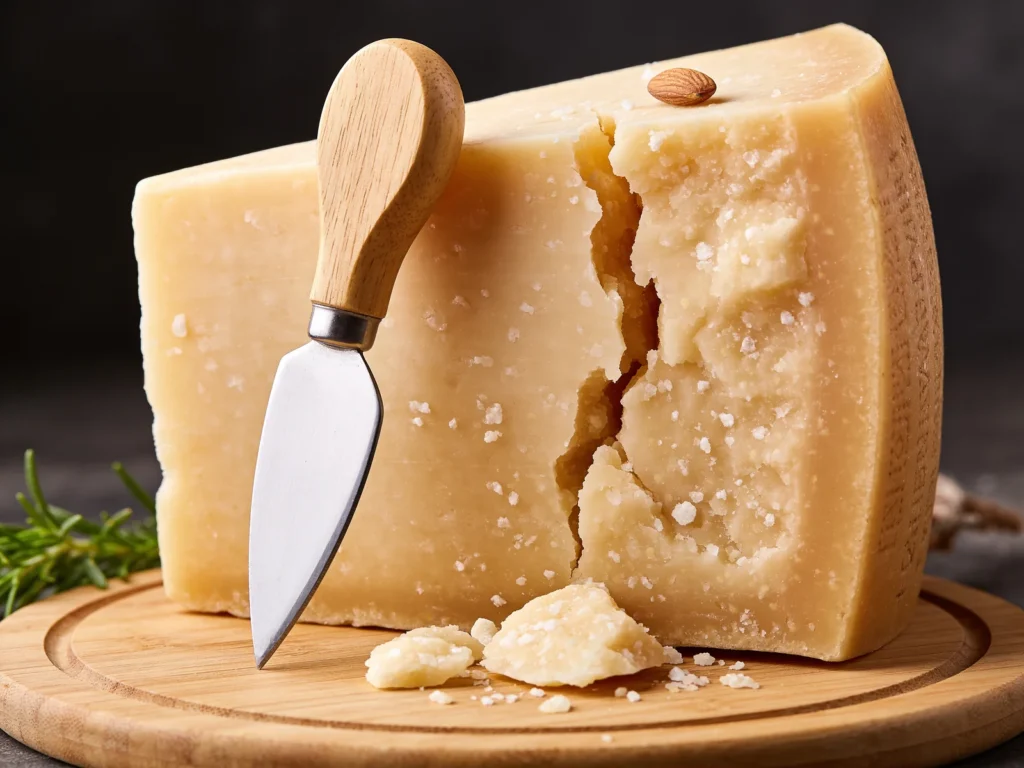
- To serve, never grate a good wheel with a fine rasp. Split the piece into rough shards along its grain with the almond knife so the crunchy tyrosine crystals stay intact.
Technique
- Only raw milk from cows fed hay and fresh forage inside the DOP zone of Parma, Reggio Emilia, Modena, Bologna west of the Reno and Mantua south of the Po may be used. Silage is banned because it carries clostridia spores that would blow the wheel.
- The white crunch in aged Parmigiano is tyrosine, an amino acid crystal thrown out by long protein breakdown. It is proof of age, not salt.
- The traditional coagulant is calf rennet, so a DOP wheel is not vegetarian. There is no DOP-legal microbial version.
- The rind is edible and full of flavour: drop a piece into minestrone or a stock pot rather than binning it.
Substitutions
- You cannot make DOP Parmigiano outside the zone, and a 40 kg wheel needs a copper vat. To cook with, Grana Padano is the closest legal cousin: younger, milder, made from once-daily milk and permitted to use lysozyme.
- For a vegetarian hard grating cheese use an Italian-style grana made with microbial rennet, and accept a softer, less crystalline texture.
Variations
- Vacche Rosse, made only from the ancient red Reggiana breed and usually aged 30 months or more.
- Parmigiano Reggiano di Montagna, from herds above 600 m, and mezzano, a wheel with small flaws that still tastes superb.
History
Made to a method described in the thirteenth century by Benedictine and Cistercian monks near Parma and Reggio; DOP rules still limit it to five provinces.
Frequently asked questions
What is Parmigiano Reggiano?
Parmigiano Reggiano is a cheese & dairy from Italy: hard cow’s-milk cheese aged one to three years, grated or eaten in shards. Made to a method described in the thirteenth century by Benedictine and Cistercian monks near Parma and Reggio; DOP rules still limit it to five provinces.
How long does Parmigiano Reggiano take to make?
Parmigiano Reggiano takes 3 hr in the dairy of preparation and 12 to 36 months ageing of cooking. The recipe makes 1 wheel of about 38–40 kg, from 550 litres of milk. It is rated hard to make.
What can I substitute in Parmigiano Reggiano?
Yes, within limits. You cannot make DOP Parmigiano outside the zone, and a 40 kg wheel needs a copper vat. To cook with, Grana Padano is the closest legal cousin: younger, milder, made from once-daily milk and permitted to use lysozyme. For a vegetarian hard grating cheese use an Italian-style grana made with microbial rennet, and accept a softer, less crystalline texture.
What is the most important thing to get right in Parmigiano Reggiano?
Pour the skimmed evening milk and the whole morning milk into the copper vat. The partial skimming sets the fat at roughly 2.4 percent and is the reason the cheese can survive three years without going rancid.