
Ingredients
Curd
- 3 litressoured milk, or 2 litres yoghurt thinned with 1 litre milk
- 1 tspsalt, optional
Equipment
- muslin
- flat boards or trays
- netting, to keep flies off
Directions
- Warm the soured milk gently to about 45°C (113°F) without stirring, until the curd separates cleanly from the greenish whey. Do not let it get hotter — above 55°C (131°F) the curd tightens into hard grains.
- Ladle the curd into a muslin-lined sieve and hang it to drain for a full day, then press it under a weight for a second day. It must end up genuinely dry and firm, not merely thick.
- Salt it lightly if you want a savoury aaruul; many Mongolian households leave it plain or add a little sugar.
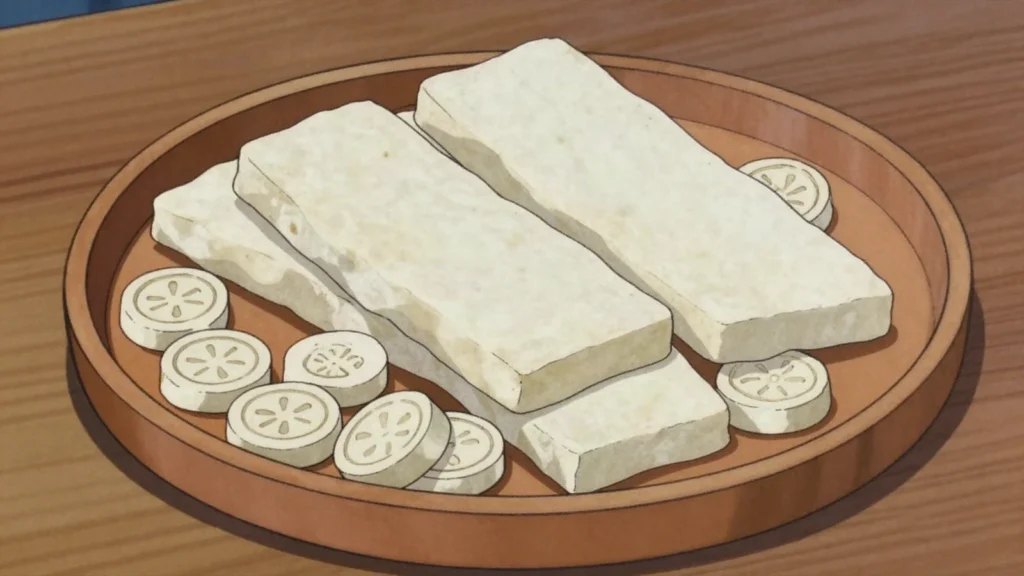
- Press the curd into a slab about 1 cm thick and cut it into squares, strips or lozenges — or press it through a mould, which is how the patterned pieces are made.
- Lay the pieces on boards in a single layer, cover with netting against flies, and dry them in the sun. On the steppe they go on the roof of the ger.
- Turn them daily. Over one to three weeks they shrink, harden and pale. They are ready when they are rock hard and click against each other — a piece still yielding in the middle will mould.
- Store in a cloth bag somewhere dry. They keep for years, which is the whole point.
- Eat by sucking or gnawing slowly, or drop a piece into hot milk tea to soften.
Technique
- Dry until genuinely hard. This decides whether the batch survives, and it is what people cut short.
- Thin pieces dry evenly; thick ones stay soft in the middle and spoil.
- It is meant to be extremely hard. This is not a failure — it is designed to be sucked, not chewed.
Substitutions
- Yoghurt in place of soured milk, which is the practical route.
- A dehydrator at 50°C (122°F) where the weather will not oblige.
- A little sugar worked in for a sweet aaruul.
Variations
- Kazakh kurt, Kyrgyz kurut and Uzbek qurt are the same food, usually rolled into balls rather than cut into slabs.
- Some households press the curd into carved wooden moulds so each piece carries a pattern.
History
Dried curds made from strained, soured milk, pressed and dried in the sun, sometimes for several days, until hard enough to store for extended periods without spoiling, developed by Mongolian nomadic herders as a practical way to preserve a large seasonal surplus of milk, produced heavily in summer months, into a durable, portable food that could be eaten through winter and during travel when fresh dairy was unavailable. Its texture, often quite hard and requiring real effort to chew or suck on slowly, is considered a normal, expected feature of properly made aaruul rather than a flaw, and different regions and households vary the exact milk source, cow, goat, sheep or yak, and slight preparation method used. It remains a common snack food across Mongolia, particularly associated with rural and herding households.
Frequently asked questions
What is Aaruul?
Aaruul is a cheese & dairy from Mongolia: rock-hard sun-dried sour milk curds, herders’ travel food. Dried curds made from strained, soured milk, pressed and dried in the sun, sometimes for several days, until hard enough to store for extended periods without spoiling, developed by Mongolian nomadic herders as a practical way to preserve a large seasonal surplus of milk, produced heavily in summer months, into a durable, portable food that could be eaten through winter and during travel when fresh dairy was unavailable. Its texture, often quite hard and requiring real effort to chew or suck on slowly, is considered a normal, expected feature of properly made aaruul rather than a flaw, and different regions and households vary the exact milk source, cow, goat, sheep or yak, and slight preparation method used. It remains a common snack food across Mongolia, particularly associated with rural and herding households.
How long does Aaruul take to make?
Aaruul takes 40 min plus 2 days draining and 1 to 3 weeks drying of preparation and 30 min of cooking. The recipe makes makes about 500 g. It is rated easy to make.
What can I substitute in Aaruul?
Yes, within limits. Yoghurt in place of soured milk, which is the practical route. A dehydrator at 50°C (122°F) where the weather will not oblige. A little sugar worked in for a sweet aaruul.
What is the most important thing to get right in Aaruul?
Warm the soured milk gently to about 45°C (113°F) without stirring, until the curd separates cleanly from the greenish whey. Do not let it get hotter — above 55°C (131°F) the curd tightens into hard grains.