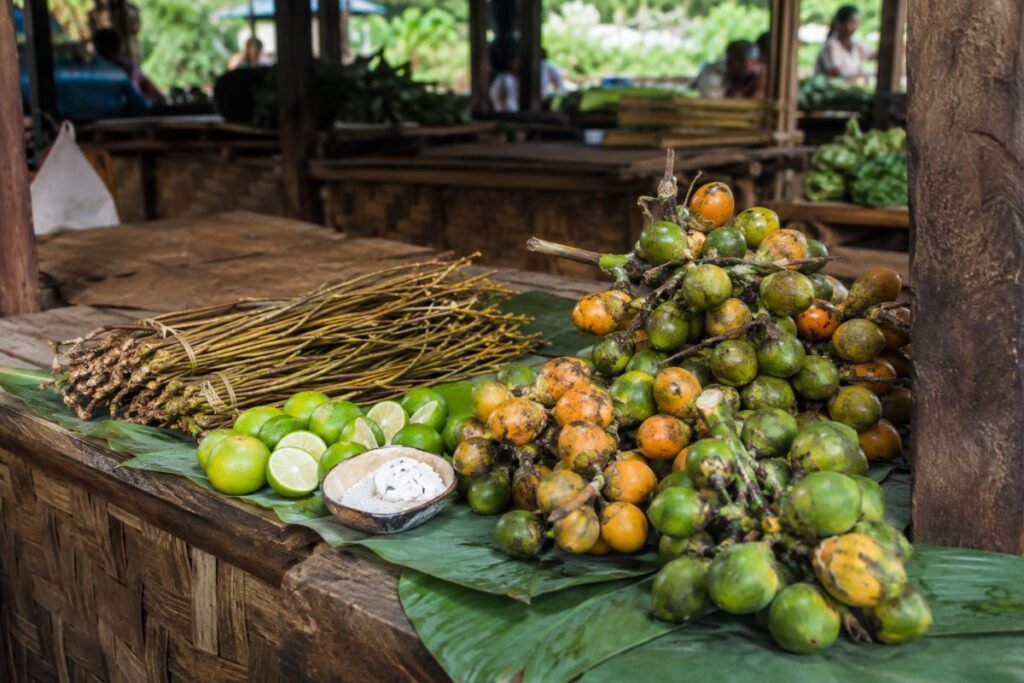

Ingredients
The chew
- 1fresh green areca nut (buai), the young soft-kernel type preferred in Papua New Guinea
- 1daka – the green catkin or fruit spike of the betel pepper vine, Piper betle
- 1 pinchslaked lime powder (kambang), made by burning coral or shells and slaking the ash with water
- a small cup or tube of the lime, with a spatula stick
Directions
- Choose a young green areca nut, firm but not hard. Nuts are sold by the string at every market in Port Moresby and Lae, graded by size and freshness.
- Bite or peel off the fibrous green husk with the teeth and discard it, leaving the pale soft kernel.
- Put the whole kernel into the mouth and chew it slowly, working it to a coarse pulp against the molars. It tastes bitter, astringent and slightly numbing at this stage.
- Take the daka stick, dip its tip into the powdered slaked lime, and knock off the excess. The amount is judged by eye and is small – a matchhead or so.
- Bite off the limed tip of the daka and chew it into the pulp already in the mouth. Do not tip lime directly into the mouth; the stick is what meters it.
- Within seconds the chemistry changes: the alkaline lime frees the arecoline from the nut and the mixture turns bright blood-red. Keep chewing and the red juice builds.
- Chew for 5–15 minutes, spitting the red juice out on the ground – never swallowing it – and keeping the quid in the cheek between chews. A warm flush, mild stimulation and increased salivation follow.
- Spit out the spent quid at the end. Offering buai to a guest, or sharing a string of it, is a basic act of hospitality across Papua New Guinea, and it functions socially the way a shared cigarette or a round of drinks does elsewhere.
Technique
- Areca nut is a Group 1 human carcinogen. Regular chewing is strongly linked to oral, pharyngeal and oesophageal cancer, oral submucous fibrosis and tooth loss, and it is addictive. This is a description of a genuine cultural practice, not a recommendation.
- The lime is caustic. Too much burns the mouth and lips immediately, which is why it is metered on the tip of the daka rather than poured. Never swallow the juice.
- Buai staining is why so many mouths and pavements in PNG are red. Port Moresby banned public sale and spitting in 2013, a hugely contentious policy, and the trade largely moved to informal markets.
Substitutions
- Where fresh green nuts are unavailable, dried areca nut is sold across Asia and is chewed the same way but is much harder and more astringent.
- Where betel pepper catkin is unavailable, chewers use a betel leaf smeared with lime instead, which is the standard South and Southeast Asian form of the same chew.
Variations
- Paan, the South Asian form, wrapped in a betel leaf with lime, catechu and sometimes tobacco or sweet fillings.
- The Solomon Islands and Vanuatu chew, essentially identical, using local nut and pepper.
- Highlands PNG chews using the larger, harder nut from lower altitudes, considered stronger.
History
Chewed nationwide and traded as informal currency; Port Moresby banned public sale and spitting in 2013, sparking street protests.
Frequently asked questions
What is Buai?
Buai is a snack from Papua New Guinea: betel nut chewed with mustard stick and lime, staining mouths bright red. Chewed nationwide and traded as informal currency; Port Moresby banned public sale and spitting in 2013, sparking street protests.
How long does Buai take to make?
Buai takes 2 min of preparation and none of cooking. The recipe makes 1 chew. It is rated easy to make.
What can I substitute in Buai?
Yes, within limits. Where fresh green nuts are unavailable, dried areca nut is sold across Asia and is chewed the same way but is much harder and more astringent. Where betel pepper catkin is unavailable, chewers use a betel leaf smeared with lime instead, which is the standard South and Southeast Asian form of the same chew.
What is the most important thing to get right in Buai?
Put the whole kernel into the mouth and chew it slowly, working it to a coarse pulp against the molars. It tastes bitter, astringent and slightly numbing at this stage.