
Ingredients
Curd (hrudka)
- 5 litresfresh ewe’s milk, at 32°C (90°F)
- 1.5 mlliquid rennet, diluted in 50 ml cool unchlorinated water
- ¼ tspmesophilic starter culture, or 100 ml live cultured buttermilk
Salting and kneading
- 20–28 gfine non-iodised salt (2.5–3.5 percent of the finished curd weight)
- 50–100 mlboiled and cooled water or whey, to adjust texture
To serve
- dark rye bread
- 1raw onion, thinly sliced
- 1 tspsweet paprika
Directions
- Warm the milk gently to 32°C (90°F), stir in the starter and hold 45 minutes so the milk acidifies to a faint tang.
- Stir in the diluted rennet with 20 up-and-down strokes, still the surface, cover and leave 40–50 minutes at 30–32°C (85–90°F) until you get a clean break: a finger lifted through the curd leaves a sharp edge and clear whey.
- Cut the curd into 2 cm cubes, rest 10 minutes, then stir slowly for 20 minutes until the pieces firm up and shrink to the size of hazelnuts.
- Ladle the curd into a cloth, gather and hang it to drain for 6–8 hours at room temperature. The compact drained lump is the hrudka.
- Ripen the wrapped hrudka on a board at 18–20°C (65–70°F) for 3 to 10 days, turning daily. It becomes softly acidic, smells sharply lactic and crumbles cleanly when broken.
- Grind or mince the ripened hrudka finely, or press it repeatedly through a coarse sieve.
- Weigh it, then knead in 2.5–3.5 percent of its weight in salt plus a little water or whey until it becomes a smooth, spreadable, gently sticky paste.
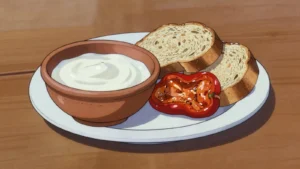
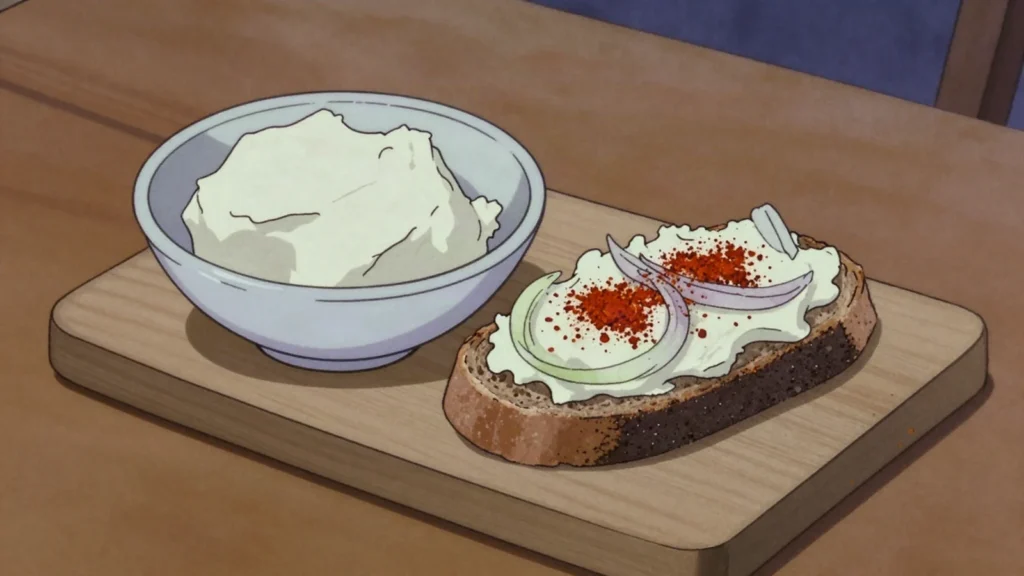
- Pack it airtight with no air pockets and refrigerate. Eat within 10–14 days, spread on rye with raw onion and paprika, or stirred through halusky.
Technique
- Slovenska bryndza is a protected designation and by tradition contains at least 50 percent ewe’s milk; a genuinely pure-sheep summer bryndza is made only during the grazing season and tastes markedly sharper.
- Food safety: authentic mountain bryndza is made from raw ewe’s milk, which carries real risk. If you cannot guarantee the animals and the milking hygiene, pasteurise at 63°C (145°F) for 30 minutes, cool to 32°C (90°F), then proceed and expect a milder cheese.
- The ripening stage is what makes bryndza taste of bryndza. Skip it and you have salted curd, not cheese; over-ripen it and it turns bitter and ammoniacal.
Substitutions
- Ewe’s milk is hard to buy: use 4 litres whole cow’s milk plus 1 litre goat’s milk for a closer tang, or full-fat cow’s milk alone for a mild imitation.
- Animal rennet can be replaced 1:1 with microbial rennet if you want the cheese suitable for vegetarians.
- At a pinch, mash a firm sheep’s feta with a splash of cream and a spoon of thick sour cream for a rough stand-in.
Variations
- Zincica, the sharp whey drink left over from the same process, drunk cold in the sheep huts.
- Ostiepok and korbacik, the smoked pressed cheeses made from the same curd when it is scalded instead of ripened.
History
Made from ewe’s milk at Tatra shepherd huts and first produced commercially in the eighteenth century; Slovenská bryndza won EU protection in 2008.
Frequently asked questions
What is Bryndza?
Bryndza is a cheese & dairy from Slovakia: soft, salty, spreadable sheep’s cheese stirred through halušky or spread on bread. Made from ewe’s milk at Tatra shepherd huts and first produced commercially in the eighteenth century; Slovenská bryndza won EU protection in 2008.
How long does Bryndza take to make?
Bryndza takes 40 min over 3 days of preparation and 10 days ripening of cooking. The recipe makes about 700 g cheese. It is rated hard to make.
What can I substitute in Bryndza?
Yes, within limits. Ewe’s milk is hard to buy: use 4 litres whole cow’s milk plus 1 litre goat’s milk for a closer tang, or full-fat cow’s milk alone for a mild imitation. Animal rennet can be replaced 1:1 with microbial rennet if you want the cheese suitable for vegetarians. At a pinch, mash a firm sheep’s feta with a splash of cream and a spoon of thick sour cream for a rough stand-in.