Ingredients
Fruit
- 2 kgripe guavas
- 500 mlwater
To set
- sugar, equal in weight to the strained pulp
- juice of 1 lemon
To wrap
- dried bijao leaves
- or baking paper
- or a lined shallow tin
To serve
- queso campesino, fresh white farmer cheese
- or a mild fresh cheese
- hot chocolate or coffee
Directions
- Wash all the guavas thoroughly. Trim off the stem and blossom ends. Cut them into rough even chunks. Do not peel or deseed them at this stage.
- Put the chunks in a heavy pot with the water. Bring the whole pot up to a simmer. Cover it and cook for about twenty-five minutes. The fruit should be completely soft and collapsing.
- Stir it occasionally as it cooks. Press it through with the back of a ladle. That takes real effort with guava. Discard the seeds and the coarse skin. Guava seeds are hard and must all come out.
- Use sugar equal to the weight of the pulp. It is what makes the paste set and keep. Return the pulp to a wide heavy pot. Add the sugar and the lemon juice. Stir over a low heat until the sugar dissolves. Now the stirring begins and does not stop.
- Stir it continuously with a long wooden spoon. A long spoon and a cloth over your hand help. Line a shallow tray with bijao leaves. Baking paper works if you have no leaves. Pour the hot paste into the tray. Spread it about two centimetres thick. Level the surface with a wet spatula.
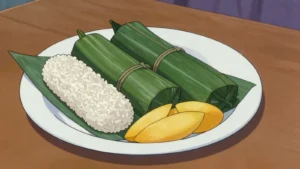
- Let it cool completely at room temperature. Cutting it is done once fully set. Cut it into small rectangular blocks. Use a knife dipped in hot water. Wrap each block in a piece of bijao leaf. That wrapping is traditional and helps it keep.
- Keep the wrapped blocks in a tin. They keep for months at room temperature. Cut a slice of the paste and a slice of cheese. Hot chocolate or coffee goes alongside.
Technique
- Bocadillo veleno holds a Colombian denomination of origin tying the name to producers in and around Velez in Santander.
- Bijao leaves are used across Colombia for wrapping food and give the paste a distinctive faint aroma.
Substitutions
- Baking paper can replace bijao leaves for wrapping, though the aroma is lost.
- Any mild fresh white cheese stands in for queso campesino.
Variations
- A version with arequipe layered through it is sold as bocadillo con arequipe.
- Some makers add a layer of guava paste of a different colour.
- Similar fruit pastes are made across Latin America and Iberia, including membrillo from quince.
History
Guava paste from Velez in Santander, wrapped in dried bijao leaves; its producers hold a Colombian denomination of origin.
Frequently asked questions
What is Bocadillo veleño?
Bocadillo veleño is a snack from Colombia: dense guava paste blocks eaten with white farmer cheese. Guava paste from Velez in Santander, wrapped in dried bijao leaves; its producers hold a Colombian denomination of origin.
How long does Bocadillo veleño take to make?
Bocadillo veleño takes 40 minutes of preparation and 1 hour 30 minutes of cooking. The recipe makes one tray, about 30 pieces. It is rated medium to make.
What can I substitute in Bocadillo veleño?
Yes, within limits. Baking paper can replace bijao leaves for wrapping, though the aroma is lost. Any mild fresh white cheese stands in for queso campesino.
What is the most important thing to get right in Bocadillo veleño?
Wash all the guavas thoroughly. Trim off the stem and blossom ends. Cut them into rough even chunks. Do not peel or deseed them at this stage.