
Ingredients
Dough
- 700 gstrong white bread flour
- 150 gwholemeal flour
- 10 gfast-action dried yeast
- 2 tspfine salt
- 1 tspsugar
- 550 mlwarm water
- 2 tbspvegetable oil
To finish
- 2 tspnigella seeds (siyah dana)
- 2 tspsesame seeds
- flour for dusting
- water for brushing
Directions
- Dissolve the yeast and sugar in the warm water and leave 10 minutes until it froths.
- Mix in both flours and the salt, then knead 10 minutes to a soft, slightly slack dough; add the oil in the last minute of kneading so it works in without greasing the gluten.
- Cover and prove 90 minutes at room temperature, until doubled and full of air.
- Knock back gently, divide into three, shape into loose balls and rest 30 minutes under a cloth so they relax and spread slightly.
- Put a baking stone, steel or heavy upturned tray on the top shelf and heat the oven as high as it goes, at least 250°C (475°F), for a full 45 minutes; the bread needs violent bottom heat to blister.
- On a floured peel, press and stretch one ball into a long oval about 40 cm by 18 cm and 8 mm thick, working from the centre out with your fingertips and leaving a thicker rim.
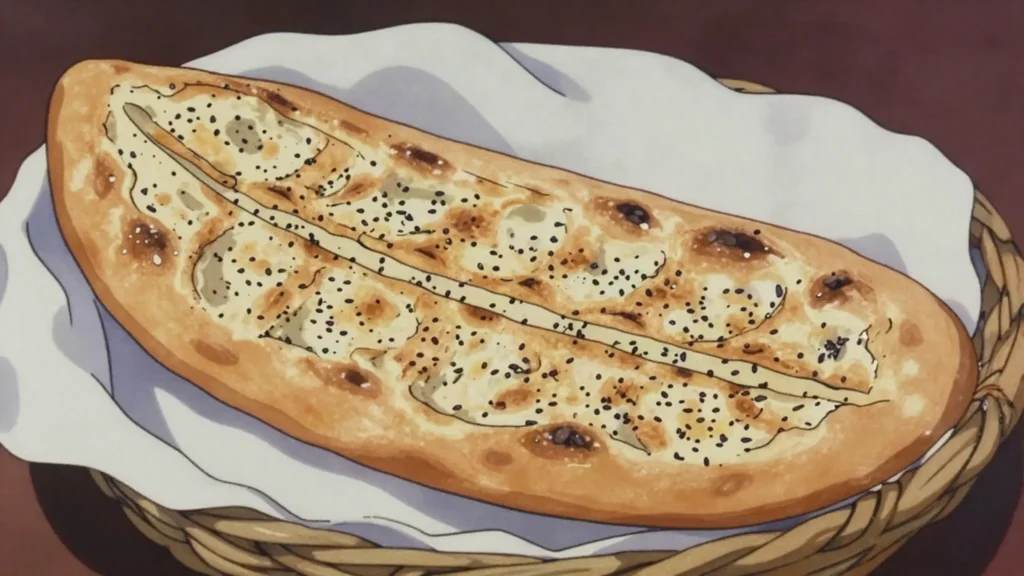
- Brush the surface with water and drag three or four fingers down the length of the dough, pressing right to the base, to cut the long parallel grooves that identify Afghan naan.
- Scatter with nigella and sesame seeds, pressing them in lightly so they do not fall off in the oven.
- Slide onto the hot stone and bake 7 to 10 minutes, until the ridges are dark brown, the raised sections are pale gold and blistered, and the bread sounds hollow when tapped.
- Wrap the hot loaves in a cloth for 5 minutes so the crust softens slightly, then tear and serve. It is eaten at every meal, used as plate, spoon and napkin.
Technique
- The real thing is slapped onto the inside wall of a wood-fired tandoor at around 400°C (750°F) and baked in three minutes, which gives the char spots and the chewy pull. A screaming domestic oven with a preheated stone is the closest home approximation.
- The finger grooves are not decorative. They stop the bread ballooning into a pocket and give it the characteristic ribbed shape sold by the bundle at every Kabul nanwai.
- A slack, wet dough is what you want. Afghan naan is soft and foldable, not crisp; a stiff dough bakes into a cracker.
Substitutions
- No baking stone: heat a cast-iron griddle or an upturned baking tray for 30 minutes and bake one loaf at a time. Half the wholemeal can be replaced with white flour for a paler, softer bread.
Variations
- Naan-e Uzbeki is round, stamped in the centre with a chekich and much thicker at the rim.
- Naan-e roghani is enriched with oil and milk and stays soft for days.
- Lavash, rolled paper-thin and baked in seconds, is the everyday bread further north.
History
Long naan-e Afghani baked against tandoor walls; households traditionally mix dough at home and carry it to the neighbourhood nanwai to bake.
Frequently asked questions
What is Afghan Bread?
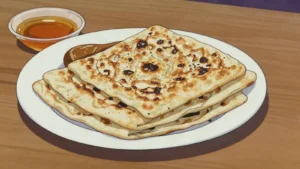
Afghan Bread is a bread & pastry from Afghanistan: long tandoor-baked flatbread dusted with nigella seeds, served at every meal. Long naan-e Afghani baked against tandoor walls; households traditionally mix dough at home and carry it to the neighbourhood nanwai to bake.
How long does Afghan Bread take to make?
Afghan Bread takes 25 min plus 2 hr proving of preparation and 10 min of cooking. The recipe makes 3 large flatbreads. It is rated medium to make.
What can I substitute in Afghan Bread?
Yes, within limits. No baking stone: heat a cast-iron griddle or an upturned baking tray for 30 minutes and bake one loaf at a time. Half the wholemeal can be replaced with white flour for a paler, softer bread.
What is the most important thing to get right in Afghan Bread?
Scatter with nigella and sesame seeds, pressing them in lightly so they do not fall off in the oven.