
Ingredients
Dough
- 400 gplain flour
- 200 gcold butter, cubed
- 100 gsoft light brown sugar
- 1egg
- 7 ginstant dried yeast
- 80 mllukewarm milk
- 1 tspground cinnamon
- ½ tspsalt
Stroop (syrup filling)
- 300 gdark treacle or dark sugar-beet syrup (schenkstroop)
- 150 gsoft dark brown sugar
- 100 gbutter
- 1 tspground cinnamon
- ½ tspsalt
- 1 tsplemon juice
Equipment
- 1stroopwafel iron, or a thin-plate pizzelle iron
- 1long thin serrated knife or a cake wire
- 1round 10 cm cutter
Directions
- Stir the yeast into the lukewarm milk and leave 10 minutes until foamy.
- Rub the cold butter into the flour, sugar, cinnamon and salt with your fingertips until it looks like coarse breadcrumbs, then work in the egg and the yeasted milk to a firm, slightly greasy dough. Do not knead it long; this is closer to a shortbread than a bread dough.
- Cover and leave at room temperature for 45–60 minutes. It will not double, but it will soften and puff slightly.
- Make the stroop: warm the treacle, brown sugar, butter, cinnamon, salt and lemon juice in a small pan over low heat, stirring, until melted and smooth. Bring it to 110°C (225°F) on a thermometer, then take it off. It should fall from the spoon in a slow thick ribbon and stay spreadable when warm.
- Keep the stroop warm over a pan of hot water. Cold stroop is unspreadable and will tear the waffle.
- Heat the iron until a drop of water dances on it, about 180°C (350°F). Roll walnut-sized balls of dough, 35–40 g each, and press one in the centre of the iron.
- Close and clamp firmly, and bake 25–40 seconds, until the waffle is a deep even gold and the steam has stopped rushing out. It must be thin and fully coloured; a pale waffle will go leathery instead of crisp.
- Work fast now. Lift the hot waffle out, trim it to a neat circle with the cutter, then lay it flat and split it horizontally through the middle with the serrated knife held parallel to the bench, sawing gently.
- Spread 1 heaped tbsp of warm stroop over the cut face of the bottom half, right to the edge, and press the top half back on so a little syrup shows at the rim.
- Repeat with the rest, splitting each waffle within about 15 seconds of coming off the iron. Once it cools it becomes brittle and will shatter.
- Eat warm, or serve the classic way: set one on top of a mug of hot coffee or tea for a couple of minutes so the steam softens the waffle and melts the syrup.
Technique
- Splitting has to happen while the waffle is scalding. This is the whole difficulty of a stroopwafel, and it is why they are made by two people, one at the iron and one with the knife.
- The syrup must be cooked to about 110°C (225°F). Under that it runs out of the finished waffle; much over it, it sets hard and cracks when you bite.
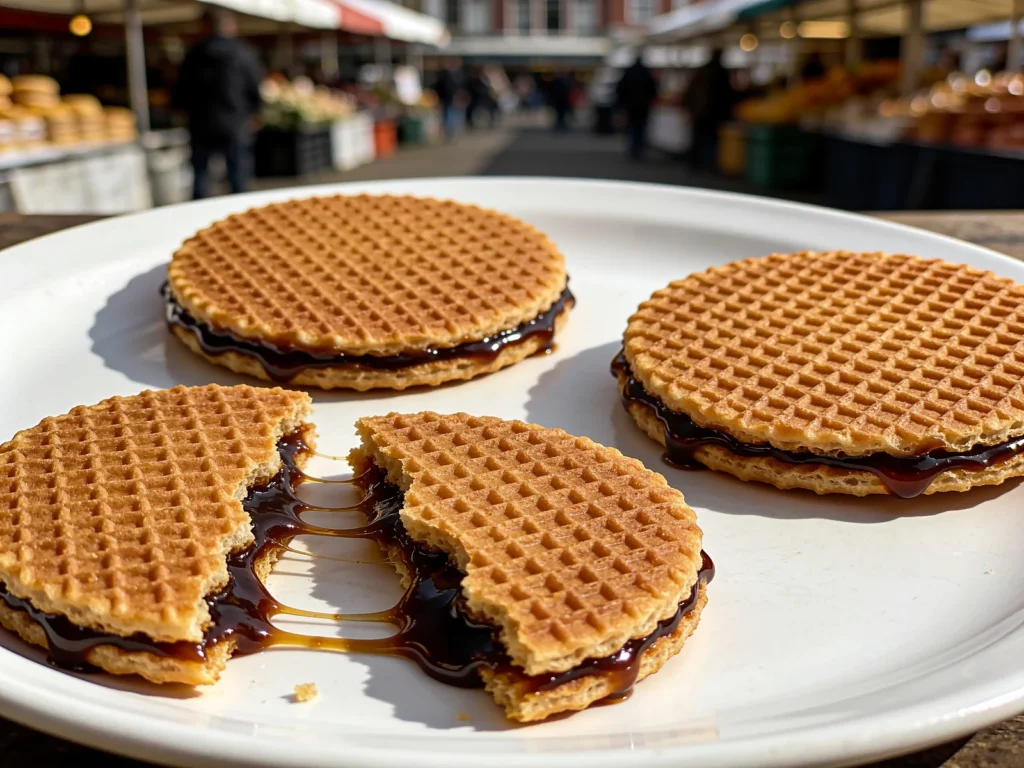
- Stroopwafels come from Gouda and are said to date from the late eighteenth century, made by bakers from leftover crumbs and syrup; the market versions there are still baked to order and eaten warm.
- The dough is enriched and yeasted but barely risen. The yeast is for flavour and a little tenderness rather than lift, since the waffle is pressed almost flat.
Substitutions
- No stroopwafel iron: a pizzelle iron gives a thinner, more fragile waffle that is harder to split but workable. A sandwich toaster does not get hot enough.
- Schenkstroop is hard to find outside the Netherlands; a mix of two parts golden syrup to one part black treacle, cooked to the same temperature, is a good stand-in.
- Dark muscovado in place of light brown sugar in the dough gives a deeper, more caramel waffle.
Variations
- Warm market stroopwafels from Gouda, made to order and eaten on the spot.
- Kletskoppen-style thin crisp versions, baked longer for a snappier waffle.
- Stroopwafels with a pinch of sea salt in the syrup, or dipped half in dark chocolate.
History
Thin waffle cookies sandwiching a caramel syrup filling, generally credited to bakers in the Dutch city of Gouda, with the earliest documented recipe dating to the late 1700s or early 1800s. One frequently repeated but unverified story credits a baker with inventing the stroopwafel specifically to use up leftover breadcrumbs by binding them with brown sugar syrup between two thin waffles, though no primary source confirms this exact account. Gouda maintained something close to a regional monopoly on stroopwafel production for much of the 1800s and 1900s, and the tradition of resting a stroopwafel over a hot cup of coffee or tea, so the rising steam softens the syrup inside, developed as a specifically Dutch serving custom rather than a formal part of the original recipe.
Frequently asked questions
What is Stroopwafel?
Stroopwafel is a snack from Netherlands: thin waffle discs sandwiching warm caramel syrup. Thin waffle cookies sandwiching a caramel syrup filling, generally credited to bakers in the Dutch city of Gouda, with the earliest documented recipe dating to the late 1700s or early 1800s. One frequently repeated but unverified story credits a baker with inventing the stroopwafel specifically to use up leftover breadcrumbs by binding them with brown sugar syrup between two thin waffles, though no primary source confirms this exact account. Gouda maintained something close to a regional monopoly on stroopwafel production for much of the 1800s and 1900s, and the tradition of resting a stroopwafel over a hot cup of coffee or tea, so the rising steam softens the syrup inside, developed as a specifically Dutch serving custom rather than a formal part of the original recipe.
How long does Stroopwafel take to make?
Stroopwafel takes 40 min of preparation and 1 hr 30 min including rising of cooking. The recipe makes about 14 waffles. It is rated medium to make.
What can I substitute in Stroopwafel?
Yes, within limits. No stroopwafel iron: a pizzelle iron gives a thinner, more fragile waffle that is harder to split but workable. A sandwich toaster does not get hot enough. Schenkstroop is hard to find outside the Netherlands; a mix of two parts golden syrup to one part black treacle, cooked to the same temperature, is a good stand-in. Dark muscovado in place of light brown sugar in the dough gives a deeper, more caramel waffle.
What is the most important thing to get right in Stroopwafel?
Rub the cold butter into the flour, sugar, cinnamon and salt with your fingertips until it looks like coarse breadcrumbs, then work in the egg and the yeasted milk to a firm, slightly greasy dough. Do not knead it long; this is closer to a shortbread than a bread dough.