
Ingredients
The beans
- 600 gfermented dried cocoa beans
- from Malekula or Malo, if possible
- or any fine single-origin bean
- whole, unroasted
The chocolate
- sugar, to taste
- about 150 to 250 g
- depending on the percentage
- 20 gcocoa butter
- optional, for a smoother bar
- a pinch of salt
For a simpler route
- 500 ggood dark chocolate
- 70percent or higher
- Vanuatu origin if you can find it
- to temper and mould
Equipment
- a baking tray
- a hairdryer or a fan
- a melanger or wet grinder
- or a strong food processor
- a thermometer
- chocolate moulds
- or a lined tray
Directions
- Start by sorting the dried fermented beans. Spread them out on a tray and look at them. Discard any that are mouldy or damaged. Discard flat beans, which have no kernel. Discard clumps that have stuck together. Spread them in one layer on a baking tray.
- Roast at about one hundred and twenty degrees. Roast them for twenty to thirty minutes. Shake the tray every ten minutes or so. They should smell strongly of chocolate. Let them cool completely on the tray. Crush the beans lightly with a rolling pin.
- Pour the cracked beans between two bowls. Use the cold setting on the hairdryer. Repeat the pouring several times over. It is a wet grinder with granite rollers.
- Add the sugar gradually during grinding. Add the cocoa butter if you are using it. Add a pinch of salt near the end. Taste as you go and adjust the sugar. Untempered chocolate sets soft and dull. Melt two thirds of the chocolate gently. Use a bowl over barely simmering water. Do not let the bowl touch the water.
- Heat dark chocolate to about fifty degrees. Use a thermometer, since this matters. Take the bowl off the heat entirely. Stir it in steadily until it melts. Keep stirring as the temperature falls.
- Bring it down to about twenty-eight degrees. Then warm it very gently back up. Bring it to about thirty-one degrees. Do not exceed thirty-two for dark chocolate. Dip a knife tip in and set it aside. It should set within three or four minutes. Start the process again if that happens. Or spread it thin on a lined tray.
- Let it set at cool room temperature. Do not set chocolate in the refrigerator. Let it set for a few hours undisturbed. Wrap the bars in foil or greaseproof paper. Store them somewhere cool and dry. Keep it well away from other foods. Well tempered dark chocolate keeps a year. Let it sit twenty minutes before eating.
Technique
- Making chocolate from beans at home is genuinely hard and is not a weekend project. Commercial chocolate is ground for a day or more in a stone melanger, and that grinding is what makes it smooth. A food processor produces a noticeably gritty paste — honest rustic chocolate rather than fine chocolate. Most readers should buy good chocolate and temper it well, which produces an excellent bar.
- Never let water reach melting chocolate. A single drop makes it seize into a grainy solid mass and there is no recovering it.
- Tempering is what gives chocolate its gloss and its snap, and stops it setting dull and streaky. Melt two thirds, take it off the heat, stir in the remaining third to seed it, cool to about 28 degrees and bring it back to 31. Do not exceed 32 for dark chocolate or the temper is destroyed.
- Test the temper on a knife tip before moulding. It should set glossy and firm in three or four minutes; streaky or soft means starting again.
- Never set or store chocolate in the refrigerator. Cold setting dulls the surface, and condensation causes sugar bloom. Around eighteen degrees is right, away from strong smells, which chocolate absorbs readily.
- Roast the beans low and slow — about 120 degrees for twenty to thirty minutes — not like nuts. Burnt cocoa is bitter beyond rescue.
- Winnow outdoors. The husk is light and papery and it goes absolutely everywhere.
- Vanuatu beans were traditionally smoke-dried over a wood fire, which is quick in a wet climate but imparts a smokiness long treated as a defect that lowered the price. Quality producers now sun-dry or use indirect dryers; a few use a little smoke deliberately as a regional character. Both approaches are current.
- Cocoa-growing countries have historically exported raw beans and imported finished chocolate, so almost all the value left. Bean-to-bar production in Port Vila since 2016 keeps more of it locally. It is a small industry and the atlas does not overstate its scale, but the shift is genuine.
Substitutions
- Good bought dark chocolate replaces the whole bean-to-bar process; temper it and mould it and the result is excellent.
- Any fine single-origin cocoa bean can be used if Vanuatu beans are unavailable, and the atlas does not pretend the result is the same.
- Added cocoa butter makes a smoother, more fluid chocolate; it can be left out for a stiffer, rougher bar.
- A strong food processor replaces a melanger at the cost of a gritty texture.
- A hairdryer on cold, or a fan, both work for winnowing.
- Milk powder can be added for a milk chocolate, though it complicates the tempering considerably.
Variations
- Single-origin bars from Malekula and from Malo are sold separately by some makers and taste noticeably different.
- A deliberately smoke-dried bar, treating the traditional drying as a feature, is made by some producers.
- Cocoa nibs, roasted and winnowed but not ground, are sold as a snack and used in baking.
- Cocoa tea, made by boiling ground beans with water and spice, is drunk across the cocoa-growing tropics.
- Bars with coconut, vanilla or local pepper are made by Vanuatu producers using other island crops.
- Papua New Guinean and Solomon Islands cocoa are the nearest regional relatives and are also smoke-dried traditionally.
History
Malekula and Malo cocoa was long exported raw; since 2016 local makers have produced award-winning bean-to-bar chocolate in Port Vila.
Frequently asked questions
What is Vanuatu Chocolate?
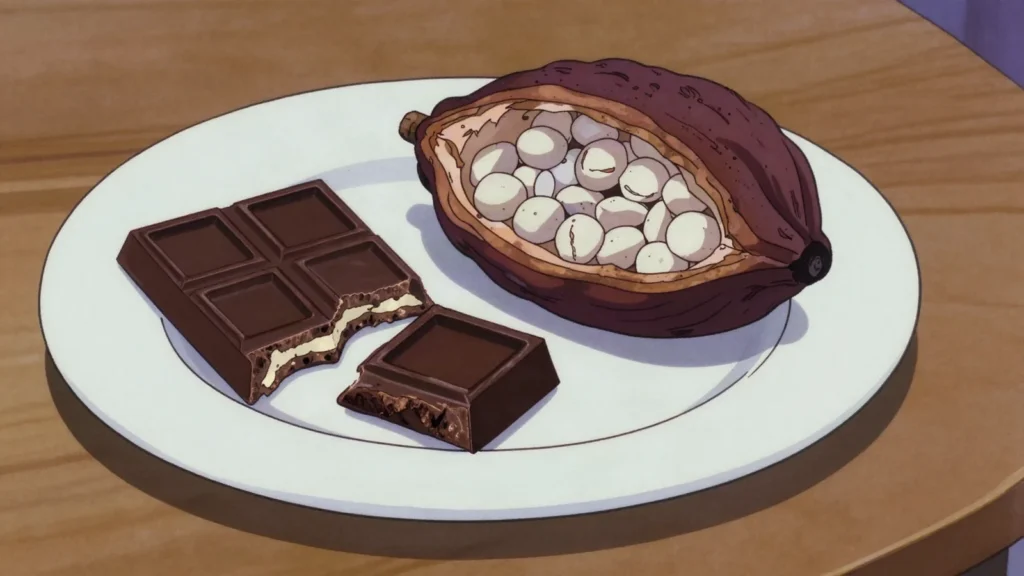
Vanuatu Chocolate is a snack from Vanuatu: dark single-origin bars made from island-grown cocoa, often smoke-dried. Malekula and Malo cocoa was long exported raw; since 2016 local makers have produced award-winning bean-to-bar chocolate in Port Vila.
How long does Vanuatu Chocolate take to make?
Vanuatu Chocolate takes 1 hour of preparation and 1 hour, plus setting of cooking. The recipe makes makes about 500 g of chocolate. It is rated hard to make.
What can I substitute in Vanuatu Chocolate?
Yes, within limits. Good bought dark chocolate replaces the whole bean-to-bar process; temper it and mould it and the result is excellent. Any fine single-origin cocoa bean can be used if Vanuatu beans are unavailable, and the atlas does not pretend the result is the same. Added cocoa butter makes a smoother, more fluid chocolate; it can be left out for a stiffer, rougher bar. A strong food processor replaces a melanger at the cost of a gritty texture. A hairdryer on cold, or a fan, both work for winnowing. Milk powder can be added for a milk chocolate, though it complicates the tempering considerably.
What is the most important thing to get right in Vanuatu Chocolate?
Add the sugar gradually during grinding. Add the cocoa butter if you are using it. Add a pinch of salt near the end. Taste as you go and adjust the sugar. Untempered chocolate sets soft and dull. Melt two thirds of the chocolate gently. Use a bowl over barely simmering water. Do not let the bowl touch the water.