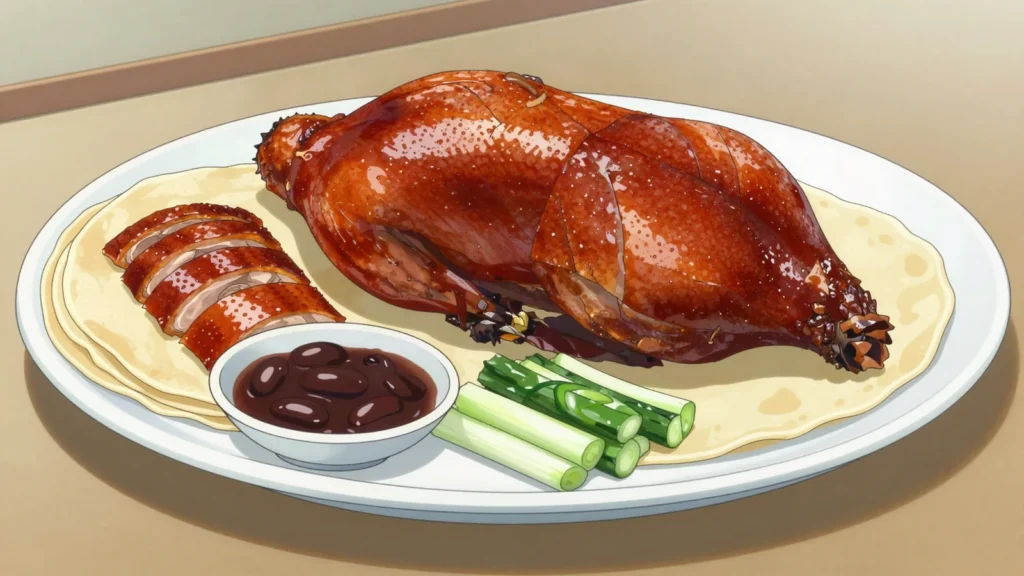

Ingredients
Duck
- 1whole duck, 2–2.5 kg, preferably a Pekin breed, head on if you can get it
- 2 tspsalt
- 1 tspfive-spice, optional (Beijing purists leave the cavity plain)
Scald and glaze
- 3 litresboiling water
- 80 gmaltose syrup, or 60 g honey
- 60 mlrice vinegar
- 1 tbspShaoxing wine
- 1 litrewater
Pancakes
- 300 gplain flour
- 180 mljust-boiled water
- 1 tbsptoasted sesame oil, for layering
To serve
- 6spring onions, cut into fine 6 cm julienne
- 1cucumber, seeded and cut into batons
- 150 gtianmianjiang (sweet bean sauce), warmed with 1 tsp sugar and 1 tsp sesame oil
- Caster sugar, for the crisp skin
Directions
- Dry the duck inside and out, remove the wing tips and any loose fat, and rub the cavity with salt. Slide a hand or an air pump between skin and breast meat to separate them so the skin can dry and crisp independently.
- Truss the neck and vent so the bird holds air, then hang it and pour the boiling water over the skin in slow passes until it tightens visibly and turns from slack to taut, about 30 seconds’ worth per side.
- Simmer the maltose, vinegar, wine and water for 2 minutes and brush this glaze over the whole bird in three coats, drying between coats.
- Hang the duck in front of a fan in a cool place, or uncovered on a rack in the fridge, for 24–48 hours until the skin is dry, tight and papery, like parchment. This is the single most important step.
- Meanwhile make the pancakes: stir the boiled water into the flour, knead to a smooth dough, rest 30 minutes, roll into 8 cm discs, oil the face of one and stack a second on top, then roll the pair out to 16 cm.
- Dry-fry each pair 45 seconds a side in a hot pan until they puff and show pale brown freckles, then peel the two apart while hot and keep them wrapped in a cloth.
- Roast the duck at 200°C (400°F) for 30 minutes breast-up, then turn down to 170°C (350°F) and give it 40–50 minutes more, turning once, until the skin is mahogany and lacquered and the juices run clear. Traditionally it hangs in a wood-fired oven over jujube or pear wood.
- Rest 10 minutes, then carve: skin first, in coin-sized pieces to be eaten dipped in caster sugar, then the breast and leg meat in thin slices, aiming for the classic 100-plus slices each carrying skin.
- Serve immediately with the pancakes, spring onion, cucumber and sweet bean sauce; the diner smears sauce, adds meat and vegetables and rolls the pancake into a tube.
Technique
- Real Peking duck is defined by air-separating the skin, scalding, maltose glazing and long drying. Skipping the drying gives you roast duck; it will taste good but the skin will be leathery rather than glassy.
- Two Beijing schools exist: guàlú, hung over open fruitwood fire (Quanjude), and mènlú, cooked in a closed oven with the residual heat of burnt sorghum straw (Bianyifang). The hung-oven style is the one most people picture.
- Maltose is stiff and sticky; warm the jar in hot water to spoon it out. Honey burns faster, so drop the oven 10°C (50°F) if you use it.
- The carcass is not thrown away: it is traditionally sent back to the kitchen to be turned into a milky duck bone and cabbage soup.
Substitutions
- No hanging space? Set the scalded, glazed duck on a rack over a tray, uncovered, on the top shelf of the fridge for 48 hours; the fridge is a dehumidifier.
- Hoisin sauce is the common substitute for tianmianjiang but is sweeter and more garlicky; thin it with a little water and sesame oil.
Variations
- Cantonese roast duck is marinated with a wet spice mix inside the cavity and served on the bone, a different dish entirely.
- Some Beijing restaurants now serve the skin with garlic paste and radish alongside the sugar.
History
Documented in Chinese imperial kitchens since at least the Yuan dynasty in the 1300s, when a cookbook for the Mongol court described roasting duck, though the dish most associate with the name today crystallized later, in Ming-dynasty Beijing, then called Peking. Restaurants specializing in the dish, including Bianyifang, tracing its own history to the 1400s, and the later Quanjude, founded in 1864, developed and popularized the now-standard technique: air is pumped between the duck’s skin and meat to separate them, the skin is glazed and air-dried, then the bird is roasted hanging in a closed or open oven until the skin turns a deep lacquered red-brown. The crisp skin, carved separately from the meat and eaten wrapped in a thin pancake with spring onion and sauce, is the part the dish is built around.
Frequently asked questions
What is Peking Duck?
Peking Duck is a main from China: lacquered roast duck carved tableside, wrapped in thin pancakes with spring onion and sweet bean sauce. Documented in Chinese imperial kitchens since at least the Yuan dynasty in the 1300s, when a cookbook for the Mongol court described roasting duck, though the dish most associate with the name today crystallized later, in Ming-dynasty Beijing, then called Peking. Restaurants specializing in the dish, including Bianyifang, tracing its own history to the 1400s, and the later Quanjude, founded in 1864, developed and popularized the now-standard technique: air is pumped between the duck’s skin and meat to separate them, the skin is glazed and air-dried, then the bird is roasted hanging in a closed or open oven until the skin turns a deep lacquered red-brown. The crisp skin, carved separately from the meat and eaten wrapped in a thin pancake with spring onion and sauce, is the part the dish is built around.
How long does Peking Duck take to make?
Peking Duck takes 1 hr over two days of preparation and 24–48 hr drying plus 1 hr 15 min roasting of cooking. The recipe makes 4 servings. It is rated hard to make.
What can I substitute in Peking Duck?
Yes, within limits. No hanging space? Set the scalded, glazed duck on a rack over a tray, uncovered, on the top shelf of the fridge for 48 hours; the fridge is a dehumidifier. Hoisin sauce is the common substitute for tianmianjiang but is sweeter and more garlicky; thin it with a little water and sesame oil.
What is the most important thing to get right in Peking Duck?
Simmer the maltose, vinegar, wine and water for 2 minutes and brush this glaze over the whole bird in three coats, drying between coats.