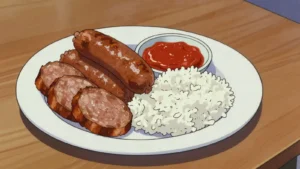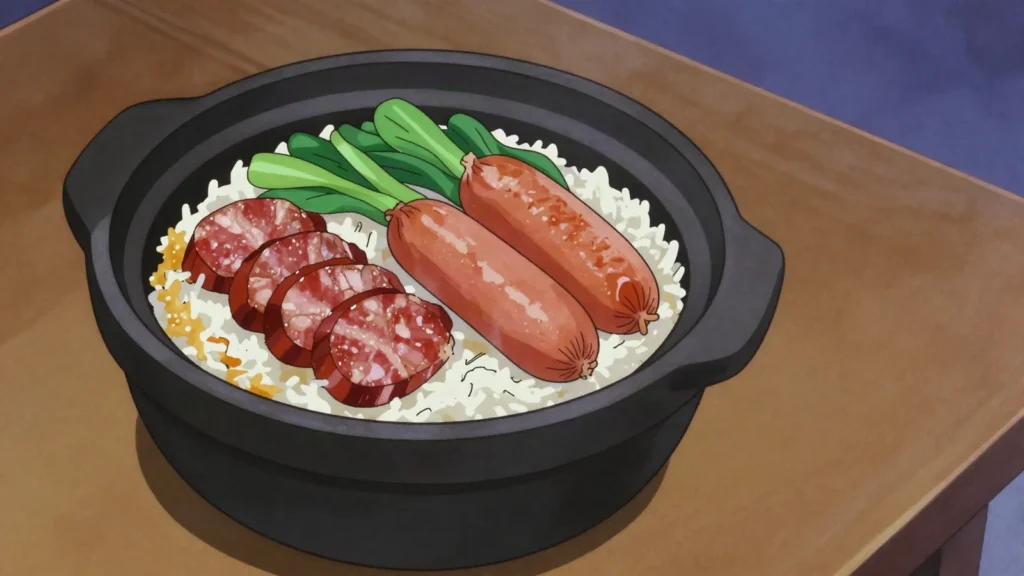

A sweet, air-dried southern Chinese pork sausage cured with rose wine and steamed over claypot rice, where its fat runs down into the grains. It belongs to the là-curing tradition: sausages hung in the cold dry winds of the twelfth lunar month, là yuè, which is what names them.
It is raw pork dried at ambient temperature over weeks, which is safe only with a correctly measured nitrite cure and cold, dry, moving air; the là yuè winds are the traditional guarantee and a warm kitchen is the opposite of them.
What goes into it
- pork and pork back fat, cut in cubes
- sugar
- salt and curing salt
- soy sauce
- rose-scented mei kuei lu chiew wine
- narrow casings
How it is made
Cubed pork and fat are marinated in sugar, salt, soy and rose wine, then stuffed into narrow casings, tied into links and hung in cold dry air. Over a couple of weeks the sausages lose much of their water and the sugar and alcohol concentrate. They are never cooked during curing — the steaming happens only when they are eaten.
How long it takes: one to three weeks of drying in cold air
How it is eaten
Sliced on the diagonal over claypot rice, in fried rice, or steamed with greens.
History
Part of the southern la-curing tradition: sausages were hung in the cold dry winds of the twelfth lunar month, la yue, which names them.
Frequently asked questions
What is Lap Cheong?
Lap Cheong is a charcuterie & cured from China: sweet air-dried pork sausage cured with rose wine, steamed over claypot rice. Part of the southern la-curing tradition: sausages were hung in the cold dry winds of the twelfth lunar month, la yue, which names them.
How is Lap Cheong made?
Cubed pork and fat are marinated in sugar, salt, soy and rose wine, then stuffed into narrow casings, tied into links and hung in cold dry air. Over a couple of weeks the sausages lose much of their water and the sugar and alcohol concentrate. They are never cooked during curing — the steaming happens only when they are eaten. It takes one to three weeks of drying in cold air.
Can I make Lap Cheong at home?
No, and the atlas gives no method for it. It is raw pork dried at ambient temperature over weeks, which is safe only with a correctly measured nitrite cure and cold, dry, moving air; the là yuè winds are the traditional guarantee and a warm kitchen is the opposite of them.
What goes into Lap Cheong?
Pork and pork back fat, cut in cubes, sugar, salt and curing salt, soy sauce, rose-scented mei kuei lu chiew wine, narrow casings.
How is Lap Cheong eaten?
Sliced on the diagonal over claypot rice, in fried rice, or steamed with greens.