
Ingredients
Cassava
- 3 kgcassava root, fresh and firm
- water, to cover
- 1large scalded bucket or clay pot
Wrapping and cooking
- 20–24large banana leaves, or the leaves of the maranta plant, wiped clean
- string or strips of leaf rib, for tying
- 1large pot with a lid and a rack or bed of leaf stalks in the base
- 1.5 litreswater, for steaming
Directions
- Peel the cassava, cut it into 10 cm lengths and cover it with cool water in the bucket, weighting the pieces down so none floats.
- Leave it to steep in the shade at 25–30°C (75–85°F) for 3–4 days. The flesh softens, the water turns cloudy and sour, and the fermentation both develops the flavour and drives down the root’s natural cyanogenic compounds.
- Drain, rinse, and pick out the woody central cord from every piece; it will never soften.
- Pound the soft cassava in a wooden mortar, in batches, into a smooth, sticky, gluey paste with no fibre left. This takes real work and is the step the dish is named for.
- Push the paste through a coarse sieve or squeeze it in a cloth to remove the last strings, and knead it by hand for 5 minutes until it is elastic and holds a shape.
- Warm the paste in a pan over low heat for 10–15 minutes, stirring hard, until it stiffens and pulls away from the sides in a single mass. This first cook is what makes it possible to wrap.
- Hold the banana leaves briefly over a flame until they turn glossy and pliable, which stops them splitting when folded.
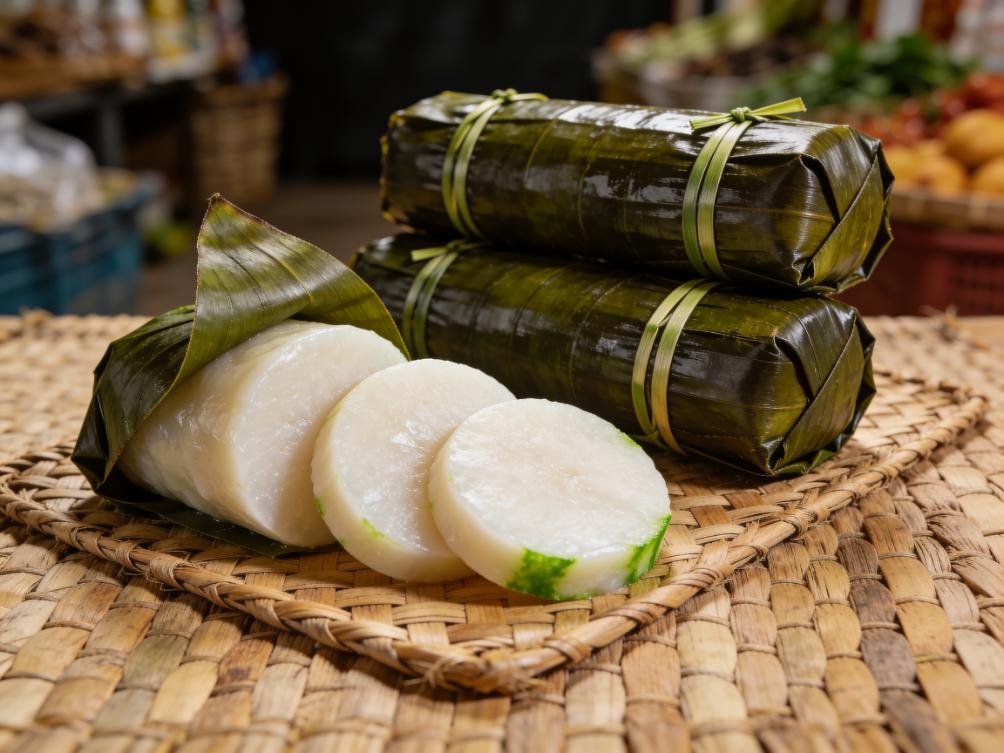
- Divide the hot paste into four, roll each into a fat cylinder, wrap it tightly in two or three overlapping leaves and tie it firmly at both ends and the middle.
- Stand the parcels upright on a rack over the water in the pot, cover, and steam 1 hour 30 minutes to 2 hours, topping up the water as needed.
- Cool the parcels completely in their leaves before unwrapping; the loaf sets firm and sliceable only as it cools. Serve cut in rounds with grilled food, stews or greens, and keep wrapped for up to five days.
Technique
- The long steep is a food-safety step. Cassava, especially bitter varieties, carries cyanogenic glycosides that fermentation, draining and thorough cooking break down; never make quiquanga from raw unsoaked root.
- Judge the ferment by smell and feel. The paste should smell sharply sour like sourdough and crush easily between the fingers. Anything putrid, slimy or off-coloured goes in the bin.
- The leaf is not just packaging. It holds the shape, keeps the loaf moist through a long steam, and gives quiquanga its faint green, tea-like scent, which is why greaseproof paper is a poor substitute.
- Known as kwanga or chikwangue in the Congo basin, this loaf is one of the great shared staples of Central Africa, sold at markets and roadsides already wrapped.
Substitutions
- No banana leaves: blanched maize husks overlapped, or a double layer of baking parchment inside foil, will hold the loaf, though you lose the aroma.
- The peeled root can be frozen and thawed before soaking, which softens the cell walls and cuts the steeping time to about two days.
Variations
- Kwanga, the identical Congolese loaf, usually made in longer, thinner batons.
- A softer version steamed for only 45 minutes and eaten warm like a dumpling.
- Sliced and fried in palm oil until crisp at the edges, served with gindungo.
History
A Bakongo staple of northern Angola, fermented for days to remove cyanide and keep for a week in the heat.
Frequently asked questions
What is Quiquanga?
Quiquanga is a fermented & pickled from Angola: fermented cassava paste pounded, wrapped in leaves and steamed to a firm loaf. A Bakongo staple of northern Angola, fermented for days to remove cyanide and keep for a week in the heat.
How long does Quiquanga take to make?
Quiquanga takes 1 hr of preparation and 3 days fermenting plus 2 hr steaming of cooking. The recipe makes 4 loaves, about 300 g each. It is rated hard to make.
What can I substitute in Quiquanga?
Yes, within limits. No banana leaves: blanched maize husks overlapped, or a double layer of baking parchment inside foil, will hold the loaf, though you lose the aroma. The peeled root can be frozen and thawed before soaking, which softens the cell walls and cuts the steeping time to about two days.
What is the most important thing to get right in Quiquanga?
Drain, rinse, and pick out the woody central cord from every piece; it will never soften.