
Ingredients
The pork
- 4thick pork loin steaks
- about 200 g each
- salt and black pepper
The stuffing
- 150 gNjeguški pršut
- or other dry-cured ham, sliced
- 150 gNjeguški sir
- or a firm mature cheese, sliced
The coating
- 100 gplain flour
- 2eggs, beaten
- 200 gfine dry breadcrumbs
- salt and black pepper
To fry and serve
- oil, for shallow frying
- or clarified butter
- lemon wedges
- potatoes or salad
Directions
- Keep the filling well away from the edges. Press the edges together firmly. The breadcrumb coating helps hold it. Flour gives the egg something to grip. The steak must be thick enough to cut open. Trim any hard sinew from the steaks. Cut it all away before cooking. Lay a steak flat on the board. Hold it down flat with your palm.
- Cut horizontally into the long side. Use a thin and very sharp knife. Cut slowly and keep the blade level. Stop about a centimetre from the far side.
- Check the corners particularly. Season the inside with pepper. Salt the outside lightly if at all. Lay ham slices inside the pocket. Lay cheese slices on top of them. Keep both well inside the edges. Leave a clear centimetre all round. Fold the top of the steak back down. Press the edges together firmly. Press along the whole open edge.
- Use the heel of your hand for it. Remember to take it out before serving. Put the flour out on one plate. Beat the eggs in a shallow bowl. Put the breadcrumbs on another plate. Season the flour and the crumbs. Season each stage rather than only the meat. Press the steak into the flour. Coat it well on both of its sides.
- Shake off all of the excess flour. Shake it off properly each time. Dip the floured steak into the egg. Coat it completely on both sides. Let all the excess egg drip off. Press the steak firmly into the crumbs. Turn it and press the other side. Press the edges particularly firmly.
- Lay the coated steaks on a tray. Refrigerate them for thirty minutes. Pour oil into a wide heavy pan. Fill it about a centimetre deep. Heat it to about one hundred and seventy degrees. Too hot and the crumb burns first. Drop a single crumb into the oil. It should sizzle steadily rather than fiercely. Keep a lid nearby to smother a flare-up. Never put water on an oil fire at all.
- Turn it over carefully with tongs. Give it another five full minutes. Turn it once rather than repeatedly. Use tongs and support it as you turn. Judging them takes a careful look. Check the first one by cutting into it. There should be no pink at the centre. Lift them out onto a wire rack. That softens the crust within minutes.
- Let them rest for five minutes. Serving them is always done hot. Remove any cocktail sticks first. Serve them whole or cut across. Cut it at the table if you like. Serve potatoes or salad alongside. It keeps a day in the refrigerator.
Technique
- This is a modern restaurant creation rather than an old village dish, built around the two famous products of Njeguši above Kotor — its dry-cured ham and its matured cheese. The ingredients are traditional and the dish is recent, and the atlas records that honestly; it is genuinely Montenegrin nonetheless.
- Cheese melts and wants to escape, so keep the filling a clear centimetre inside the edges, press the whole open edge firmly together, press the breadcrumbs in hardest at the edges, and chill the coated steaks thirty minutes before frying — firm cheese leaks far less. A cocktail stick through a stubborn edge is useful insurance, but remember to remove it.
- Fry at a moderate rather than high heat, since the crumb burns long before a thick stuffed steak cooks through; ten minutes is a starting point and thicker ones need longer. Browning them and finishing in a moderate oven for ten minutes is worth doing with very thick steaks.
Substitutions
- Any dry-cured ham and firm mature cheese stand in for the Njeguši products.
- Two thin beaten steaks sandwiched around the filling and sealed at the edges replace the cut pocket; both methods are used.
Variations
- Season the inside with pepper only, since the ham and cheese are both salty, and salt the outside lightly if at all.
- Turn the steak once rather than repeatedly, since each turn risks cracking the coating.
- Rest it five minutes before cutting, which lets the juices settle and the molten cheese firm slightly.
History
A modern restaurant dish built from the two famous products of Njeguši village above Kotor.
Frequently asked questions
What is Njeguski stek?
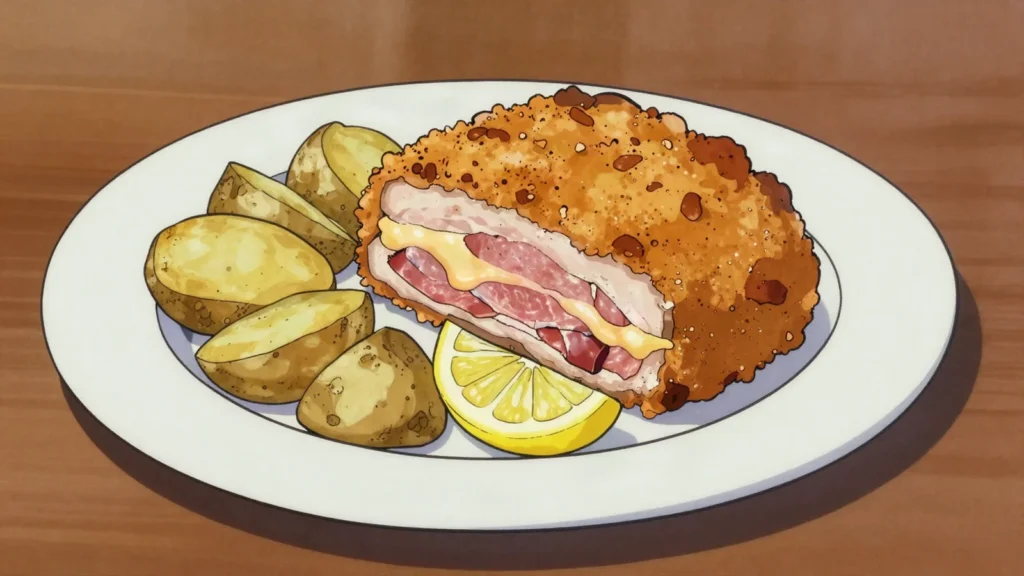
Njeguski stek is a main from Montenegro: pork loin stuffed with Njeguši ham and cheese, breaded and fried. A modern restaurant dish built from the two famous products of Njeguši village above Kotor.
How long does Njeguski stek take to make?
Njeguski stek takes 40 minutes of preparation and 25 minutes of cooking. The recipe makes serves 4. It is rated medium to make.
What can I substitute in Njeguski stek?
Yes, within limits. Any dry-cured ham and firm mature cheese stand in for the Njeguši products. Two thin beaten steaks sandwiched around the filling and sealed at the edges replace the cut pocket; both methods are used.
What is the most important thing to get right in Njeguski stek?
Keep the filling well away from the edges. Press the edges together firmly. The breadcrumb coating helps hold it. Flour gives the egg something to grip. The steak must be thick enough to cut open. Trim any hard sinew from the steaks. Cut it all away before cooking. Lay a steak flat on the board. Hold it down flat with your palm.