
Ingredients
Pudding
- 1 litrewhole milk
- 90 grice flour
- 120 gcaster sugar
- 1 pinchsalt
- 3 tbsprose water
- 1strip of lemon zest (optional)
To decorate
- 1 tspground cinnamon
- 2 tbspchopped pistachios or toasted almonds
- a few dried rose petals (optional)
Directions
- Whisk the rice flour into 250 ml of the cold milk in a bowl until completely smooth, with no lumps at all; lumps formed now will never dissolve later.
- Heat the remaining 750 ml milk with the sugar, salt and lemon zest in a heavy saucepan over medium-low heat until it steams and the sugar has dissolved.
- Pour the rice-flour slurry into the hot milk in a steady stream while whisking constantly.
- Cook over low heat, stirring without stopping with a wooden spoon and reaching into the corners of the pan, for 12 to 15 minutes.
- Watch for the mixture to thicken to the consistency of pouring custard, then to coat the spoon so a drawn finger leaves a clean line, and to lose all taste of raw starch.
- Take off the heat, remove the zest, and stir in the rose water; adding it off the heat keeps the perfume, which boils away in seconds.
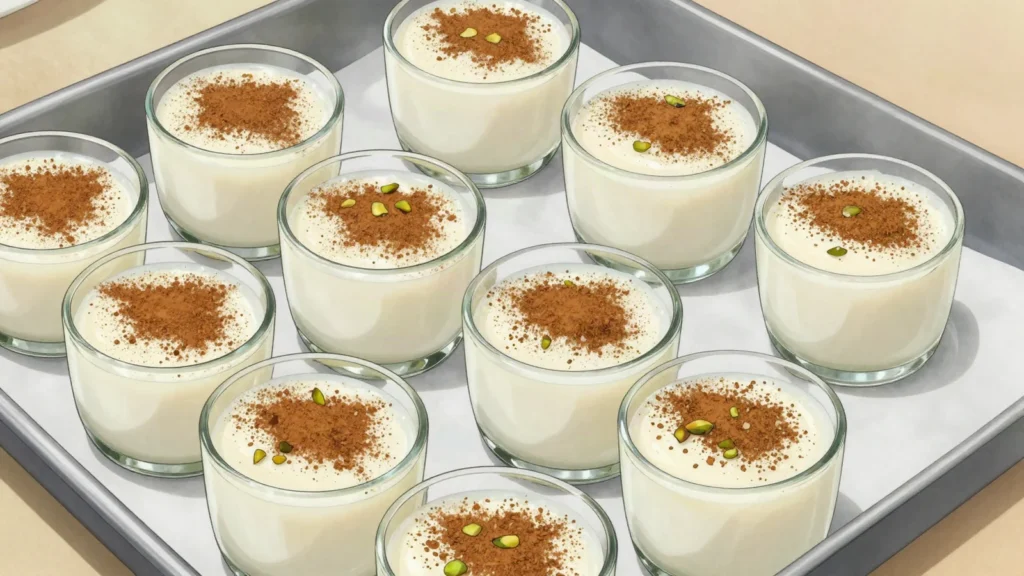
- Pour into small glasses or shallow bowls through a fine sieve, filling them to within 1 cm of the rim.
- Cool to room temperature, pressing cling film onto the surface if you dislike skin, then chill for at least 3 hours until set to a soft, spoonable cream that just holds its shape.
- Dust generously with cinnamon in stripes or through a stencil, scatter with pistachios and rose petals, and serve cold.
Technique
- Constant stirring over low heat is the whole technique. Rice flour catches on the base within seconds and a scorched pudding cannot be rescued.
- The set is soft, not firm. Mhalbi should wobble and be eaten with a spoon, quite unlike a cornflour blancmange, and it firms slightly further overnight.
- Rose water strength varies enormously by brand. Start with two tablespoons, taste, then add more, since too much tastes of soap.
- Known as muhallabia across the Levant, the Algerian version is distinguished by the heavy cinnamon dusting and by being set in small individual glasses.
Substitutions
- No rice flour: cornflour works at 70 g, though the texture is glossier and more gelatinous than the slightly grainy traditional set.
- Orange-flower water can replace the rose water, giving a version closer to the Algiers palate.
Variations
- Some cooks stir a tablespoon of ground almonds into the milk for a richer, cloudier pudding.
- A layered version alternates plain and cocoa-flavoured mhalbi in the glass.
- In the east it is often set thicker in a large dish and cut into squares.
History
A cool set pudding of rice flour, milk and orange-blossom or rose water, served in small bowls during Ramadan and in summer.
Frequently asked questions
What is Mhalbi?
Mhalbi is a dessert from Algeria: rose-scented rice-flour milk pudding dusted with cinnamon. A cool set pudding of rice flour, milk and orange-blossom or rose water, served in small bowls during Ramadan and in summer.
How long does Mhalbi take to make?
Mhalbi takes 10 min of preparation and 20 min plus 3 hr chilling of cooking. The recipe makes 6 small glasses. It is rated easy to make.
What can I substitute in Mhalbi?
Yes, within limits. No rice flour: cornflour works at 70 g, though the texture is glossier and more gelatinous than the slightly grainy traditional set. Orange-flower water can replace the rose water, giving a version closer to the Algiers palate.
What is the most important thing to get right in Mhalbi?
Whisk the rice flour into 250 ml of the cold milk in a bowl until completely smooth, with no lumps at all; lumps formed now will never dissolve later.