
Ingredients
Jameed
- 2balls dried jameed, about 400 g
- 1 litrewater, for soaking
Sauce
- 500 mlof the lamb cooking broth
- 1 tbspcornflour, slaked, optional
- salt
To serve
- lamb on the bone
- rice
- shrak bread
- toasted almonds and pine nuts
- parsley
Directions
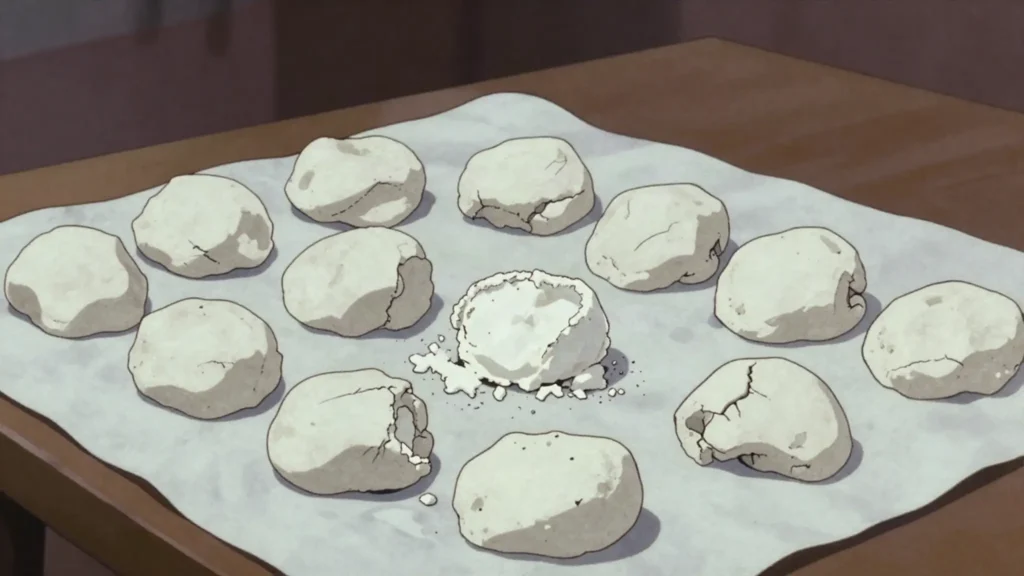
- Jameed is bought, not made at home. Ewe’s milk is soured, salted, drained and dried into rock-hard balls over weeks, and that is a producer’s craft; Karak is the recognised source and its jameed is the one people ask for.
- What follows is the reconstitution, which is what a Jordanian kitchen actually does with it.
- Break the dry balls into pieces with a hammer or the flat of a heavy knife, which takes real force.
- Soak the pieces in water overnight, or for at least 12 hours, until they soften right through.
- Give it the full soak. Jameed is dried to the hardness of stone and a short soak leaves gritty lumps that never smooth out.
- Blend the softened jameed with its soaking water until completely smooth, then pass it through a fine sieve.
- Sieve it even after blending. Any remaining grain will sit at the bottom of the pot and catch.
- Combine the jameed liquid with the strained broth from the lamb and bring it to a bare simmer.
- Stir it constantly and in one direction as it heats.
- Constant stirring is not optional. Jameed sauce splits and curdles the moment it is left still or allowed to boil, and once split it does not come back.
- Keep it just below a simmer for 30 to 40 minutes, until it thickens slightly and loses its raw sharpness.
- If it refuses to thicken, slake a spoonful of cornflour in cold water and stir it through, which is the common domestic fix.
- Taste for salt, remembering that jameed is already heavily salted.
- It should be tart, salty and thick enough to coat the rice without being a gravy.
- Ladle it over the lamb and rice for mansaf, with the rest served in a jug alongside, and finish with toasted nuts and parsley.
- Mansaf is eaten from a shared platter with the right hand, and the jameed sauce is poured on at the table.
Technique
- It is sharply sour and very salty on its own, which is correct and is what balances the fatty lamb.
- Jameed is also sold as a thick paste or a powder, both of which skip the soaking.
- Karak jameed is the benchmark and is priced accordingly.
Substitutions
- Jameed paste or powder, made up to the packet directions.
- Thick sour yoghurt with plenty of salt and lemon, which is an approximation rather than a substitute.
Variations
- Made with goat jameed rather than sheep.
- Thinner, as a soup poured over shrak bread.
- With a little turmeric, which some households add for colour.
History
Ewe’s milk soured, salted and dried into rock-hard balls; the Karak region is the recognised source.
Frequently asked questions
What is Jameed?
Jameed is a sauce & condiment from Jordan: dried goat-yoghurt balls reconstituted into mansaf sauce; Karak’s finest. Ewe’s milk soured, salted and dried into rock-hard balls; the Karak region is the recognised source.
How long does Jameed take to make?
Jameed takes 12 hr soaking of preparation and 1 hr of cooking. The recipe makes sauce for 8. It is rated medium to make.
What can I substitute in Jameed?
Yes, within limits. Jameed paste or powder, made up to the packet directions. Thick sour yoghurt with plenty of salt and lemon, which is an approximation rather than a substitute.
What is the most important thing to get right in Jameed?
Give it the full soak. Jameed is dried to the hardness of stone and a short soak leaves gritty lumps that never smooth out.