
Ingredients
Bhat (rice)
- 400 glong-grain or basmati rice, rinsed until the water runs clear
- 700 mlwater
- ½ tspsalt
Dal
- 250 gmasoor (red) lentils or a mix of masoor and mung, rinsed
- 1.2 litreswater
- 1 tspturmeric
- 1 tspsalt
- 1tomato, chopped
Jhaneko (tempering)
- 3 tbspghee or mustard oil
- 1 tspcumin seed
- ½ tspfenugreek seed
- 1 tspjimbu (Himalayan aromatic herb)
- 4garlic cloves, sliced
- 2dried red chillies, broken
- 1small onion, finely sliced
- ½ tspasafoetida
Tarkari (vegetable curry)
- 400 gpotatoes, in 2 cm cubes
- 300 gcauliflower, in florets
- 2 tbspmustard oil
- 1 tspcumin seed
- 1onion, sliced
- 1 tbspginger-garlic paste
- 1 tspturmeric
- 1 tspground coriander
- 1 tspchilli powder
- 1tomato, chopped
- 1 tspsalt
- 200 mlwater
Saag and achar
- 300 gmustard greens (rayo saag), chopped
- 1 tbspmustard oil, 1 dried chilli, 2 garlic cloves
- 3tomatoes, blistered over a flame
- 2 tbspwhite sesame seeds, toasted and ground
- 2dried chillies, roasted
- 1 tsptimur (Sichuan pepper), ½ tsp salt
- 200 gplain yoghurt, to serve
Directions
- Start the dal: simmer the lentils with the water, turmeric, salt and tomato in a covered pot over medium-low heat for 25–30 minutes, skimming the foam, until they collapse completely into a loose soup. A pressure cooker does this in 8 minutes.
- Cook the rice: bring the water and salt to a boil, add the rinsed rice, cover and cook on the lowest heat for 12 minutes, then rest off the heat for 10 minutes without lifting the lid. The grains should be separate and dry.
- Make the tarkari: heat the mustard oil until it smokes faintly and then let it cool for 20 seconds, which takes the raw pungency off. Fry the cumin 20 seconds, add the onion and cook 6 minutes to golden.
- Stir in the ginger-garlic paste and the ground spices for 1 minute, add the tomato and cook until it breaks down, then add the potatoes, cauliflower, salt and water. Cover and cook 18–20 minutes until the potatoes are tender and the sauce clings rather than pools.
- Cook the saag: heat 1 tbsp mustard oil, crackle the dried chilli and garlic for 30 seconds, add the greens and a pinch of salt and stir-fry over high heat for 4–5 minutes until wilted and still dark green, never grey.
- Make the golbheda ko achar: blister the tomatoes directly over a flame until blackened in patches, peel, then grind with the toasted sesame, roasted chillies, timur and salt into a coarse, smoky relish.
- Now temper the dal. Heat the ghee in a small pan until shimmering, add the cumin and fenugreek and let them darken for 15 seconds, then the jimbu, garlic, dried chillies and onion, and fry to deep gold, about 3 minutes.
- Kill the heat, add the asafoetida, and pour the whole sizzling lot straight into the dal. It will hiss violently. Clamp the lid on for 30 seconds to trap the aroma, then stir through.
- Check the dal: it should be pourable, the consistency of thin cream, and taste of the tempering more than of raw lentil. Loosen with hot water if it has thickened.
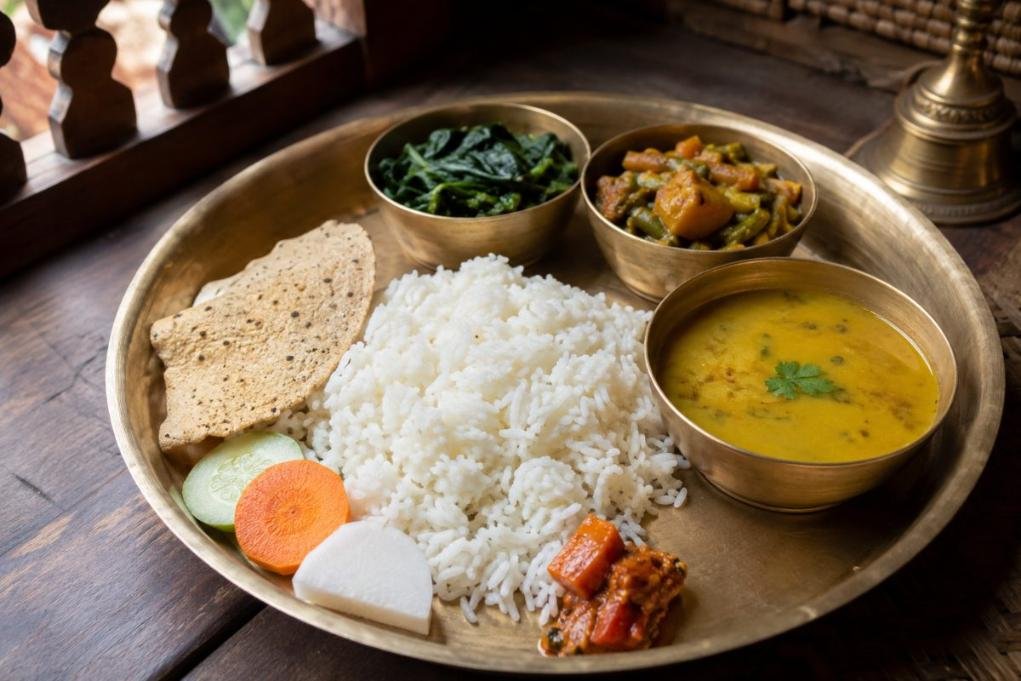
- Serve on one large plate or a compartmented thali: a mound of rice in the centre, dal in a bowl to be poured over it, tarkari, saag, achar and yoghurt around the edge. Eat with the right hand, mixing rice and dal at the plate, and take second helpings, which is the whole point of dal bhat.
Technique
- Jimbu is the flavour that makes a dal taste Nepali rather than Indian. It is a dried Himalayan allium, sold in small bundles, and it goes into the hot ghee at the end, never boiled with the lentils.
- The tempering goes in at the last moment, off the heat, and the pot is covered immediately. Everything you are chasing is volatile and lost within a minute.
- Mustard oil is heated to smoking and then cooled slightly before anything goes in; used cold it tastes acrid and raw.
- Dal bhat is eaten twice a day, morning and evening, across most of Nepal, and the accompanying tarkari and achar change with the season while rice and dal never do.
Substitutions
- No jimbu: use 1 tsp dried chives plus a pinch of dried garlic. It is a shadow of the real thing but closer than leaving it out.
- Timur can be replaced by Sichuan pepper, which is a close relative, or by black pepper plus a squeeze of lime for the tingle it is missing.
- Mustard greens can be swapped for spinach or kale; kale needs 3 minutes longer.
Variations
- Newari-style thali with black-eyed beans, bamboo shoot and potato curry.
- Thakali dal bhat from the Mustang region, with a thinner dal and a gundruk (fermented greens) soup on the side.
- Kwati, the nine-bean dal served in place of the usual lentils at the Janai Purnima festival.
History
A twice-daily plate of lentil soup, rice and vegetable or meat side dishes, eaten so routinely across Nepal that the phrase dal bhat power is used colloquially to describe the energy and stamina, including among Everest region porters and guides, attributed to eating it as a staple meal. Its core components, rice cultivation in Nepal’s lower and middle elevations and lentil farming across the subcontinent, both predate any specific documented recipe, reflecting an agricultural pattern rather than a single invented dish. In hill and mountain regions where rice cultivation is less practical at higher elevation, dhido, a thick porridge made from millet or buckwheat, traditionally replaces the rice portion, meaning dal bhat functions less as one fixed recipe than as a flexible daily meal structure adapted to what a given region can grow.
Frequently asked questions
What is Dal Bhat?
Dal Bhat is a main from Nepal: twice-daily platter of rice, lentil soup, curries and pickles. A twice-daily plate of lentil soup, rice and vegetable or meat side dishes, eaten so routinely across Nepal that the phrase dal bhat power is used colloquially to describe the energy and stamina, including among Everest region porters and guides, attributed to eating it as a staple meal. Its core components, rice cultivation in Nepal’s lower and middle elevations and lentil farming across the subcontinent, both predate any specific documented recipe, reflecting an agricultural pattern rather than a single invented dish. In hill and mountain regions where rice cultivation is less practical at higher elevation, dhido, a thick porridge made from millet or buckwheat, traditionally replaces the rice portion, meaning dal bhat functions less as one fixed recipe than as a flexible daily meal structure adapted to what a given region can grow.
How long does Dal Bhat take to make?
Dal Bhat takes 35 min of preparation and 1 hr of cooking. The recipe makes 4 servings. It is rated medium to make.
What can I substitute in Dal Bhat?
Yes, within limits. No jimbu: use 1 tsp dried chives plus a pinch of dried garlic. It is a shadow of the real thing but closer than leaving it out. Timur can be replaced by Sichuan pepper, which is a close relative, or by black pepper plus a squeeze of lime for the tingle it is missing. Mustard greens can be swapped for spinach or kale; kale needs 3 minutes longer.
What is the most important thing to get right in Dal Bhat?
Stir in the ginger-garlic paste and the ground spices for 1 minute, add the tomato and cook until it breaks down, then add the potatoes, cauliflower, salt and water. Cover and cook 18–20 minutes until the potatoes are tender and the sauce clings rather than pools.