
Ingredients
Chew
- 1areca nut, fresh or dried
- 1or 2 betel leaves, pani
- a smear of slaked lime, tsuna
Sometimes
- a little tobacco, in some preparations
To serve
- offered to guests on arrival, and after meals
Directions
- Doma is areca nut wrapped in betel leaf with slaked lime, chewed after meals and offered to guests in Bhutan.
- It is central to Bhutanese hospitality and etiquette, and it is offered on arrival and at ceremonies and formal occasions.
- Now the health facts, which must come first and be stated plainly.
- Areca nut is classified by the International Agency for Research on Cancer as a Group 1 carcinogen, meaning it is carcinogenic to humans.
- That classification applies to areca nut on its own, without tobacco.
- Chewing it is causally linked to cancers of the mouth, pharynx and oesophagus.
- It is also strongly associated with oral submucous fibrosis, a progressive condition that stiffens the tissues of the mouth and limits how far it can be opened.
- Areca nut contains arecoline, which is a stimulant and is addictive, and regular users experience genuine dependence.
- Adding tobacco, which is common in some regions, compounds the risk considerably.
- None of this is disputed in the medical literature.
- Bhutan and other countries where it is chewed have run public health campaigns about it.
- It is recorded here because it is a real and important part of Bhutanese life, not because it is recommended.
- Anyone reading this should understand the risk before deciding anything.
- Now the cultural role, which is genuine and worth describing.
- Offering doma is a fundamental courtesy in Bhutan and refusing it can be awkward.
- It is presented at weddings, at formal meetings and when visiting a home.
- There are etiquette conventions around how it is offered and received, including using both hands.
- It appears in Bhutanese art, literature and ceremony, and it has been part of the culture for centuries.
- It is also chewed casually and constantly by a great many people, which is where the health burden comes from.
- Now the three components of the chew.
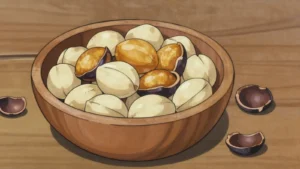
- The areca nut is the seed of the areca palm, often called betel nut, which is confusing since it is not a nut and not betel.
- The betel leaf is the leaf of a pepper vine, Piper betle, which is a different plant entirely.
- Slaked lime, calcium hydroxide, is smeared on the leaf.
- Now what the slaked lime does.
- The alkaline lime changes the chemistry of the chew and releases the alkaloids from the nut in a form the body absorbs.
- Without lime the effect is much weaker, which is why all three components are used together.
- It is also what produces the red colour and the red staining of teeth, gums and saliva.
- Now a warning about the lime itself.
- Slaked lime is caustic and it burns skin and mouth tissue.
- Too much causes mouth ulcers and burns, and this is a common injury among users.
- It is one of the mechanisms by which the chew damages the mouth.
- Now the preparation, described for completeness.
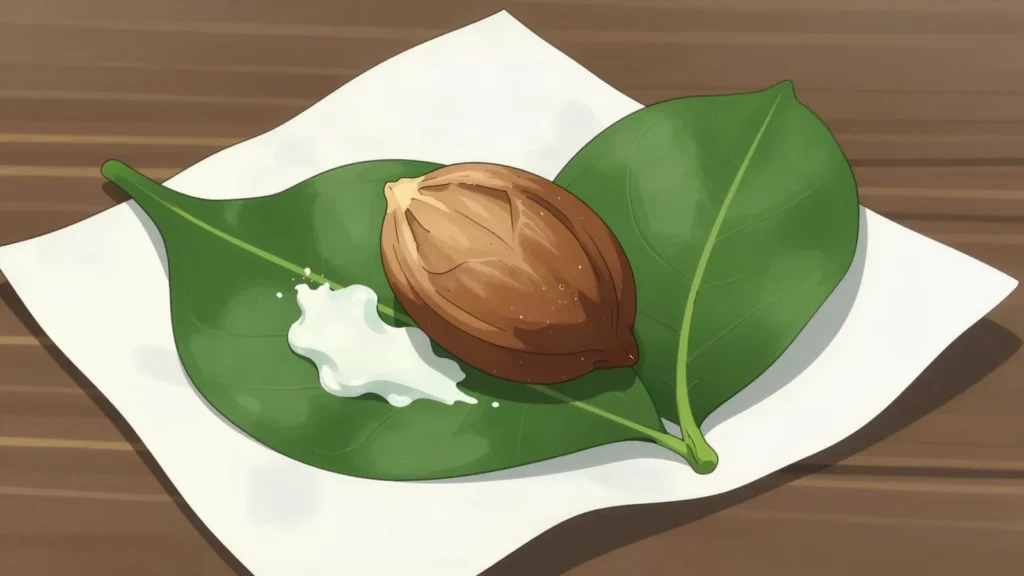
- The areca nut is cut into pieces, or used whole if small and fresh.
- A betel leaf is smeared thinly with slaked lime paste.
- The nut is placed on the leaf and the leaf is folded around it.
- Now the chewing of the parcel.
- The parcel is chewed rather than swallowed, and the juice is spat out.
- Swallowing the juice is not the practice and it increases irritation of the throat and stomach.
- Now the red staining, which is unmistakable.
- The chew turns bright red in the mouth and stains teeth, gums and lips.
- Red stains on pavements from spat juice are a common sight where it is chewed.
- Long-term users often have permanently stained teeth.
- Now the fresh and dried forms.
- Fresh green areca nut is preferred in Bhutan and it is softer and considered better.
- Dried nut is harder and is used where fresh is unavailable.
- Now the wider regional context.
- Similar chews are used across South and Southeast Asia under names including paan, betel quid and buai.
- Indian paan often adds sweeteners, spices and sometimes tobacco.
- The health consequences are broadly the same across all these preparations.
- Now the practical position on it.
- This entry describes a genuine and important cultural practice.
- It is not a recipe to try, and anyone offered doma while travelling should feel free to decline politely.
- Declining with a smile and a reason is generally understood, particularly by younger Bhutanese, many of whom do not chew.
- Anyone who does chew regularly and has concerns should see a dentist or a doctor, since oral changes are detectable early.
Technique
- Areca nut is an IARC Group 1 carcinogen, causally linked to oral cancer.
- It is addictive, and slaked lime is caustic and burns mouth tissue.
- It is nonetheless central to Bhutanese hospitality and etiquette.
Substitutions
- There is no substitute, and declining is entirely reasonable.
- Plain betel leaf without areca nut avoids the main risk.
Variations
- Indian paan, often with sweeteners and spices.
- Betel quid across South and Southeast Asia.
- Preparations with tobacco, which are considerably more harmful.
History
Central to Bhutanese hospitality and etiquette, offered on arrival and at ceremonies; the lime turns the chew red and stains the teeth.
Frequently asked questions
What is Doma?
Doma is a snack from Bhutan: areca nut with betel leaf and slaked lime, chewed after meals and offered to guests. Central to Bhutanese hospitality and etiquette, offered on arrival and at ceremonies; the lime turns the chew red and stains the teeth.
How long does Doma take to make?
Doma takes 2 min of preparation and none of cooking. The recipe makes 1 chew. It is rated easy to make.
What can I substitute in Doma?
Yes, within limits. There is no substitute, and declining is entirely reasonable. Plain betel leaf without areca nut avoids the main risk.
What is the most important thing to get right in Doma?
Now the health facts, which must come first and be stated plainly.