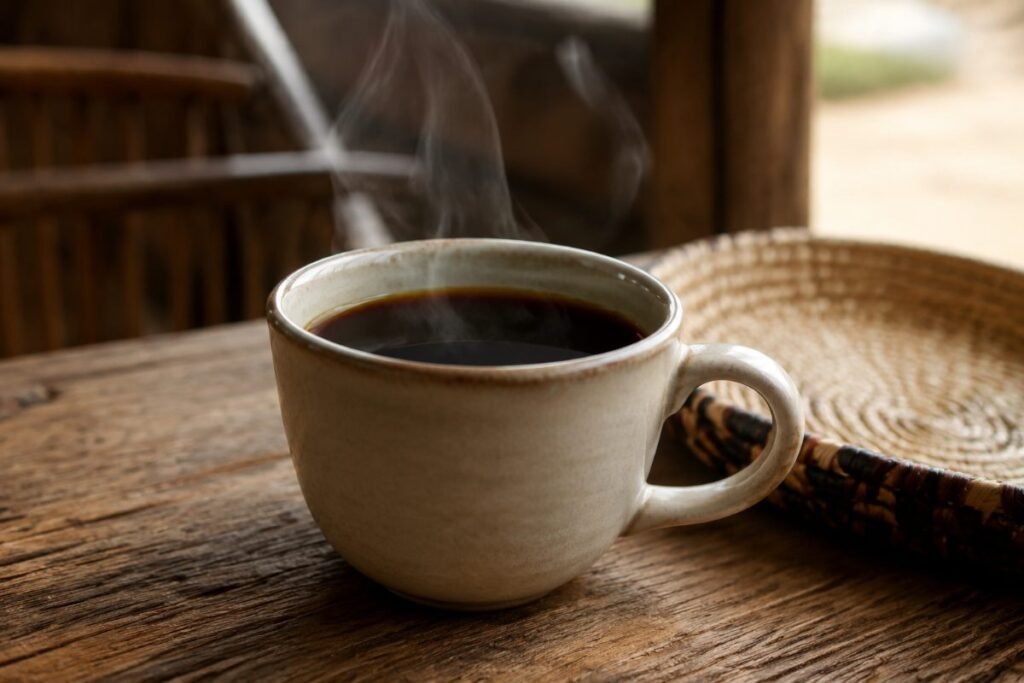

Ingredients
- 36 gAngolan coffee beans, dark roast (a robusta-led blend from Uíge, Cazengo or Amboim), freshly ground fine
- 60 mlfiltered water, at 92–94°C (200–200°F), for brewing
- 2–4 tspwhite sugar, to taste
To serve
- 2demitasse cups (60 ml), warmed
- cold water on the side
Directions
- Grind 18 g per cup to a fine espresso grind, like sifted sand that clumps when pressed.
- Warm the cups with boiling water and empty them. A cold demitasse will drop a 30 ml shot by 10 degrees before it reaches the table.
- Cut the shot the moment it goes pale and thin, or the cup turns ashy and bitter. The crema on a robusta-heavy blend should be thick, dense and hazelnut brown, holding a spoonful of sugar on the surface for a second or two before it sinks.
- Serve immediately, short and very sweet, with a glass of cold water beside it.
Technique
- Angola was one of the world’s largest coffee producers before 1975, almost entirely robusta from the northern provinces, and the plantation stock still growing wild around Uíge is the base of the revived industry.
- Robusta carries roughly twice the caffeine and far less acidity than arabica, which is why the Angolan cup is bitter, chocolatey and heavy-bodied, and why it takes sugar so well.
- Angola also grows a rare wild coffee, Coffea canephora var. ngandensis, and small quantities of arabica on the Huíla plateau; single-origin Angolan bags are increasingly sold in Lisbon and Luanda specialty roasters.
Substitutions
- No espresso machine? A stovetop moka pot on low heat gives the closest result: fill the basket level, never tamped, and pull it off the heat as soon as the stream turns pale.
- If you cannot source Angolan beans, a dark-roasted Ugandan or Vietnamese robusta blend gives a similar body and bitterness.
Variations
- Café com leite, the long morning version with hot milk, taken with bread and butter.
- Garoto, a small cup cut with a splash of milk, borrowed from Portuguese café habit.
History
Angola was among the world’s largest coffee exporters before 1975; the civil war destroyed the plantations, and replanting began only recently.
Frequently asked questions
What is Café angolano?
Café angolano is a drink from Angola: strong dark robusta, served short and sweet in Luanda cafés. Angola was among the world’s largest coffee exporters before 1975; the civil war destroyed the plantations, and replanting began only recently.
How long does Café angolano take to make?
Café angolano takes 5 min of preparation and 5 min of cooking. The recipe makes 2 servings. It is rated easy to make.
What can I substitute in Café angolano?
Yes, within limits. No espresso machine? A stovetop moka pot on low heat gives the closest result: fill the basket level, never tamped, and pull it off the heat as soon as the stream turns pale. If you cannot source Angolan beans, a dark-roasted Ugandan or Vietnamese robusta blend gives a similar body and bitterness.
What is the most important thing to get right in Café angolano?
Robusta carries roughly twice the caffeine and far less acidity than arabica, which is why the Angolan cup is bitter, chocolatey and heavy-bodied, and why it takes sugar so well.