
Ingredients
Batter
- 200 gplain flour
- 20 gcornflour
- 1 tspbaking powder
- 40 gsugar
- ½ tspsalt
- 1egg
- 350 mlmilk
- 20 gbutter, melted
Filling
- 400 gsweet red bean paste
Equipment
- a bungeoppang mould, or a taiyaki pan
- oil, for brushing
Directions
- Whisk the flour, cornflour, baking powder, sugar and salt together in a bowl.
- Beat the egg with the milk and melted butter, whisk it into the dry ingredients until completely smooth, then rest the batter for 30 minutes. Resting relaxes the gluten so the batter runs right out into the tail and the fins instead of stopping short of them.
- If your red bean paste is loose, cook it down in a dry pan until it holds its shape on a spoon, then roll it into small fish-shaped ovals. Loose paste bursts out through the seam of the mould.
- Heat the mould over a medium flame and brush both halves generously with oil, working it into the fin grooves where the batter always sticks.
- Fill the bottom half of the mould about two thirds full, lay a piece of bean paste along the middle, then cover it with a little more batter.
- Close the mould and turn it over immediately, then keep turning it every 30 seconds or so throughout cooking.
- Cook for 4 to 5 minutes in total. The constant turning is what gives an even shell; left to sit on one side, the batter pools and one face comes out thick and pale while the other burns.
- Open the mould and trim the frill of overflowed batter from the seam with scissors.
- Eat them hot, from a paper cup, in winter. Whether you start at the head or the tail is a long-running and entirely unserious Korean argument.
Technique
- It was adapted from Japanese taiyaki during the colonial period and reshaped as the crucian carp, a fish people actually knew from Korean rivers.
- The batter is thin and pourable, closer to a crêpe batter than a waffle batter. Thick batter gives you a dense fish with no crisp edge.
- They are a winter street food and they do not keep. Ten minutes out of the mould and the shell has softened.
Substitutions
- A taiyaki pan, which is the same tool with a sea bream on it instead of a carp.
- Shop-bought danpat, thickened in a pan if it is too wet.
Variations
- Filled with vanilla custard, now about as common as red bean.
- Filled with cream cheese, or with a pizza filling for children.
- Split and filled with soft-serve ice cream, sold as bungeoppang ice cream.
History
Adapted from Japanese taiyaki during the colonial period and reshaped as the crucian carp, a fish familiar in Korean rivers.
Frequently asked questions
What is Bungeoppang?
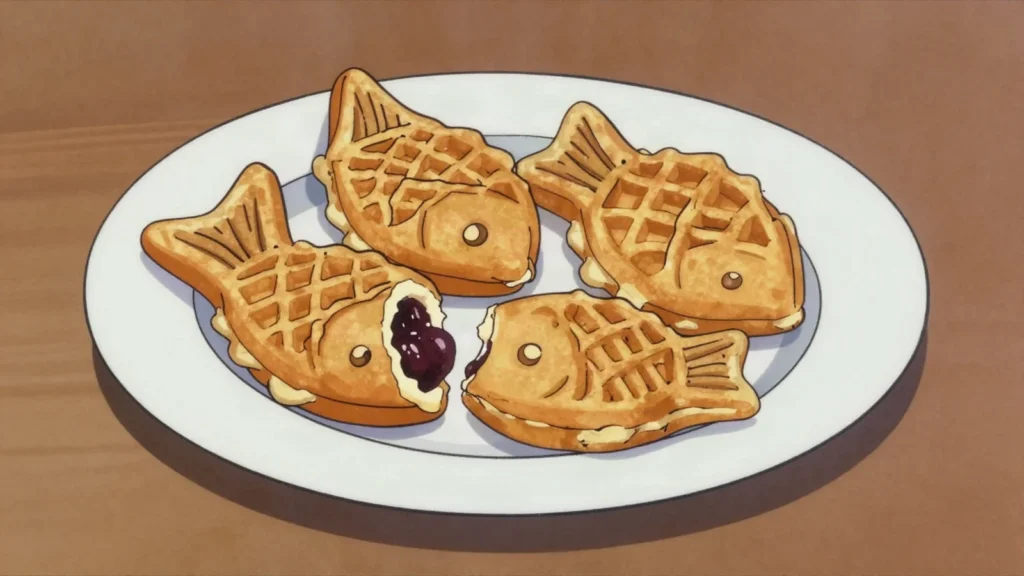
Bungeoppang is a street food from South Korea: fish-shaped waffle filled with sweet red-bean paste. Adapted from Japanese taiyaki during the colonial period and reshaped as the crucian carp, a fish familiar in Korean rivers.
How long does Bungeoppang take to make?
Bungeoppang takes 20 min plus 30 min resting of preparation and 25 min of cooking. The recipe makes 10 pieces. It is rated easy to make.
What can I substitute in Bungeoppang?
Yes, within limits. A taiyaki pan, which is the same tool with a sea bream on it instead of a carp. Shop-bought danpat, thickened in a pan if it is too wet.
What is the most important thing to get right in Bungeoppang?
Beat the egg with the milk and melted butter, whisk it into the dry ingredients until completely smooth, then rest the batter for 30 minutes. Resting relaxes the gluten so the batter runs right out into the tail and the fins instead of stopping short of them.