
Ingredients
How it is made (a winery process, not a home one)
- ripe Shiraz grapes from warm Australian regions such as the Barossa, Grampians and McLaren Vale
- cultured wine yeast for the primary ferment
- liqueur de tirage: a measured dose of sugar and yeast for the second ferment in bottle
- liqueur d’expedition: the dosage, usually 30 to 60 g/l of sugar in older base wine, added at disgorgement
- heavy sparkling wine bottles, crown seals and cork with a wire cage
To serve
- 1 bottlechilled to 12 to 14°C (55°F), cooler than a still red but warmer than a white sparkling
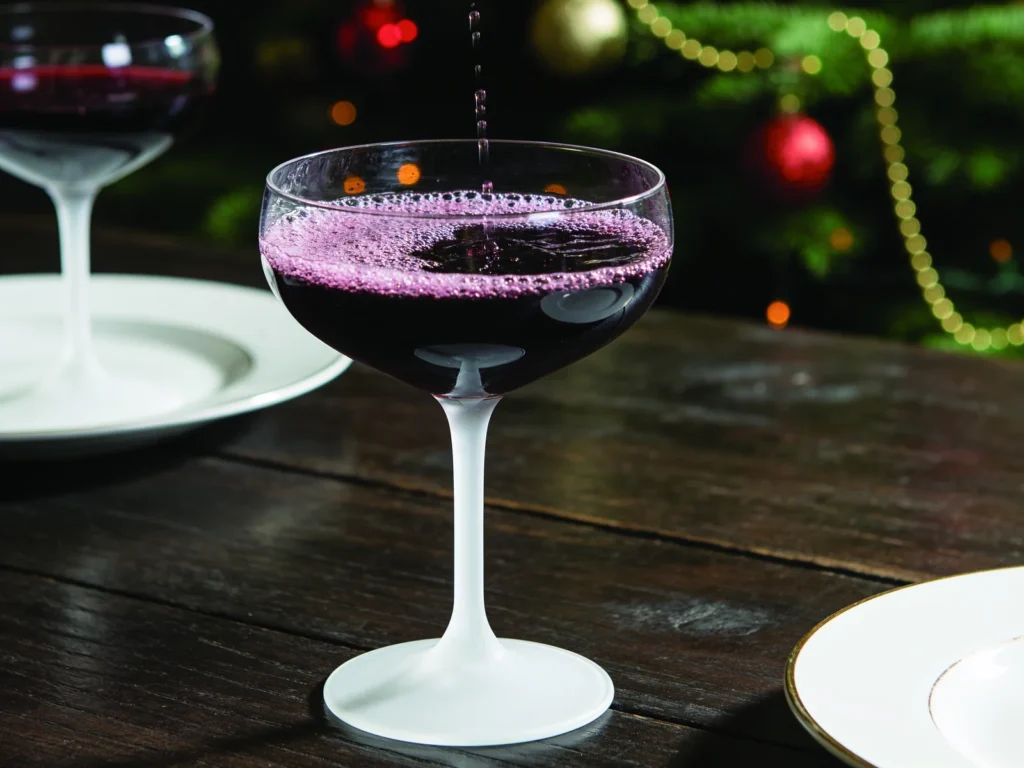
- large white wine glasses or small tulips rather than flutes
- no ice
Classic Australian pairings
- Christmas pudding and fruit mince pies
- a wedge of aged cheddar and quince paste
- grilled field mushrooms and roasted root vegetables
Directions
- Understand the base: unlike Champagne, this starts as a properly ripe, full-bodied red wine, fermented on skins for colour and tannin, then usually oak-matured for a year or more.
- The winemaker blends across vintages and parcels to build a base with soft tannins, since hard tannin and carbon dioxide together taste aggressively bitter, which is why cheap sparkling reds can be so unpleasant.
- The base wine is bottled with the liqueur de tirage and sealed under crown cap, and a second fermentation runs in that bottle over several weeks at around 12°C (55°F), generating roughly six atmospheres of pressure.
- The bottles rest horizontally on their lees for anything from nine months to several years; this ageing is what gives the best examples their bready, savoury complexity underneath the blackberry fruit.
- The bottles are riddled, by hand on pupitres or in a mechanical gyropalette, to work the sediment into the neck over a few weeks.
- The neck is frozen, the crown cap released and the ice plug of sediment fired out by the internal pressure, then the bottle is topped up with the dosage, which is deliberately generous here: sparkling Shiraz is made off-dry, because sugar softens the tannin.
- Finally it is corked, caged, and often given further bottle age before release; many Australian producers hold theirs for years and some release museum bottlings at fifteen or twenty years.
- To serve, chill to 12 to 14°C (55°F), open carefully with the bottle at an angle and a hand on the cork, and pour into a white wine glass so the wine can breathe. Too cold and the fruit shuts down; a flute traps the aroma.
Technique
- This is a winery process. There is no honest home version, and attempting a second bottle ferment in ordinary bottles is dangerous, since six atmospheres of pressure will burst standard glass.
- Australia effectively owns this style. It began at Great Western in Victoria in the 1880s, where Seppelt made sparkling Burgundy, and it is now the country’s signature Christmas wine, drunk cool with a hot-weather lunch.
- The dosage is not a flaw. Off-dry is correct here, because the residual sugar balances the tannin and the acidity, and a bone-dry sparkling Shiraz tastes hard and drying.
- Some producers use the transfer method or tank method rather than a full traditional-method bottle ferment; both are legitimate and the label will often say which.
Substitutions
- If you cannot find Australian sparkling Shiraz, an Italian Lambrusco Grasparossa is the nearest widely available equivalent, lighter in body and usually less sweet.
- A sparkling red made from Durif, Grenache or Cabernet is produced by several Australian wineries and drinks in the same way.
- For a non-alcoholic pairing at the same table, a chilled dark grape and pomegranate juice with soda gets close to the flavour.
Variations
- Seppelt Show Sparkling Shiraz from Great Western is the historic benchmark and is released with extended bottle age.
- Barossa producers make richer, riper, more chocolatey examples than the cooler Grampians style.
- A Christmas tradition in some households is to serve it alongside pudding, where the dosage carries the sweetness.
History
Developed by Australian winemakers from the 1880s after French attempts at sparkling burgundy, and now a national Christmas tradition.
Frequently asked questions
What is Sparkling Shiraz?
Sparkling Shiraz is a wine & spirit from Australia: fizzy dark red wine, berry-rich and off-dry; drunk at Christmas lunch. Developed by Australian winemakers from the 1880s after French attempts at sparkling burgundy, and now a national Christmas tradition.
How long does Sparkling Shiraz take to make?
Sparkling Shiraz takes 5 min to serve of preparation and 9 months to several years on lees of cooking. The recipe makes 1 bottle, 750 ml, serving 6 glasses (production notes describe the winery process). It is rated hard to make.
What can I substitute in Sparkling Shiraz?
Yes, within limits. If you cannot find Australian sparkling Shiraz, an Italian Lambrusco Grasparossa is the nearest widely available equivalent, lighter in body and usually less sweet. A sparkling red made from Durif, Grenache or Cabernet is produced by several Australian wineries and drinks in the same way. For a non-alcoholic pairing at the same table, a chilled dark grape and pomegranate juice with soda gets close to the flavour.
What is the most important thing to get right in Sparkling Shiraz?
The winemaker blends across vintages and parcels to build a base with soft tannins, since hard tannin and carbon dioxide together taste aggressively bitter, which is why cheap sparkling reds can be so unpleasant.