
Ingredients
- 4 slicesgood white sandwich bread, or a soft wholemeal loaf, cut about 1.5 cm thick
- 40 gsalted butter, at room temperature and genuinely soft
- 1to 2 tsp Vegemite, total, for all four slices
Directions
- Take the butter out of the fridge at least 30 minutes ahead. Cold butter tears hot toast and will not spread into an even layer, which is the whole foundation of the dish.
- Toast the bread to a medium gold, firm enough to hold the butter without going limp but not so dark that the crumb dries out. A pop-up toaster on a middle setting is standard.
- Butter it immediately, while the toast is hot enough that the butter melts into the surface. Be generous: this should be a thick layer, and the butter is what carries and tempers the Vegemite.
- Take the smallest quantity of Vegemite you think could possibly be enough, then halve it. Roughly a quarter to a half teaspoon per slice is right.
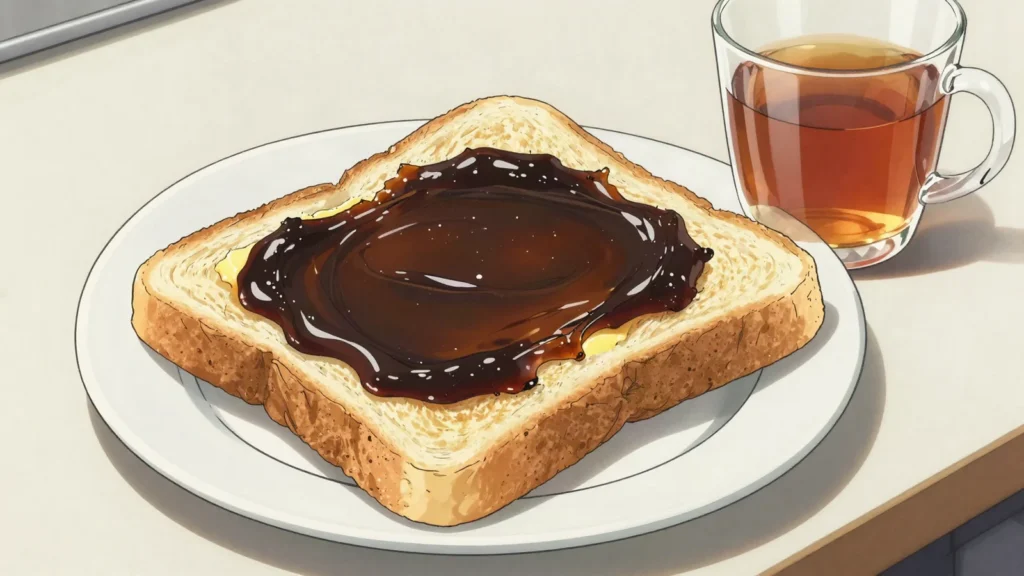
- Scrape it across the buttered toast with the flat of a knife, spreading it as thinly and evenly as you can. The correct look is a translucent brown film through which you can still see the toast, not an opaque black layer.
- Work quickly while the butter is still soft. Vegemite is stiff and will drag and tear cold toast into holes.
- Cut into triangles or fingers, which children call soldiers, and eat immediately, while the butter is molten and the toast still has crunch at the edges.
- Serve with tea or coffee. If you are new to it, start with the barest scraping and increase over several days; the salt hit is intense on first acquaintance.
Technique
- Vegemite is a concentrated brewers’ yeast extract with added salt, malt extract, B vitamins and vegetable flavours, developed in Melbourne in 1922 by the food chemist Cyril Callister after the First World War disrupted supplies of British Marmite. It is vegetarian and contains no meat products.
- Spreading it thickly is the classic mistake made by visitors and is why so many of them dislike it. Australians use it as a savoury seasoning, not as a jam.
- It is very salty, around 3.4 grams of sodium per 100 grams as eaten, which is another reason the layer is thin.
- Vegemite is not the same as Marmite. It is darker, saltier, less sweet and thicker, and the British and New Zealand Marmites are both distinct products; Australians can tell instantly.
Substitutions
- No Vegemite? Marmite works but is sweeter and runnier, so use even less; promite and other yeast spreads sit somewhere between.
- Margarine or a dairy-free spread can replace butter, though the flavour is noticeably thinner.
Variations
- Cheesymite, Vegemite spread under grated tasty cheese and grilled until bubbling, the classic scroll and toastie filling.
- Vegemite and avocado on toast, the modern Melbourne café version.
- Vegemite soldiers with a soft-boiled egg, a standard Australian childhood breakfast.
History
Vegemite, a thick, dark, intensely salty spread made from leftover brewer’s yeast extract, was developed in Melbourne in 1922 by food technologist Cyril Callister, commissioned by the Fred Walker Company specifically to compete with Marmite, a similar British yeast-extract spread that had previously dominated the Australian market and became harder to import during and after the First World War. Spread thinly on buttered toast, a much smaller quantity than casual observers unfamiliar with the product typically expect, given its very concentrated, intense flavour, Vegemite on toast became an enduring staple of Australian breakfast and school lunch culture through the 1900s. Its distinctive, polarizing taste has made it, similarly to Nordic salmiakki, something of a cultural marker strongly associated with Australian national identity specifically, often surprising to first-time tasters from outside the country.
Frequently asked questions
What is Vegemite on Toast?
Vegemite on Toast is a breakfast from Australia: buttered toast scraped with salty yeast-extract spread, childhood breakfast icon. Vegemite, a thick, dark, intensely salty spread made from leftover brewer’s yeast extract, was developed in Melbourne in 1922 by food technologist Cyril Callister, commissioned by the Fred Walker Company specifically to compete with Marmite, a similar British yeast-extract spread that had previously dominated the Australian market and became harder to import during and after the First World War. Spread thinly on buttered toast, a much smaller quantity than casual observers unfamiliar with the product typically expect, given its very concentrated, intense flavour, Vegemite on toast became an enduring staple of Australian breakfast and school lunch culture through the 1900s. Its distinctive, polarizing taste has made it, similarly to Nordic salmiakki, something of a cultural marker strongly associated with Australian national identity specifically, often surprising to first-time tasters from outside the country.
How long does Vegemite on Toast take to make?
Vegemite on Toast takes 3 min of preparation and 3 min of cooking. The recipe makes 2 servings. It is rated easy to make.
What can I substitute in Vegemite on Toast?
Yes, within limits. No Vegemite? Marmite works but is sweeter and runnier, so use even less; promite and other yeast spreads sit somewhere between. Margarine or a dairy-free spread can replace butter, though the flavour is noticeably thinner.
What is the most important thing to get right in Vegemite on Toast?
Take the butter out of the fridge at least 30 minutes ahead. Cold butter tears hot toast and will not spread into an even layer, which is the whole foundation of the dish.