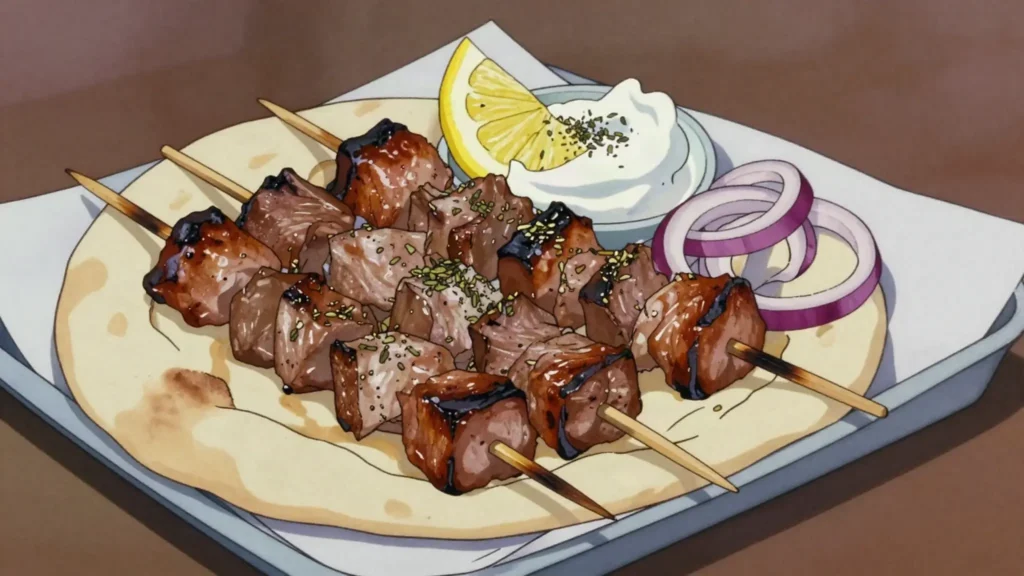

Ingredients
Meat and marinade
- 800 gpork neck, in 3 cm cubes with the fat left on
- 80 mlGreek extra virgin olive oil
- Juice of 1 lemon
- 2 tspdried oregano, crumbled
- 3garlic cloves, crushed
- 1 tspcoarsely ground black pepper
- 1 tspfine salt, added only at the grill
- 8wooden skewers, soaked 30 minutes
Ladolemono
- 60 mlolive oil
- Juice of 1 lemon
- 1 tspdried oregano
- A pinch of salt
To serve
- 4thick Greek pitas, brushed with olive oil
- 300 gtzatziki
- 2tomatoes, sliced
- 1red onion, thinly sliced
- Sweet paprika and chopped parsley
- Lemon wedges
Directions
- Cut the pork neck into even 3 cm cubes, keeping every seam of fat. Lean loin makes a dry souvlaki; the fat is what bastes it.
- Toss the cubes with the oil, lemon juice, oregano, garlic and pepper, but no salt. Cover and refrigerate 4–12 hours.
- Light a charcoal fire and let it burn down to grey-white embers, hot enough that you can hold a hand 10 cm above the grill for only 3–4 seconds.
- Thread 5 or 6 cubes onto each skewer, pressed close but not crushed, leaving a small gap between pieces so the heat reaches all sides. Salt them now.
- Grill 10–12 minutes, turning every 2–3 minutes, so each face caramelises. Move the skewers away from any flare-up rather than letting the fat flame.
- Whisk the ladolemono until it thickens slightly, and brush the skewers with it in the last 2 minutes on the fire.
- The souvlaki is done when the outside is charred at the corners and the centre reads 68–70°C (155–160°F), still faintly pink and juicy. Rest 3 minutes off the heat.
- Warm the oiled pitas directly over the dying coals for 20–30 seconds a side until they puff and take a few dark spots.
- Serve either as bare skewers with lemon wedges and bread, or slide the meat off into a pita with tzatziki, tomato, onion, paprika and parsley, then roll tightly in paper.
Technique
- Salting hours ahead draws out moisture and firms the surface; salt at the grill instead, so the meat stays juicy and takes colour faster.
- Charcoal is not a preference, it is the flavour. Gas gives you grilled pork; embers give you souvlaki.
- In Athens a small skewer is called a kalamaki, and souvlaki can mean the whole wrapped sandwich; in Thessaloniki and much of the north souvlaki is the skewer itself. Both usages are correct locally.
- Do not pack the cubes tight together or they steam where they touch and never brown.
Substitutions
- No pork neck: use chicken thigh, boned and cubed, marinated the same way; breast dries out.
- No charcoal grill: sear on a ridged cast-iron pan over high heat, in batches, so the pan never cools and the meat never stews.
Variations
- Kalamaki, the small Athenian pork skewer eaten straight from the stick.
- Souvlaki merida, a plate of several skewers with pita, chips and salad.
- Souvla, the Cypriot cousin: much larger chunks turned slowly on a long spit over embers.
History
Small pieces of meat grilled on a skewer, a cooking method with roots stretching back to ancient Greece, where archaeological evidence, including skewer-holding stone supports found on the island of Santorini, suggests grilled meat on a stick was already established well over three thousand years ago, making souvlaki’s underlying technique considerably older than most dishes still eaten in roughly the same form today. Its modern name derives from souvla, the Greek word for a skewer or spit itself. Souvlaki is commonly confused outside Greece with gyro, sliced meat carved from a large rotating vertical spit and wrapped in pita, which is a related but technically distinct dish, since traditional souvlaki refers specifically to individually skewered and grilled pieces of meat rather than meat sliced from a large standing spit.
Frequently asked questions
What is Souvlaki?
Souvlaki is a street food from Greece: charcoal pork skewers with pita and tzatziki. Small pieces of meat grilled on a skewer, a cooking method with roots stretching back to ancient Greece, where archaeological evidence, including skewer-holding stone supports found on the island of Santorini, suggests grilled meat on a stick was already established well over three thousand years ago, making souvlaki’s underlying technique considerably older than most dishes still eaten in roughly the same form today. Its modern name derives from souvla, the Greek word for a skewer or spit itself. Souvlaki is commonly confused outside Greece with gyro, sliced meat carved from a large rotating vertical spit and wrapped in pita, which is a related but technically distinct dish, since traditional souvlaki refers specifically to individually skewered and grilled pieces of meat rather than meat sliced from a large standing spit.
How long does Souvlaki take to make?
Souvlaki takes 25 min of preparation and 15 min, plus 4 hr marinating of cooking. The recipe makes 4 servings (8 skewers). It is rated easy to make.
What can I substitute in Souvlaki?
Yes, within limits. No pork neck: use chicken thigh, boned and cubed, marinated the same way; breast dries out. No charcoal grill: sear on a ridged cast-iron pan over high heat, in batches, so the pan never cools and the meat never stews.
What is the most important thing to get right in Souvlaki?
Grill 10–12 minutes, turning every 2–3 minutes, so each face caramelises. Move the skewers away from any flare-up rather than letting the fat flame.