
Ingredients
Coffee
- 60 gwhole-bean washed Rwandan arabica, Red Bourbon from Huye, Nyamasheke or the Lake Kivu hills, roasted light to medium and rested 7–14 days after roast
- 1 litrefiltered water at 94°C (200°F)
- 1paper filter, rinsed
To serve
- Nothing, or 1 tsp sugar per cup
- Optional 30 ml hot milk, the way it is drunk in Kigali cafes
Directions
- Boil the water and let it stand 30 seconds off the boil to reach about 94°C (200°F).
- Rinse the paper filter with hot water to remove paper taste and warm the vessel, then discard that water.
- Add the grounds, level the bed, and pour 60 ml of water in a slow spiral.
- Wait 30–45 seconds while the bed swells and domes: this bloom means the coffee is fresh.
- Pour the remaining water in three even additions, keeping the slurry level near the top of the bed. Total contact time should be 3 to 3 min 30 sec.
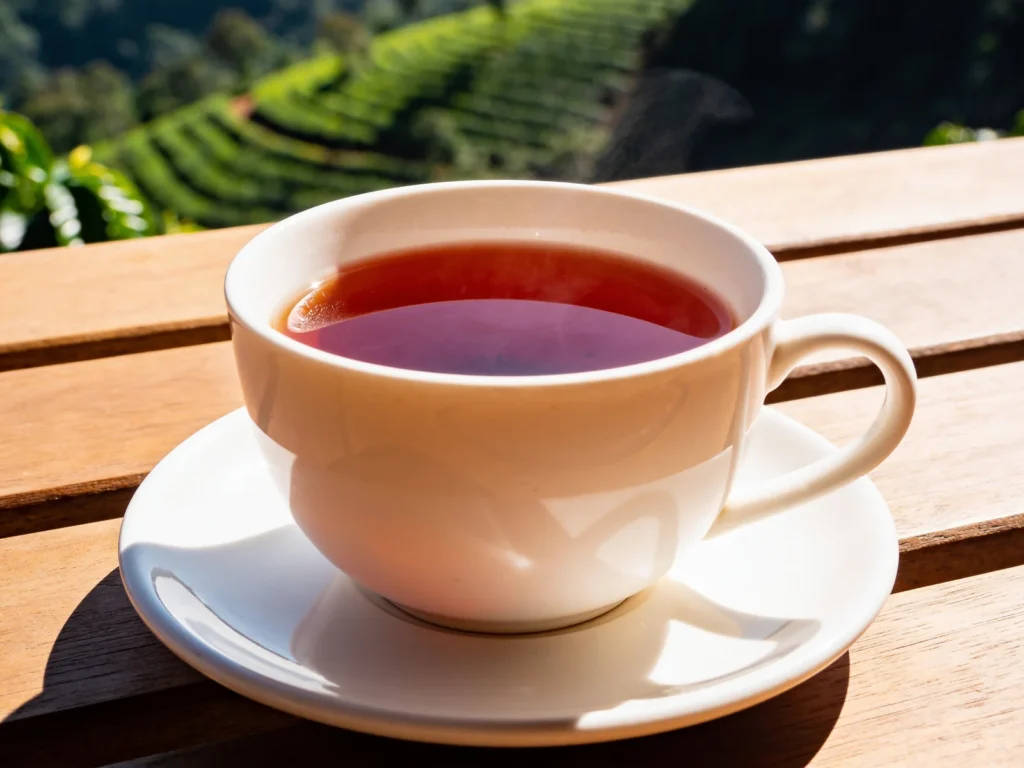
- Swirl the brewed coffee, let it cool 1 minute, and drink from a warmed cup: expect orange blossom, red apple, lemongrass and a clean tea-like finish. For the roadside style, serve very hot in a glass with a spoon of sugar; Rwandans rarely mask a good Bourbon lot with milk.
Technique
- Rwanda is almost entirely Red Bourbon arabica grown at 1,500–2,200 m; the altitude and slow cherry maturation are why the acidity is bright rather than sour.
- The defect to know about is the potato taste defect, a raw-potato note caused by antestia bug damage. It hits single cups at random and is not a brewing fault; a good exporter sorts hard against it.
- Do not brew light-roast Rwandan coffee at a rolling boil. Above 96°C (205°F) the delicate floral esters are stripped and only the bitterness is left.
Substitutions
- No pour-over cone? Use a French press: 60 g coarse grind, 1 litre of 94°C (200°F) water, stir the crust at 4 minutes, skim, plunge at 8 minutes.
- If you can only find dark roast, drop the dose to 55 g and the water to 90°C (195°F) to avoid ashiness.
Variations
- Kivu lots skew red-fruited and syrupy; Huye Mountain and Nyamagabe lots skew floral and citric.
- A small but growing volume of natural and honey-processed Rwandan micro-lots gives strawberry and rum-soaked fruit instead of the classic clean cup.
History
German missionaries planted coffee around 1904; after 2000 a shift to washing stations and Red Bourbon turned Rwanda into a specialty origin.
Frequently asked questions
What is Rwandan coffee?
Rwandan coffee is a drink from Rwanda: bright, floral washed arabica from the hills around Lake Kivu and Huye. German missionaries planted coffee around 1904; after 2000 a shift to washing stations and Red Bourbon turned Rwanda into a specialty origin.
How long does Rwandan coffee take to make?
Rwandan coffee takes 5 min of preparation and 5 min of cooking. The recipe makes 4 cups (each 250 ml). It is rated easy to make.
What can I substitute in Rwandan coffee?
Yes, within limits. No pour-over cone? Use a French press: 60 g coarse grind, 1 litre of 94°C (200°F) water, stir the crust at 4 minutes, skim, plunge at 8 minutes. If you can only find dark roast, drop the dose to 55 g and the water to 90°C (195°F) to avoid ashiness.
What is the most important thing to get right in Rwandan coffee?
Rwanda is almost entirely Red Bourbon arabica grown at 1,500–2,200 m; the altitude and slow cherry maturation are why the acidity is bright rather than sour.