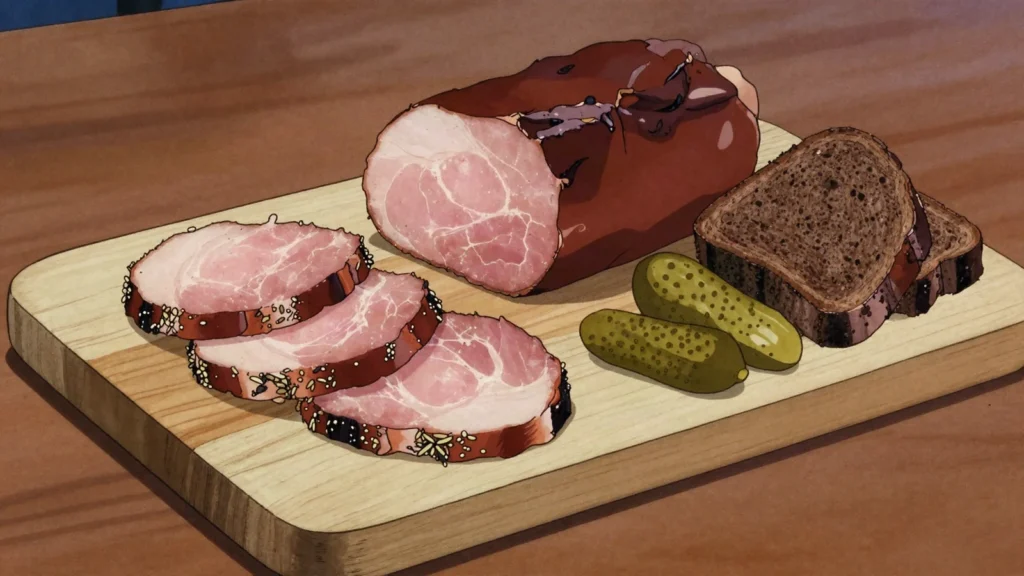

Ingredients
What to buy
- palendvitsa, ready cured
- also sold as polędwica
- whole or sliced
- from a Belarusian, Polish or Eastern European shop
- see the note on why no method is given
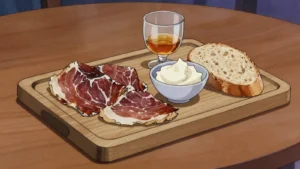
To serve on a board
- black rye bread
- butter
- gherkins
- pickled mushrooms
- horseradish
- mustard
- sliced onion
To drink
- krambambula
- or kvass
- or beer
Directions
- Slice it as thin as you can. Thick slices are chewy and tough.
- Use a very sharp knife.
- Chill the piece first for half an hour.
- Slice across the grain. Cold firm meat slices thinner than soft meat.
- Take it out of the refrigerator twenty minutes before serving. Cold cured meat tastes of very little.
- Heat dries it further and toughens it. It makes no recommendation about anyone’s diet.
Technique
- The atlas gives no curing method, deliberately. Dry-curing whole muscle uses nitrite salts measured in small precise quantities to prevent botulism; it needs controlled temperature and humidity for weeks; and the meat is never cooked, so everything that makes it safe happens during the cure with no later step to correct a mistake. Buy it cured — it is widely sold and inexpensive. The same position applies to Tiroler Speck and Verhackert.
- Slice it as thin as you can. It is very lean and dense, so thick slices are chewy and tough while paper-thin slices are tender and release their flavour — this makes more difference than anything else. Chill it half an hour first, since cold firm meat slices thinner, or ask the shop to machine-slice it.
- Take it out twenty minutes before serving. Cold cured meat tastes of very little; at room temperature the aromatics come out.
- Judge a piece by colour and firmness: deep red to burgundy, firm and dry, with edges not much darker than the middle. A very dark hard rim around a soft centre is case hardening — the classic failure of a dry cure — and means the drying went wrong.
- A powdery white bloom on a whole dried piece is often deliberate; green, black or fuzzy growth is not. Sliminess or a sour or ammoniac smell means leave it.
- Buy from a proper shop with refrigerated display and labelling. A ready-to-eat product that is never cooked depends entirely on how it was made.
- Caraway is not cumin, though the names are confused in several languages.
- It is not really cooked. Heat dries it further and toughens it — scatter it over eggs or a salad at the end at most.
- Store a whole piece wrapped in paper rather than plastic. Paper lets it breathe where plastic makes it sweat.
- Cured meats contain nitrites and processed meat has documented health associations, with public health bodies advising moderation. The atlas records that as fact and makes no dietary recommendation.
- Advice on ready-to-eat cured meats in pregnancy varies by country, concerning listeria and toxoplasma. The atlas records that the question exists and leaves it to a doctor or midwife.
Substitutions
- Polish polędwica is the same product under its Polish name.
- Italian lonzino or lonza is the closest Western equivalent.
- Spanish lomo embuchado is the paprika-cured version of the same cut.
- Bresaola substitutes, though it is beef rather than pork.
- Kumpiak, the Belarusian ham, serves the same place on a board.
- Any thinly sliced dry-cured meat works for the board.
Variations
- Kumpiak is the whole smoked and dried Belarusian ham.
- Polędwica sopocka in Poland is smoked as well as cured.
- Salo is the cured pork fat served on the same board.
- Kryvianka is the blood sausage from the same winter slaughter.
- Lomo embuchado adds paprika to the same cut.
- A garlic-heavy version is made in some households.
History
A Belarusian dry cure: the loin is rubbed with salt and caraway, hung to dry for weeks and then sliced very thin.
Frequently asked questions
What is Palendvitsa?
Palendvitsa is a charcuterie & cured from Belarus: pork tenderloin salted with caraway and coriander, air-dried. A Belarusian dry cure: the loin is rubbed with salt and caraway, hung to dry for weeks and then sliced very thin.
How long does Palendvitsa take to make?
Palendvitsa takes 10 minutes of preparation and none of cooking. The recipe makes buy 60 g per person. It is rated easy to make.
What can I substitute in Palendvitsa?
Yes, within limits. Polish polędwica is the same product under its Polish name. Italian lonzino or lonza is the closest Western equivalent. Spanish lomo embuchado is the paprika-cured version of the same cut. Bresaola substitutes, though it is beef rather than pork. Kumpiak, the Belarusian ham, serves the same place on a board. Any thinly sliced dry-cured meat works for the board.
What is the most important thing to get right in Palendvitsa?
The atlas gives no curing method, deliberately. Dry-curing whole muscle uses nitrite salts measured in small precise quantities to prevent botulism; it needs controlled temperature and humidity for weeks; and the meat is never cooked, so everything that makes it safe happens during the cure with no later step to correct a mistake. Buy it cured — it is widely sold and inexpensive. The same position applies to Tiroler Speck and Verhackert.