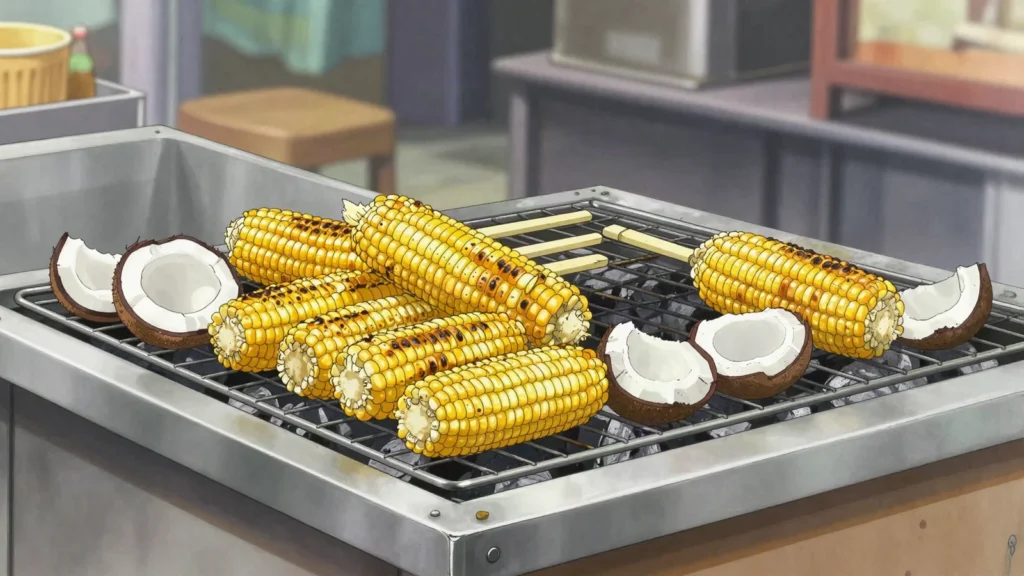

Ingredients
The maize
- 6cobs of field maize
- or 6 cobs of sweetcorn
- husks removed
- see the note on which
Sometimes brushed with
- 2 tablespoonsred palm oil
- or vegetable oil
- or butter
- salt, to sprinkle
- a pinch of chilli powder
For the fire
- charcoal
- or a wood fire
- long tongs
To serve
- fresh coconut
- cut into pieces
- salt
- a hot pepper sauce, optional
- a cold drink
Directions
- Adjust the time accordingly. Strip off the husks and the silk. Pull it all off, since it burns and tastes acrid. Rub the cob with a dry cloth to catch the last of it. Give them thirty minutes.
- Let it burn right down to embers. That takes twenty to thirty minutes. Grill outdoors in open air only. Keep a bucket of water or sand nearby.
- Keep children and animals away from the fire. Do not use petrol or spirit to light or revive it. Use proper firelighters or a chimney starter. Lay them directly on a grill over the embers. Turn them every two or three minutes.
- Keep turning throughout. Field maize takes twenty to twenty-five minutes. Press a kernel with a fingernail or a knife tip. It should be firm but yielding.
- Taste one if you can do so safely. Do not keep roasting hoping it will soften. Drain the water into a glass and drink it. Hold it over a bowl in one hand. Turn it as you tap.
- Keep tapping until it splits. Never hold a coconut in your palm and swing a machete at it. Cut it into pieces of a few centimetres. Leave the brown skin on or peel it off.
- Serve the cobs hot, straight from the coals. Serve the coconut pieces alongside. Put salt on the table. Roast the cobs at two hundred and twenty degrees. Give them twenty-five minutes, turning them. Turn them frequently. It keeps a day refrigerated.
Technique
- This uses field maize, not sweetcorn, and the difference decides the dish. Field maize is starchy, picked mature, firm and chewy, tasting of maize rather than sugar. Sweetcorn roasted over coals is a good thing but not the same thing, and the atlas does not pretend otherwise.
- Field maize stays chewy however long you roast it, and that is correct rather than undercooked. Roasting on hoping it will soften only burns it.
- Let the fire burn right down to grey-ashed embers with no flames. Flames burn the cob to ash and deposit acrid soot; embers give the steady radiant heat you want.
- Turn the cobs every two or three minutes throughout. That is the whole technique — uneven turning gives one burnt side and one raw.
- Blackened patches are wanted, not uniform blackness. That char is where the flavour is, and a pale evenly cooked cob has missed the point; a wholly carbonised one is simply burnt.
- Strip every thread of silk off before roasting. It burns and tastes acrid — rub the cob with a dry cloth to catch the last of it.
- Soaking the cobs in salted water for thirty minutes adds moisture, seasons them and slows the burning. It is optional and it helps.
- Charcoal produces carbon monoxide, which has no colour, smell or taste and kills in enclosed spaces. Grill outdoors only, never in a garage, tent or shed, and never bring a used grill inside. Keep water or sand nearby and never use petrol to light or revive a fire.
- Never hold a coconut in your palm and swing a blade at it — that is how serious hand injuries happen. Tap around its equator with the back of a heavy knife, turning as you go, or wrap it in a cloth and strike it on concrete; fifteen minutes in a hot oven also cracks it.
- Drain the coconut water first by piercing the one soft eye of the three, and drink it.
- Heavily charred food carries some documented concerns about compounds formed at high heat, better studied in meat than in vegetables. The atlas records that the question exists, makes no health claim, and notes that eating blackened patches occasionally is ordinary eating.
- The maize and coconut are sold together because each improves the other — dry, chewy and smoky against wet, sweet and rich. That pairing is specific and genuine.
- A very hot ridged griddle pan is the best indoor method. An oven at 220 degrees finished under a grill works too, at the cost of the smoke, which is a real loss.
Substitutions
- Sweetcorn replaces field maize where it cannot be found, giving a sweeter and juicier cob in less time.
- Frozen cobs replace fresh and go on the coals from frozen with a few extra minutes.
- Red palm oil, butter or vegetable oil can all be brushed on; plain is equally common.
- Salt, chilli powder or a pepper sauce season the finished cob.
- A ridged griddle pan or a hot oven replaces charcoal indoors.
- Roasting the cobs in their husks first steams them for a softer result.
Variations
- Maize roasted in its husk and then charred is softer and less smoky.
- Boiled maize, maïs bouilli, is the other common street preparation.
- Elote in Mexico dresses grilled maize with mayonnaise, cheese, chilli and lime.
- Bhutta in India rubs the grilled cob with lime, salt and chilli.
- Corn chaff in Cameroon uses the same maize stewed with beans and palm oil.
- Grilled plantain is sold from the same stands and eaten the same way.
Frequently asked questions
What is Mais braise?
Mais braise is a street food from Cameroon: charcoal-roasted maize cobs, chewy and smoky, often eaten with fresh coconut.
How long does Mais braise take to make?
Mais braise takes 10 minutes of preparation and 25 minutes of cooking. The recipe makes serves 6. It is rated easy to make.
What can I substitute in Mais braise?
Yes, within limits. Sweetcorn replaces field maize where it cannot be found, giving a sweeter and juicier cob in less time. Frozen cobs replace fresh and go on the coals from frozen with a few extra minutes. Red palm oil, butter or vegetable oil can all be brushed on; plain is equally common. Salt, chilli powder or a pepper sauce season the finished cob. A ridged griddle pan or a hot oven replaces charcoal indoors. Roasting the cobs in their husks first steams them for a softer result.
What is the most important thing to get right in Mais braise?
Keep children and animals away from the fire. Do not use petrol or spirit to light or revive it. Use proper firelighters or a chimney starter. Lay them directly on a grill over the embers. Turn them every two or three minutes.